CDS-Creative Data Solutions, Davis, CA, USA.
West Coast Metabolomics Center, University of California, Davis, CA, USA.
Physiol Rep. 2020 Sep;8(17):e14547. doi: 10.14814/phy2.14547.
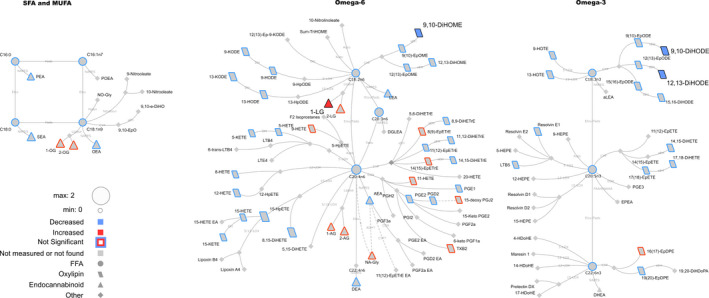
Very little is known about how metabolic health status, insulin resistance or metabolic challenges modulate the endocannabinoid (eCB) or polyunsaturated fatty acid (PUFA)-derived oxylipin (OxL) lipid classes. To address these questions, plasma eCB and OxL concentrations were determined at rest, 10 and 20 min during an acute exercise bout (30 min total, ~45% of preintervention V̇O , ~63 W), and following 20 min recovery in overnight-fasted sedentary, obese, insulin-resistant women under controlled diet conditions. We hypothesized that increased fitness and insulin sensitivity following a ~14-week training and weight loss intervention would lead to significant changes in lipid signatures using an identical acute exercise protocol to preintervention. In the first 10 min of exercise, concentrations of a suite of OxL diols and hydroxyeicosatetraenoic acid (HETE) metabolites dropped significantly. There was no increase in 12,13-DiHOME, previously reported to increase with exercise and proposed to activate muscle fatty acid uptake and tissue metabolism. Following weight loss intervention, exercise-associated reductions were more pronounced for several linoleate and alpha-linolenate metabolites including DiHOMEs, DiHODEs, KODEs, and EpODEs, and fasting concentrations of 9,10-DiHODE, 12,13-DiHODE, and 9,10-DiHOME were reduced. These findings suggest that improved metabolic health modifies soluble epoxide hydrolase, cytochrome P450 epoxygenase (CYP), and lipoxygenase (LOX) systems. Acute exercise led to reductions for most eCB metabolites, with no evidence for concentration increases even at recovery. It is proposed that during submaximal aerobic exercise, nonoxidative fates of long-chain saturated, monounsaturated, and PUFAs are attenuated in tissues that are important contributors to the blood OxL and eCB pools.
人们对代谢健康状况、胰岛素抵抗或代谢挑战如何调节内源性大麻素 (eCB) 或多不饱和脂肪酸 (PUFA)衍生的氧化脂类 (OxL) 脂质类知之甚少。为了解决这些问题,在控制饮食条件下,对空腹久坐、肥胖、胰岛素抵抗的女性进行了一项急性运动试验(共 30 分钟,约为预干预 V̇O 的 45%,约为 63W),在运动后 10 分钟和 20 分钟休息时以及运动后 20 分钟恢复期,测定了血浆 eCB 和 OxL 浓度。我们假设,在经过大约 14 周的训练和减肥干预后,身体适应性和胰岛素敏感性的提高将导致使用与预干预相同的急性运动方案时,脂质特征发生显著变化。在运动的前 10 分钟,一系列 OxL 二醇和羟二十碳四烯酸 (HETE) 代谢物的浓度显著下降。此前报道称,12,13-DiHOME 随着运动而增加,并被提议激活肌肉脂肪酸摄取和组织代谢,但在运动中并没有增加。在减肥干预后,几种亚油酸和α-亚麻酸代谢物(包括 DiHOMEs、DiHODEs、KODEs 和 EpODEs)的运动相关减少更为明显,并且空腹时 9,10-DiHODE、12,13-DiHODE 和 9,10-DiHOME 的浓度降低。这些发现表明,代谢健康的改善会改变可溶性环氧化物水解酶、细胞色素 P450 环氧化物酶 (CYP) 和脂氧合酶 (LOX) 系统。急性运动导致大多数 eCB 代谢物的浓度降低,即使在恢复期也没有证据表明浓度增加。据提议,在亚最大有氧运动期间,长链饱和、单不饱和和多不饱和脂肪酸的非氧化命运在对血液 OxL 和 eCB 池有重要贡献的组织中减弱。