The Mental Health Center, Shantou University Medical College, Shantou, China.
The Center for Injury Prevention Research, Shantou University Medical College, Shantou, China.
J Affect Disord. 2020 Nov 1;276:446-452. doi: 10.1016/j.jad.2020.07.085. Epub 2020 Jul 20.
COVID-19 outbreak happened last December in China and is still continuing. Here, we reported effects of COVID-19 outbreak on the mood of general public and ascertained impacts of psychosocial factors on the plague-related emotional measures.
During Feb. 4-6, 2020, a self-reported questionnaire Beck Anxiety Inventory (BAI) was disseminated to general public via Wechat, along with a sociodemographic information sheet. BAI score and incidences of moderate and severe anxiety in subgroups of respondents were compared. Multiple linear and logistic regressions were done for correlation analysis and to identify factors predictive of anxiety.
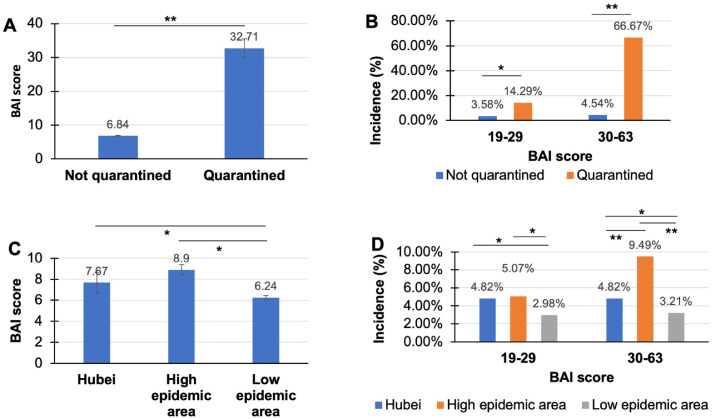
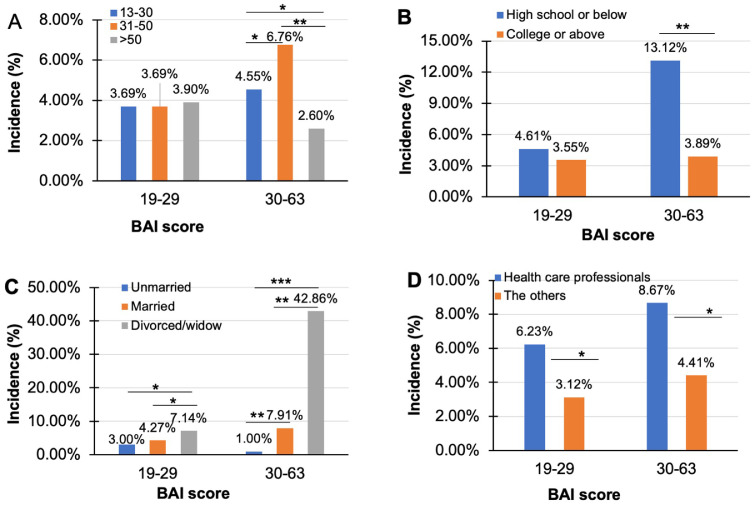
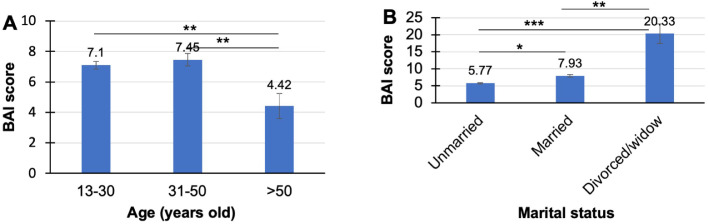
Averaged BAI score of all respondents is higher than those of general public in two previous studies. The people quarantined for probable COVID-19 infection presented higher BAI score and incidences of moderate and severe anxiety relative to non-quarantined respondents. People in high epidemic area showed higher BAI score and incidences of moderate and severe anxiety compared to those in low epidemic area. Significant associations existed between anxiety level of the respondents and each of the investigated factors, except for gender. Quarantine was the predictor with a highest OR, followed by divorced/widow. The other factors showed smaller but significant effects on the anxiety level of respondents.
This cross-sectional study was unable to track the emotional changes in the respondents over time. It had a relatively small sample and involved some of emotional measures only.
These data are of help in planning psychological interventions for the different subpopulations in general public during and after COVID-19 outbreak.
COVID-19 疫情于去年 12 月在中国爆发,目前仍在持续。在此,我们报告了 COVID-19 疫情对公众情绪的影响,并确定了社会心理因素对与瘟疫相关的情绪测量的影响。
2020 年 2 月 4 日至 6 日,通过微信向公众发放了一份自我报告的贝克焦虑量表(BAI)问卷,并附有一份社会人口统计学信息表。比较了受访者亚组的 BAI 评分和中重度焦虑的发生率。进行了多元线性和逻辑回归分析,以进行相关性分析,并确定焦虑的预测因素。
所有受访者的平均 BAI 评分均高于之前两项研究中的一般公众。因疑似 COVID-19 感染而被隔离的人群的 BAI 评分和中重度焦虑的发生率高于未被隔离的人群。高疫情地区的人群的 BAI 评分和中重度焦虑的发生率高于低疫情地区的人群。除性别外,受访者的焦虑水平与所调查的每个因素之间均存在显著关联。隔离是预测焦虑水平的最强因素,其次是离异/丧偶。其他因素对受访者的焦虑水平也有较小但显著的影响。
这项横断面研究无法跟踪受访者随时间的情绪变化。样本量相对较小,且仅涉及部分情绪测量。
这些数据有助于在 COVID-19 疫情期间和之后为公众的不同亚群规划心理干预措施。