Department of Graduate Public Health (College of Veterinary Medicine), Tuskegee University, 1200 W Montgomery Rd, Tuskegee, AL, 36088, USA.
Biology Department (College of Arts and Sciences), Tuskegee University, 1200 W Montgomery Rd, Tuskegee, AL, 36088, USA.
BMC Cancer. 2020 Sep 1;20(1):830. doi: 10.1186/s12885-020-07338-7.
Our objective was to assess racial differences in the 5-year relative survival rates (RSRs) of Cervical Cancer (CerCancer) by stage at diagnosis, between Black and White women, living in Alabama, USA.
Data for 3484 Blacks and 21,059 Whites diagnosed with CerCancer were extracted from the 2004 to 2013 Surveillance, Epidemiology, and End Results (SEER) database. We incorporated age groups, CerCancer stages, county, and year of diagnosis to compare the RSR between Blacks and Whites, using SEER*Stat software.
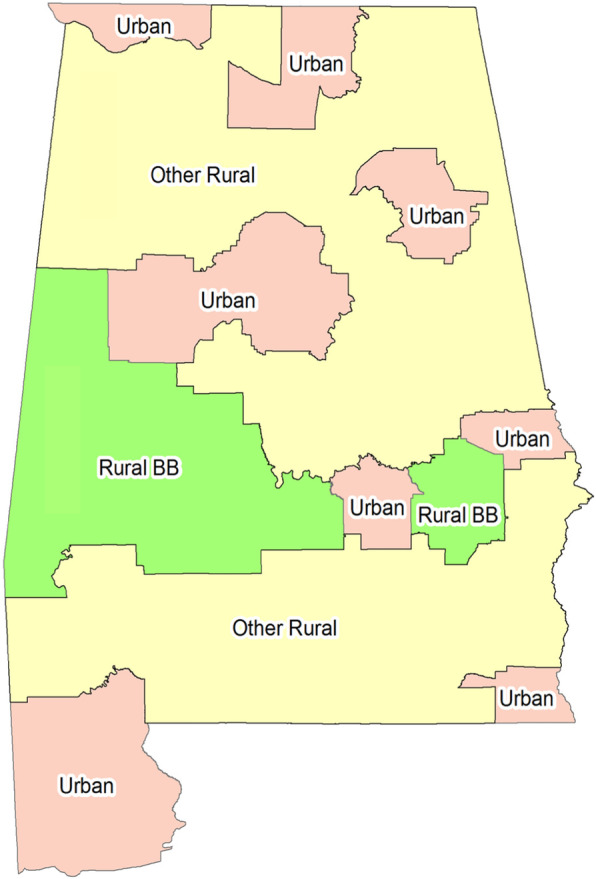
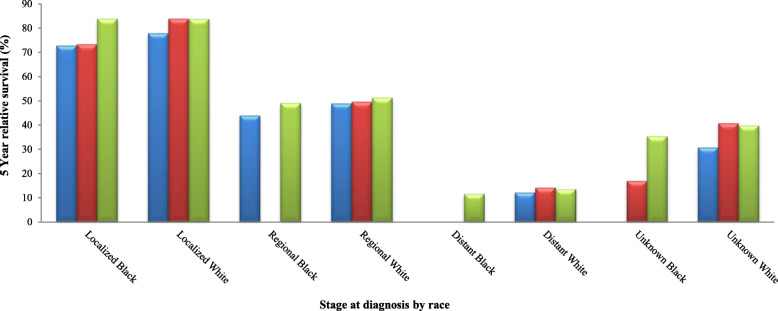
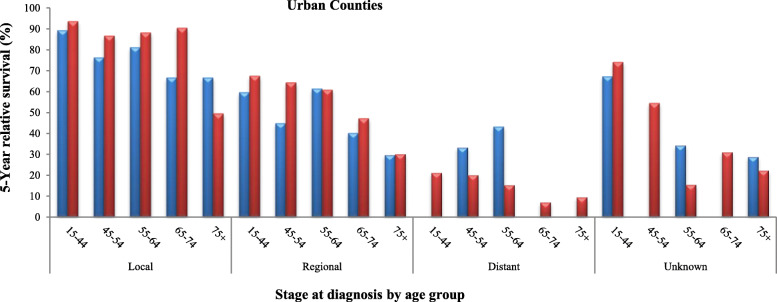
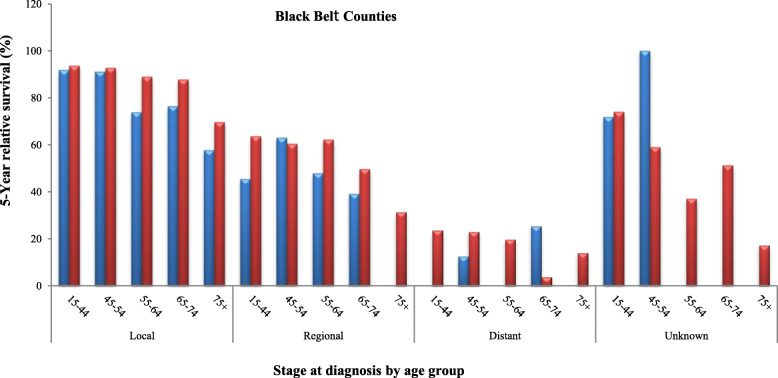
In urban, Black Belt (BB) and other rural counties, Whites diagnosed with localized stage of CerCancer always had better chances of survival because their RSRs were always more than 77%, compared to Blacks. Only exception was in Blacks living in other rural counties, who had a significantly higher RSR of 83.8% (95% Cl, 74.2-90.1). Which was the same as in Whites (83.8% (95% CI 74.5-89.9) living in BBC. Although, in other rural counties, Whites had a slightly lower RSR of 83.7% (95% CI 79.9-86.8%), their RSR was better compared to Blacks and Whites living in BB and other rural counties who had slightly higher RSRs of 83.8%. This was due to statistical precision, which depended on their larger sample size and a lower variability therefore, more reliability resulting in a tighter confidence interval with a smaller margin of error. In all the three county groups, Whites 15-44 years old diagnosed with localized stage of CerCancer had a higher RSR of 93.6% (95% CI 91.4-95.2%) for those living in urban and BB counties, and 94.6% (95% CI 93.6-95.4) for those living in other rural counties. The only exception was in Blacks 65-74 years old living in other rural counties who had the highest RSR of 96.9% (95% Cl, 82.9-99.5). However, Whites were considered to have a better RSR. This was also due to the statistical precision as mentioned above.
There were significant racial differences in the RSRs of CerCancer. Overall, Black women experienced the worst RSRs compared to their White counterparts.
本研究旨在评估美国阿拉巴马州黑人和白人女性宫颈癌(CerCancer)患者诊断时不同分期的 5 年相对生存率(RSR)的种族差异。
从 2004 年至 2013 年的监测、流行病学和最终结果(SEER)数据库中提取了 3484 名黑人患者和 21059 名白人患者的 CerCancer 数据。我们结合年龄组、CerCancer 分期、县和诊断年份,使用 SEER*Stat 软件比较了黑人和白人患者之间的 RSR。
在城市、黑带(BB)和其他农村县,诊断为局限性 CerCancer 的白人患者的生存率总是更高,因为他们的 RSR 始终超过 77%,而黑人患者则低于 77%。唯一的例外是在其他农村县的黑人患者,他们的 RSR 显著更高,为 83.8%(95%Cl,74.2-90.1)。这与生活在黑带(BB)和其他农村县的白人患者的 RSR 相同,这些患者的 RSR 也为 83.8%(95%CI 74.5-89.9)。尽管其他农村县的白人患者的 RSR 略低,为 83.7%(95%CI 79.9-86.8%),但与生活在 BB 和其他农村县的黑人患者相比,他们的 RSR 更好,这些患者的 RSR 略高,为 83.8%。这是由于统计学精度所致,统计学精度取决于较大的样本量和较小的变异性,从而提高了可靠性,导致置信区间更紧,误差幅度更小。在这三个县组中,诊断为局限性 CerCancer 的 15-44 岁白人患者的 RSR 更高,城市和 BB 县的 RSR 为 93.6%(95%CI 91.4-95.2%),其他农村县的 RSR 为 94.6%(95%CI 93.6-95.4%)。唯一的例外是 65-74 岁的黑人患者,他们的 RSR 最高,为 96.9%(95%Cl,82.9-99.5%)。然而,白人患者被认为具有更好的 RSR。这也是由于上述统计学精度所致。
宫颈癌患者的 RSR 存在显著的种族差异。总体而言,与白人患者相比,黑人女性的 RSR 最差。