Department of Radiology and Nuclear Medicine, Amsterdam UMC, Vrije Universiteit Amsterdam, De Boelelaan, 1117 1081, HV, Amsterdam, The Netherlands.
Alzheimer Center and department of Neurology, Amsterdam UMC, Vrije Universiteit Amsterdam, De Boelelaan, 1117 1081, HV, Amsterdam, The Netherlands.
Eur J Nucl Med Mol Imaging. 2021 Mar;48(3):721-728. doi: 10.1007/s00259-020-05006-3. Epub 2020 Sep 2.
Visual reading of F-florbetapir positron emission tomography (PET) scans is used in the diagnostic process of patients with cognitive disorders for assessment of amyloid-ß (Aß) depositions. However, this can be time-consuming, and difficult in case of borderline amyloid pathology. Computer-aided pattern recognition can be helpful in this process but needs to be validated. The aim of this work was to develop, train, validate and test a convolutional neural network (CNN) for discriminating between Aß negative and positive F-florbetapir PET scans in patients with subjective cognitive decline (SCD).
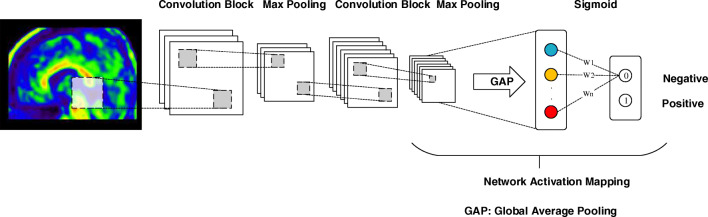
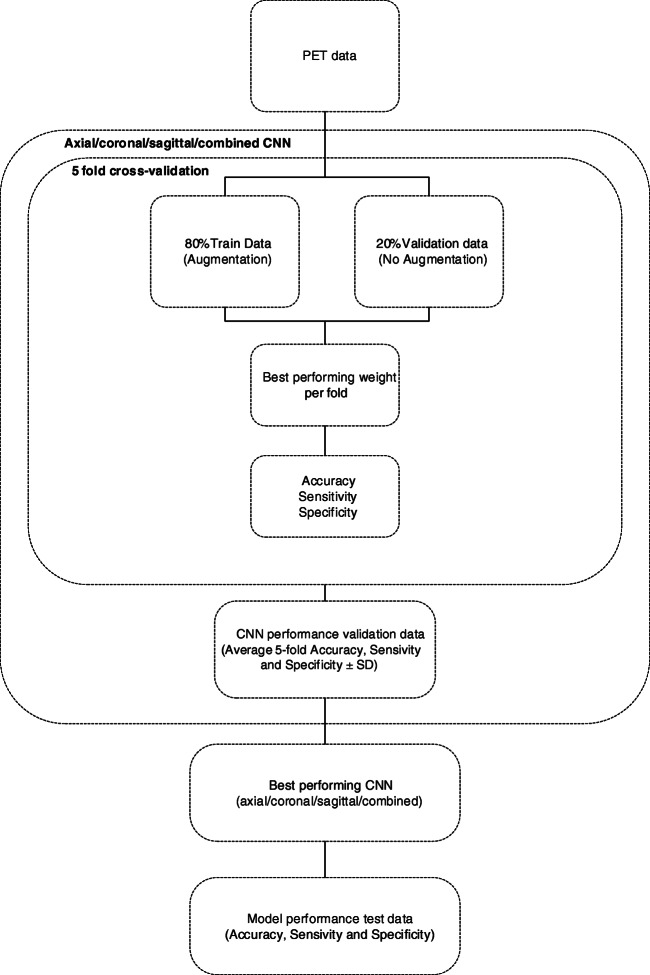
F-florbetapir PET images were acquired and visually assessed. The SCD cohort consisted of 133 patients from the SCIENCe cohort and 22 patients from the ADNI database. From the SCIENCe cohort, standardized uptake value ratio (SUVR) images were computed. From the ADNI database, SUVR images were extracted. 2D CNNs (axial, coronal and sagittal) were built to capture features of the scans. The SCIENCe scans were randomly divided into training and validation set (5-fold cross-validation), and the ADNI scans were used as test set. Performance was evaluated based on average accuracy, sensitivity and specificity from the cross-validation. Next, the best performing CNN was evaluated on the test set.
The sagittal 2D-CNN classified the SCIENCe scans with the highest average accuracy of 99% ± 2 (SD), sensitivity of 97% ± 7 and specificity of 100%. The ADNI scans were classified with a 95% accuracy, 100% sensitivity and 92.3% specificity.
The 2D-CNN algorithm can classify Aß negative and positive F-florbetapir PET scans with high performance in SCD patients.
在认知障碍患者的诊断过程中,视觉阅读 F-氟比他滨正电子发射断层扫描(PET)扫描用于评估淀粉样蛋白-β(Aβ)沉积。然而,这可能很耗时,并且在边缘淀粉样病理学情况下很困难。计算机辅助模式识别在这个过程中可能会有所帮助,但需要验证。这项工作的目的是开发、训练、验证和测试卷积神经网络(CNN),以区分主观认知下降(SCD)患者的 Aβ阴性和阳性 F-氟比他滨 PET 扫描。
采集 F-氟比他滨 PET 图像并进行视觉评估。SCD 队列由 SCIENCe 队列的 133 名患者和 ADNI 数据库的 22 名患者组成。从 SCIENCe 队列中,计算标准化摄取值比(SUVR)图像。从 ADNI 数据库中提取 SUVR 图像。构建 2D CNN(轴位、冠状位和矢状位)以捕获扫描的特征。SCIENCe 扫描随机分为训练集和验证集(5 折交叉验证),ADNI 扫描用作测试集。基于交叉验证的平均准确率、敏感性和特异性评估性能。接下来,在测试集上评估表现最佳的 CNN。
矢状 2D-CNN 对 SCIENCe 扫描的分类具有最高的平均准确率 99%±2(SD)、敏感性 97%±7 和特异性 100%。ADNI 扫描的分类准确率为 95%、敏感性为 100%、特异性为 92.3%。
2D-CNN 算法可以对 SCD 患者的 Aβ阴性和阳性 F-氟比他滨 PET 扫描进行分类,具有较高的性能。