Center for Synaptic Plasticity, School of Physiology, Pharmacology and Neuroscience, University of Bristol, University Walk, Bristol, BS8 1TD, UK.
Department of Bioengineering, Imperial College London, London, UK.
Nat Commun. 2020 Sep 2;11(1):4395. doi: 10.1038/s41467-020-18074-8.
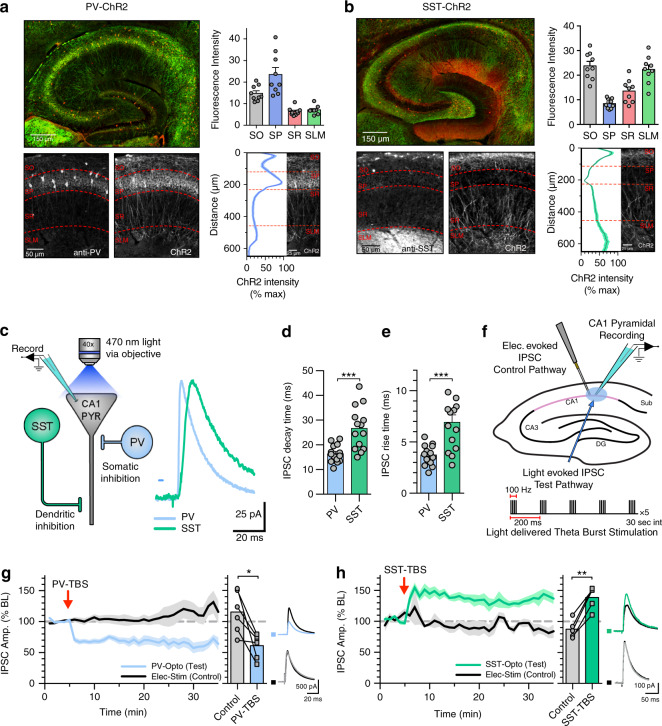
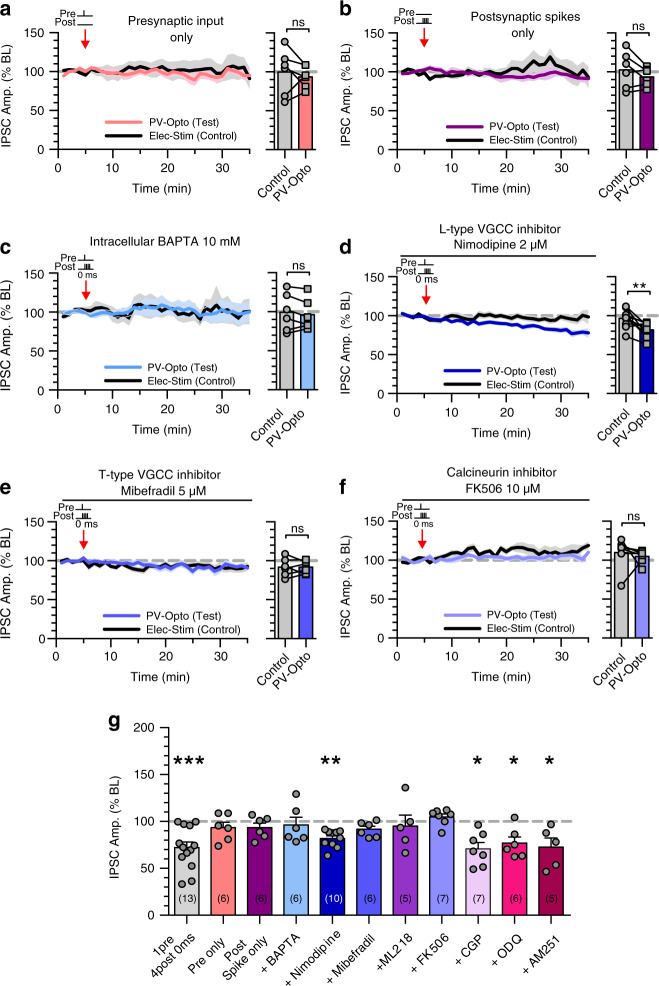
The formation and maintenance of spatial representations within hippocampal cell assemblies is strongly dictated by patterns of inhibition from diverse interneuron populations. Although it is known that inhibitory synaptic strength is malleable, induction of long-term plasticity at distinct inhibitory synapses and its regulation of hippocampal network activity is not well understood. Here, we show that inhibitory synapses from parvalbumin and somatostatin expressing interneurons undergo long-term depression and potentiation respectively (PV-iLTD and SST-iLTP) during physiological activity patterns. Both forms of plasticity rely on T-type calcium channel activation to confer synapse specificity but otherwise employ distinct mechanisms. Since parvalbumin and somatostatin interneurons preferentially target perisomatic and distal dendritic regions respectively of CA1 pyramidal cells, PV-iLTD and SST-iLTP coordinate a reprioritisation of excitatory inputs from entorhinal cortex and CA3. Furthermore, circuit-level modelling reveals that PV-iLTD and SST-iLTP cooperate to stabilise place cells while facilitating representation of multiple unique environments within the hippocampal network.
海马体细胞组合中空间表达的形成和维持受到来自不同中间神经元群体的抑制模式的强烈影响。尽管已知抑制性突触强度具有可塑造性,但在不同的抑制性突触上诱导长时程可塑性及其对海马体网络活动的调节仍未得到很好的理解。在这里,我们表明,在生理活动模式期间,来自表达 Parvalbumin 和 Somatostatin 的中间神经元的抑制性突触分别经历长时程压抑和长时程增强(PV-iLTD 和 SST-iLTP)。这两种形式的可塑性都依赖于 T 型钙通道的激活来赋予突触特异性,但在其他方面采用不同的机制。由于 Parvalbumin 和 Somatostatin 中间神经元优先靶向 CA1 锥体神经元的胞体和远端树突区域,PV-iLTD 和 SST-iLTP 协调从内嗅皮层和 CA3 传入的兴奋性输入的重新优先化。此外,电路级建模揭示了 PV-iLTD 和 SST-iLTP 合作稳定位置细胞,同时促进海马体网络中多个独特环境的表示。