Division of Optometry and Visual Sciences, School of Health Sciences, City, University of London, London, UK.
Division of Optometry and Visual Sciences, School of Health Sciences, City, University of London, London, UK; Department of Ophthalmology, Guy's and St Thomas' NHS Foundation Trust, London, UK.
Am J Ophthalmol. 2021 Mar;223:42-52. doi: 10.1016/j.ajo.2020.08.039. Epub 2020 Sep 1.
To assess accuracy and adherence of visual field (VF) home monitoring in a pilot sample of patients with glaucoma.
Prospective longitudinal feasibility and reliability study.
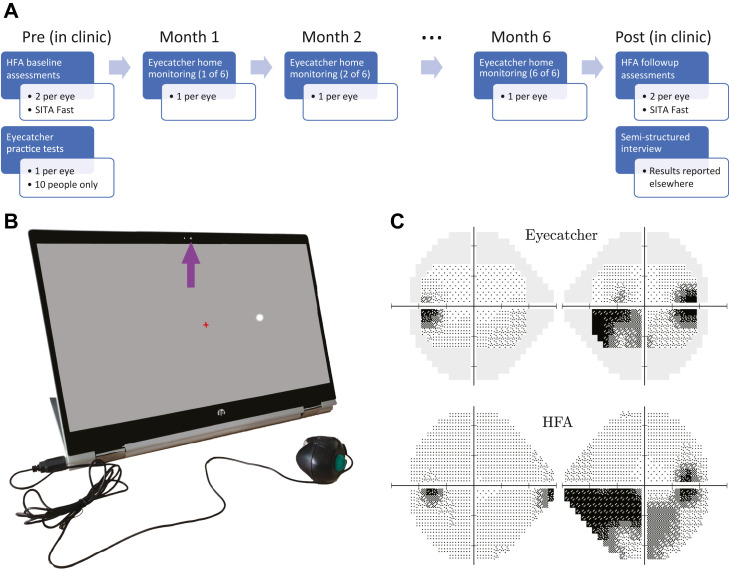
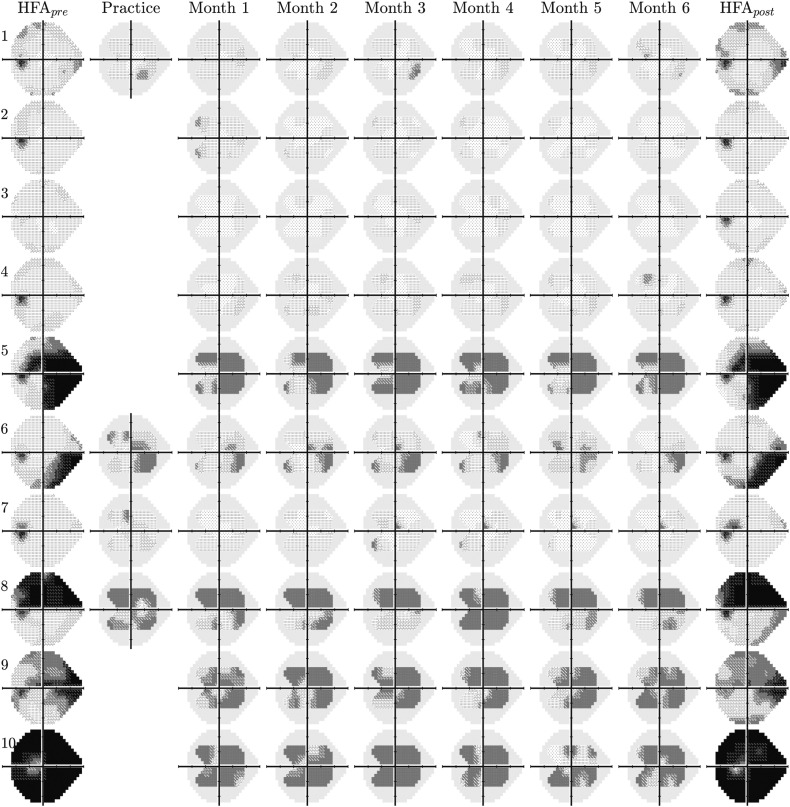
Twenty adults (median 71 years) with an established diagnosis of glaucoma were issued a tablet perimeter (Eyecatcher) and were asked to perform 1 VF home assessment per eye, per month, for 6 months (12 tests total). Before and after home monitoring, 2 VF assessments were performed in clinic using standard automated perimetry (4 tests total, per eye).
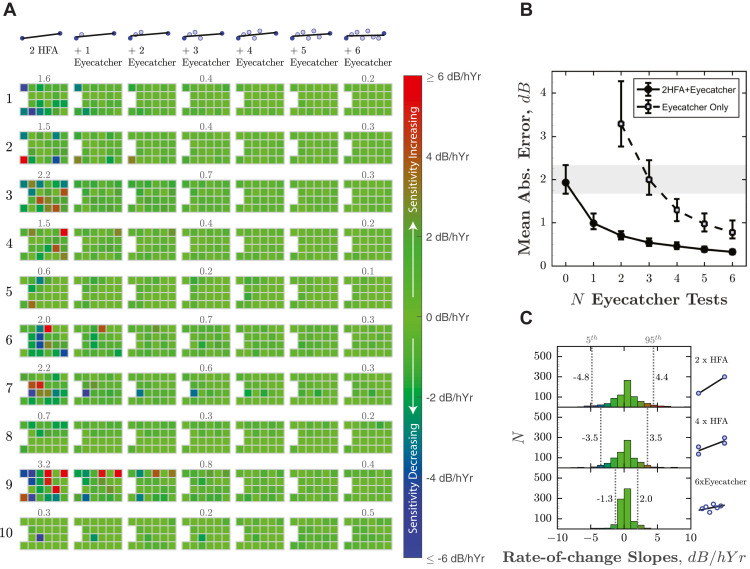
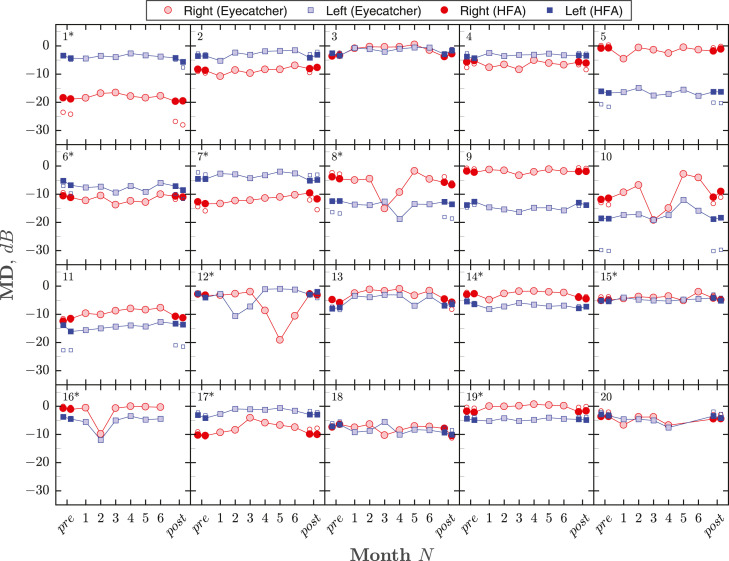
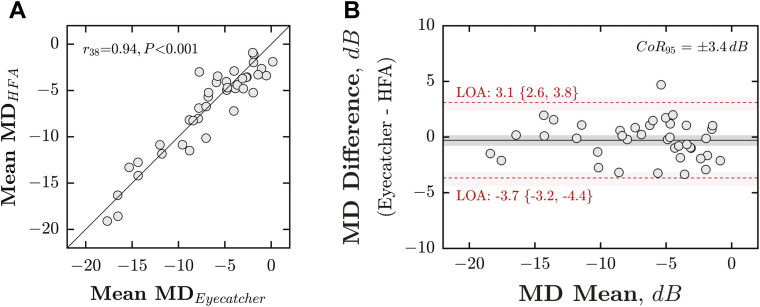
All 20 participants could perform monthly home monitoring, though 1 participant stopped after 4 months (adherence: 98% of tests). There was good concordance between VFs measured at home and in the clinic (r = 0.94, P < .001). In 21 of 236 tests (9%), mean deviation deviated by more than ±3 dB from the median. Many of these anomalous tests could be identified by applying machine learning techniques to recordings from the tablets' front-facing camera (area under the receiver operating characteristic curve = 0.78). Adding home-monitoring data to 2 standard automated perimetry tests made 6 months apart reduced measurement error (between-test measurement variability) in 97% of eyes, with mean absolute error more than halving in 90% of eyes. Median test duration was 4.5 minutes (quartiles: 3.9-5.2 minutes). Substantial variations in ambient illumination had no observable effect on VF measurements (r = 0.07, P = .320).
Home monitoring of VFs is viable for some patients and may provide clinically useful data.
评估青光眼患者的试点样本中视野(VF)家庭监测的准确性和依从性。
前瞻性纵向可行性和可靠性研究。
20 名成年人(中位数 71 岁)被诊断为青光眼,他们被发放了一台平板电脑式视野计(Eyecatcher),并被要求每月对每只眼睛进行 1 次 VF 家庭评估,共进行 6 个月(共 12 次测试)。在家庭监测前后,对每只眼睛在诊所进行了 2 次 VF 评估,使用标准自动视野计(共 4 次测试)。
所有 20 名参与者都能够进行每月的家庭监测,尽管有 1 名参与者在 4 个月后停止(依从率:98%的测试)。家庭测量的 VF 与诊所测量的 VF 之间具有良好的一致性(r=0.94,P<0.001)。在 236 次测试中的 21 次(9%)中,平均偏差偏离中位数超过±3 dB。通过将来自平板电脑前置摄像头的记录应用机器学习技术,可以识别许多异常测试(受试者工作特征曲线下面积=0.78)。将 6 个月内相隔 2 次的标准自动视野计测试与家庭监测数据结合使用,可以减少 97%的眼睛的测量误差(测试间测量变异性),90%的眼睛的平均绝对误差减少了一半以上。中位数测试时间为 4.5 分钟(四分位数:3.9-5.2 分钟)。环境光照的大幅变化对 VF 测量没有明显影响(r=0.07,P=0.320)。
对于某些患者,VF 的家庭监测是可行的,并且可能提供有临床价值的数据。