Department of Pediatrics, The Saban Research Institute, Children's Hospital Los Angeles, University of Southern California , Los Angeles, CA, USA.
Department of Integrative Physiology, University of Colorado Boulder , Boulder, CO, USA.
Gut Microbes. 2020 Nov 9;12(1):1813534. doi: 10.1080/19490976.2020.1813534.
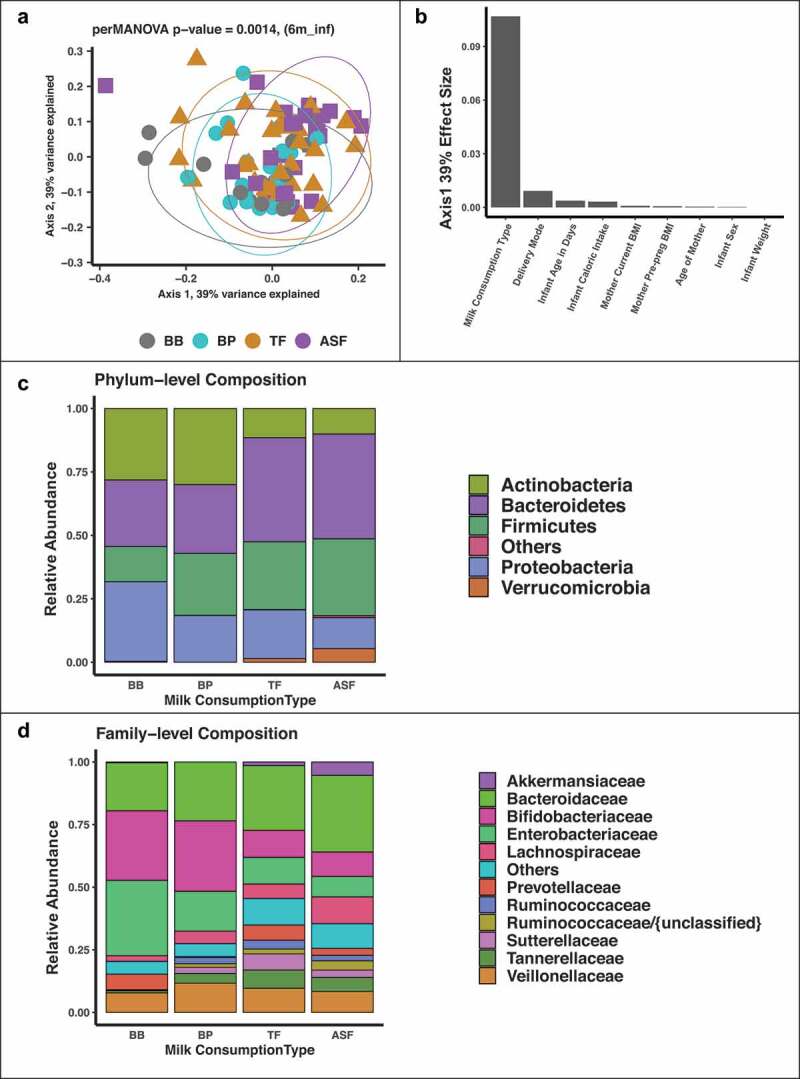
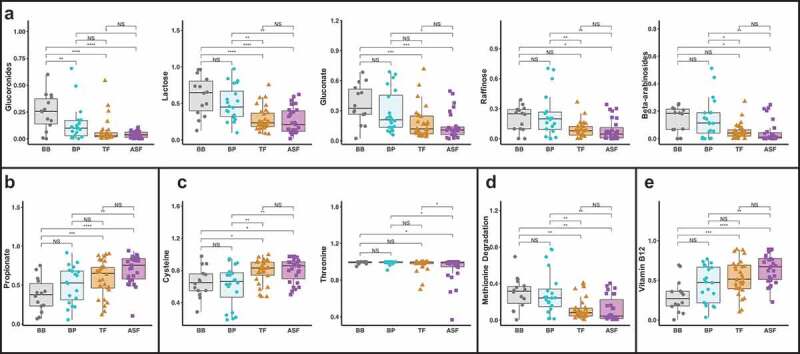
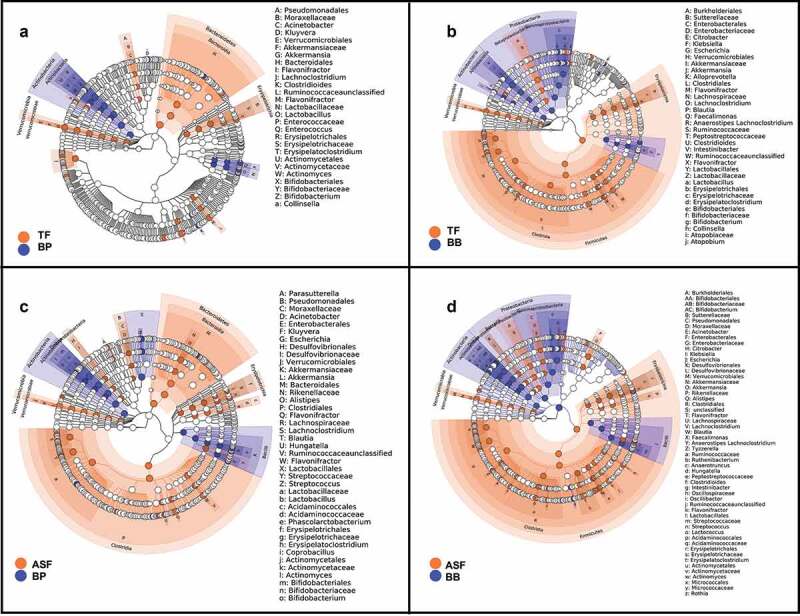
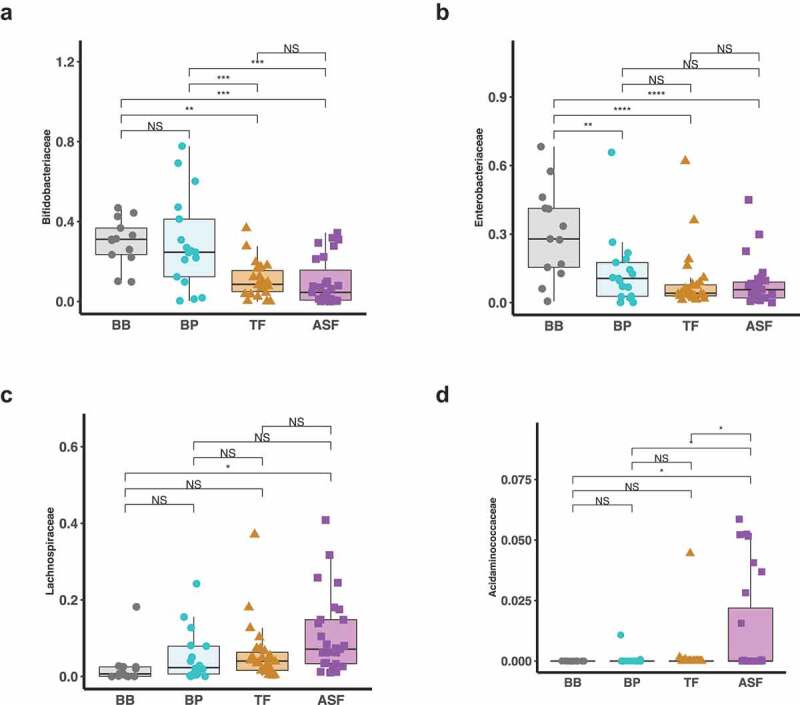
Infant formula feeding, compared with human milk, has been associated with development of a distinct infant gut microbiome, but no previous study has examined effects of formula with added sugars. This work examined differences in gut microbiota among 91 Hispanic infants who consumed human milk [at breast (BB) vs. pumped in bottle (BP)] and 2 kinds of infant formula [(traditional lactose-based (TF) vs. lactose-reduced with added sugar (ASF)]. At 1 and 6 months, infant stool was collected to characterize gut microbiota. At 6 months, mothers completed 24-hour dietary recalls and questionnaires to determine infant consumption of human milk (BB vs. BP) or formula (TF vs. ASF). Linear regression models were used to determine associations of milk consumption type and microbial features at 6 months. Infants in the formula groups exhibited a significantly more 'mature' microbiome than infants in the human milk groups with the most pronounced differences observed between the ASF vs. BB groups. In the ASF group, we observed reduced log-normalized abundance of (TF-BB Mean Difference = -0.71, ASF-BB Mean Difference = -1.10), and increased abundance of (TF-BB Mean Difference = +0.89, ASF-BB Mean Difference = +1.20). We also observed a higher Community Phenotype Index of propionate, most likely produced by , in the ASF group (TF-BB Mean Difference = +0.27, ASF-BB Mean Difference = +0.36). This study provides the first evidence that consumption of infant formula with added sugar may have a stronger association than birth delivery mode, infant caloric intake, and maternal BMI on the infant's microbiome at 6 months of age.
配方奶喂养与母乳相比,与婴儿肠道微生物群的明显发展有关,但以前没有研究过添加糖的配方奶的影响。这项工作研究了 91 名西班牙裔婴儿的肠道微生物群差异,这些婴儿分别饮用母乳(直接哺乳 (BB) 与奶瓶哺乳 (BP))和 2 种婴儿配方奶(传统乳糖基 (TF) 与添加糖的乳糖减少型 (ASF))。在 1 个月和 6 个月时,收集婴儿粪便以描述肠道微生物群。在 6 个月时,母亲完成 24 小时饮食回忆和问卷调查,以确定婴儿母乳(BB 与 BP)或配方奶(TF 与 ASF)的摄入量。线性回归模型用于确定 6 个月时牛奶消耗类型与微生物特征的关联。配方奶组的婴儿表现出明显更“成熟”的微生物群,而母乳喂养组的婴儿则更为明显,ASF 组与 BB 组之间的差异最为明显。在 ASF 组中,我们观察到 (TF-BB 均值差 = -0.71,ASF-BB 均值差 = -1.10)的对数正态化丰度降低,而 (TF-BB 均值差 = +0.89,ASF-BB 均值差 = +1.20)的丰度增加。我们还观察到 ASF 组中丙酸的更高社区表型指数,很可能是由 产生的,(TF-BB 均值差 = +0.27,ASF-BB 均值差 = +0.36)。这项研究首次提供了证据,表明与出生方式、婴儿热量摄入和母亲 BMI 相比,添加糖的婴儿配方奶的消耗与 6 个月大婴儿的微生物群有更强的关联。