Department of Health Sciences, Faculty of Science, Vrije Universiteit Amsterdam, Amsterdam Public Health Research Institute, Amsterdam, The Netherlands.
Department of Public and Occupational Health, Amsterdam UMC, Vrije Universiteit Amsterdam, Amsterdam Public Health Research Institute, Amsterdam, The Netherlands.
BMC Health Serv Res. 2020 Sep 4;20(1):831. doi: 10.1186/s12913-020-05570-2.
Dementia is a progressive disease that decreases quality of life of persons with dementia and is associated with high societal costs. The burden of caring for persons with dementia also decreases the quality of life of family caregivers. The objective of this study was to assess the societal cost-effectiveness of Namaste Care Family program in comparison with usual care in nursing home residents with advanced dementia.
Nursing homes were randomized to either Namaste Care Family program or usual care. Outcome measures of the cluster-randomized trial in 231 residents included Quality of Life in Late-Stage Dementia (QUALID) and the Gain in Alzheimer Care Instrument (GAIN) for family caregivers over 12 months of follow-up. Health states were measured using the EQ-5D-3L questionnaire which were translated into utilities. QALYs were calculated by multiplying the amount of time a participant spent in a specific health state with the utility score associated with that health state. Healthcare utilization costs were estimated using standard unit costs, while intervention costs were estimated using a bottom-up approach. Missing cost and effect data were imputed using multiple imputation. Bootstrapped multilevel models were used after multiple imputation. Cost-effectiveness acceptability curves were estimated.
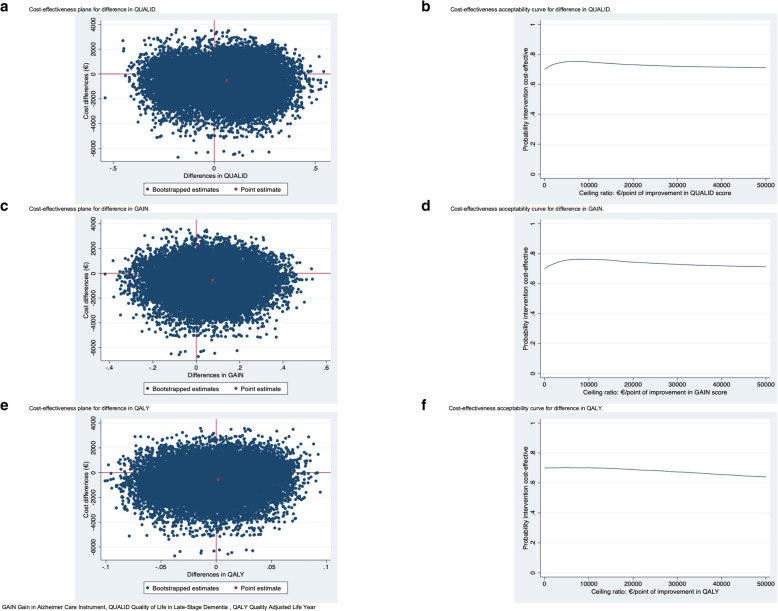
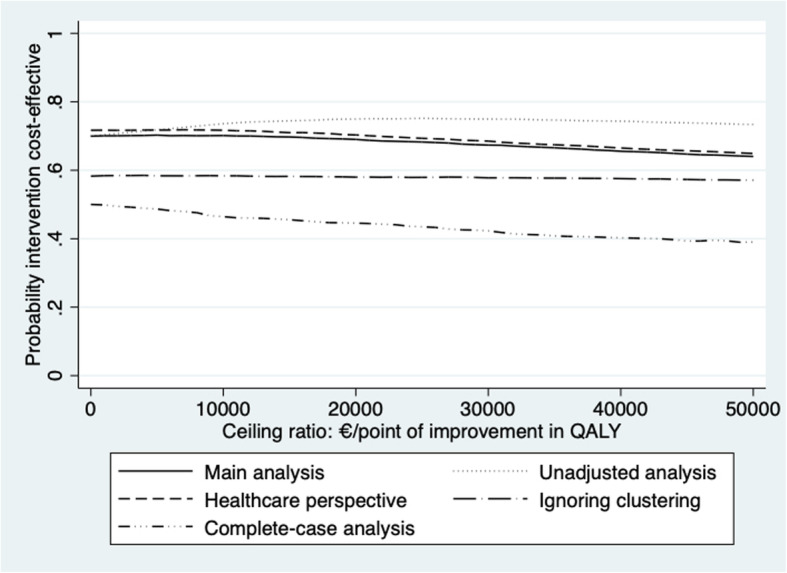
The Namaste Care Family program was more effective than usual care in terms of QUALID (- 0.062, 95%CI: - 0.40 to 0.28), QALY (0.0017, 95%CI: - 0.059 to 0.063) and GAIN (0.075, 95%CI: - 0.20 to 0.35). Total societal costs were lower for the Namaste Care Family program as compared to usual care (- 552 €, 95%CI: - 2920 to 1903). However, these differences were not statistically significant. The probability of cost-effectiveness at a ceiling ratio of 0 €/unit of effect extra was 0.70 for the QUALID, QALY and GAIN.
The Namaste Care Family program is dominant over usual care and, thus, cost-effective, although statistical uncertainty was considerable.
Netherlands Trial Register ( http://www.trialregister.nl/trialreg/index.asp , identifier: NL5570, date of registration: 2016/03/23).
痴呆症是一种进行性疾病,会降低痴呆症患者的生活质量,并导致高昂的社会成本。照顾痴呆症患者的负担也会降低家庭照顾者的生活质量。本研究的目的是评估与常规护理相比,Namaste Care Family 计划在养老院中晚期痴呆症患者中的社会效益和成本效益。
养老院被随机分配到 Namaste Care Family 计划或常规护理组。231 名居民的聚类随机试验的结局指标包括晚期痴呆症生活质量(QUALID)和阿尔茨海默病护理增益量表(GAIN),随访 12 个月。健康状况使用 EQ-5D-3L 问卷进行测量,该问卷转化为效用值。QALY 通过将参与者在特定健康状态下的时间乘以与该健康状态相关的效用得分来计算。医疗保健利用成本使用标准单位成本估算,而干预成本使用自下而上的方法估算。使用多重插补法估算缺失的成本和效果数据。插补后使用 bootstrap 多水平模型。估计成本效益接受曲线。
与常规护理相比,Namaste Care Family 计划在 QUALID(-0.062,95%CI:-0.40 至 0.28)、QALY(0.0017,95%CI:-0.059 至 0.063)和 GAIN(0.075,95%CI:-0.20 至 0.35)方面更有效。与常规护理相比,Namaste Care Family 计划的总社会成本更低(-552 欧元,95%CI:-2920 至 1903)。然而,这些差异没有统计学意义。在效果增量 0 欧元/单位的上限比率下,QUALID、QALY 和 GAIN 的成本效益概率为 0.70。
尽管统计不确定性较大,但与常规护理相比,Namaste Care Family 计划具有优势,因此具有成本效益。
荷兰试验注册中心(http://www.trialregister.nl/trialreg/index.asp,标识符:NL5570,注册日期:2016/03/23)。