Robertson Sarah, Cooper Claudia, Hoe Juanita, Hamilton Olivia, Stringer Aisling, Livingston Gill
Division of Psychiatry,University College London (UCL),6Floor Maple House,W1T 7NF,London,UK.
Int Psychogeriatr. 2017 Apr;29(4):569-581. doi: 10.1017/S1041610216002167. Epub 2017 Jan 16.
Quality of life (QoL) is an important outcome for people with dementia living in care homes but usually needs to be rated by a proxy. We do not know if relative or paid carer proxy reports differ. We conducted the first systematic review and meta-analysis of data investigating whether and how these proxy reports of QoL differ.
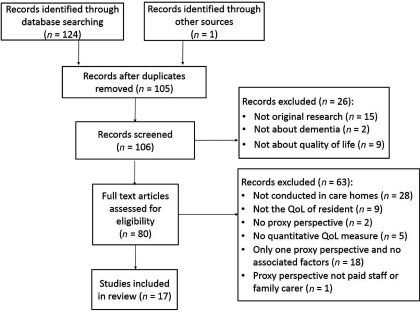
We searched four databases: Medline, Embase, PsychInfo, and CINAHL in October 2015 with the terms: dementia, QoL, proxy, and care home. Included studies either compared proxy QoL ratings or investigated the factors associated with them. We meta-analyzed data comparing staff and family proxy rated QoL.
We included 17/105 papers identified. We found no difference between global proxy ratings of QoL (n = 1,290; pooled effect size 0.06 (95% CI = -0.08 to 0.19)). Studies investigating factors associated with ratings (n = 3,537) found family and staff ratings correlated with the resident's physical and mental health. Staff who were more distressed rated resident QoL lower. Relatives rated it lower when the resident had lived in the care home for longer, when they observed more restraint, or contributed more to fees.
Relatives and staff proxy QoL ratings share a clear relationship to resident health and overall ratings were similar. Rater-specific factors were, however, also associated with scores. Understanding why different raters consider the QoL of the same person differently is an important consideration when evaluating the meaning of proxy rated QoL. Proxy raters' backgrounds may affect their rating of QoL.
生活质量(QoL)对于居住在养老院的痴呆症患者来说是一个重要的结果指标,但通常需要由代理人进行评分。我们不知道亲属或付费护理人员的代理报告是否存在差异。我们对调查这些生活质量代理报告是否存在差异以及如何存在差异的数据进行了首次系统评价和荟萃分析。
2015年10月,我们在四个数据库中进行了检索:医学索引数据库(Medline)、荷兰医学文摘数据库(Embase)、心理学文摘数据库(PsychInfo)和护理学与健康领域数据库(CINAHL),检索词为:痴呆症、生活质量、代理人和养老院。纳入的研究要么比较了代理生活质量评分,要么调查了与之相关的因素。我们对比较工作人员和家属代理评定的生活质量的数据进行了荟萃分析。
我们纳入了所识别的105篇论文中的17篇。我们发现生活质量的总体代理评分之间没有差异(n = 1290;合并效应量为0.06(95%置信区间 = -0.08至0.19))。调查与评分相关因素的研究(n = 3537)发现,家属和工作人员的评分与居民的身心健康相关。苦恼程度较高的工作人员对居民生活质量的评分较低。当居民在养老院居住时间较长、观察到更多约束措施或支付费用比例较高时,亲属对其生活质量的评分较低。
亲属和工作人员的代理生活质量评分与居民健康有着明确的关系,总体评分相似。然而,特定评分者的因素也与得分相关。在评估代理评定的生活质量的意义时,理解为什么不同的评分者对同一个人的生活质量有不同的看法是一个重要的考虑因素。代理评分者的背景可能会影响他们对生活质量的评分。