Landscape Ecology, University of Rostock, Rostock, Germany.
GFZ German Research Centre for Geosciences, Potsdam, Germany.
Philos Trans R Soc Lond B Biol Sci. 2020 Oct 26;375(1810):20190685. doi: 10.1098/rstb.2019.0685. Epub 2020 Sep 7.
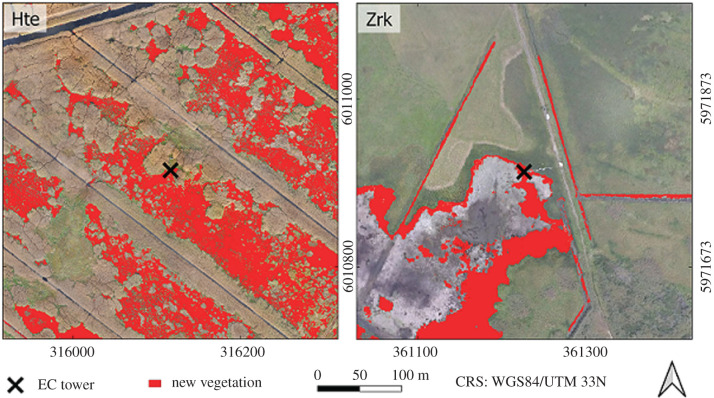
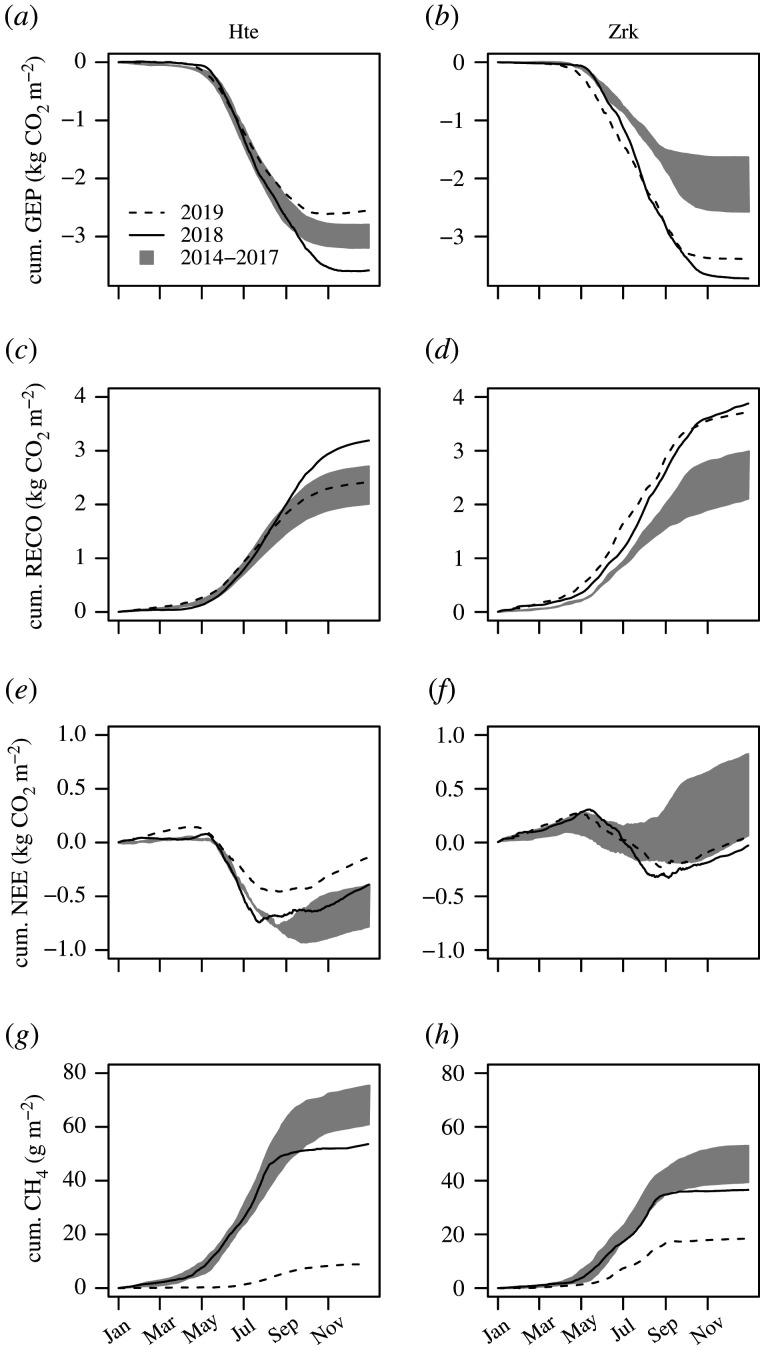
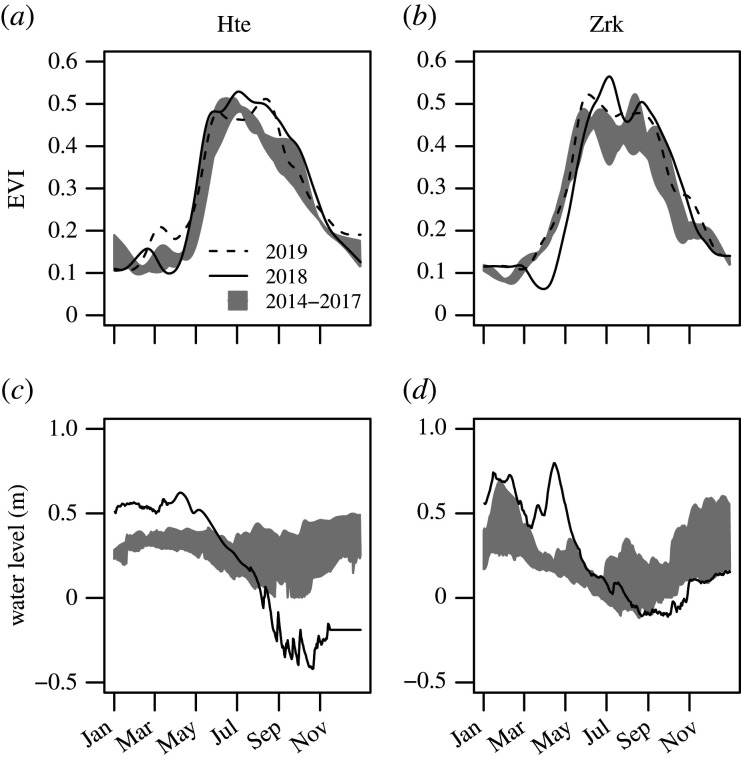
Peatland rewetting aims at stopping the emissions of carbon dioxide (CO) and establishing net carbon sinks. However, in times of global warming, restoration projects must increasingly deal with extreme events such as drought periods. Here, we evaluate the effect of the European summer drought 2018 on vegetation development and the exchange of methane (CH) and CO in two rewetted minerotrophic fens (Hütelmoor-Hte and Zarnekow-Zrk) including potential carry-over effects in the post-drought year. Drought was a major stress factor for the established vegetation but also promoted the rapid spread of new vegetation, which will likely gain a lasting foothold in Zrk. Accordingly, drought increased not only respiratory CO losses but also photosynthetic CO uptake. Altogether, the drought reduced the net CO sink in Hte, while it stopped the persistent net CO emissions of Zrk. In addition, the drought reduced CH emissions in both fens, though this became most apparent in the post-drought year and suggests a lasting shift towards non-methanogenic organic matter decomposition. Occasional droughts can be beneficial for the restoration of the peatland carbon sink function if the newly grown vegetation increases CO sequestration in the long term. Nonetheless, care must be taken to prevent extensive peat decay. This article is part of the theme issue 'Impacts of the 2018 severe drought and heatwave in Europe: from site to continental scale'.
泥炭地复湿旨在停止二氧化碳(CO)排放并建立净碳汇。然而,在全球变暖的情况下,恢复项目必须越来越多地应对极端事件,如干旱期。在这里,我们评估了 2018 年欧洲夏季干旱对植被发育和甲烷(CH)和 CO 交换的影响,包括在干旱后年份的潜在滞后效应。干旱是已建立植被的主要胁迫因素,但也促进了新植被的快速扩散,这可能会在 Zrk 中获得持久的立足点。因此,干旱不仅增加了呼吸 CO 的损失,还增加了光合作用 CO 的吸收。总的来说,干旱减少了 Hte 的净 CO 汇,而停止了 Zrk 的持续净 CO 排放。此外,干旱减少了两个沼泽地的 CH 排放,但在干旱后年份最为明显,表明非甲烷有机物质分解的持续转变。如果新生长的植被从长远来看增加 CO 固存,那么偶尔的干旱可能有利于恢复泥炭地碳汇功能。然而,必须注意防止广泛的泥炭腐烂。本文是“2018 年欧洲严重干旱和热浪的影响:从地点到大陆尺度”主题问题的一部分。