Huxhold Oliver, Hees Elena, Webster Noah J
German Centre of Gerontology, Manfred-von-Richthofen-Straße 2, 12101 Berlin, Germany.
Institute for Social Research, University of Michigan, Ann Arbor, MI USA.
Eur J Ageing. 2020 Mar 10;17(3):271-280. doi: 10.1007/s10433-020-00552-z. eCollection 2020 Sep.
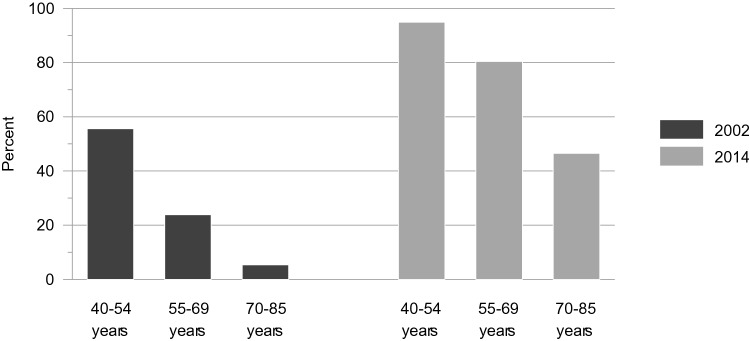
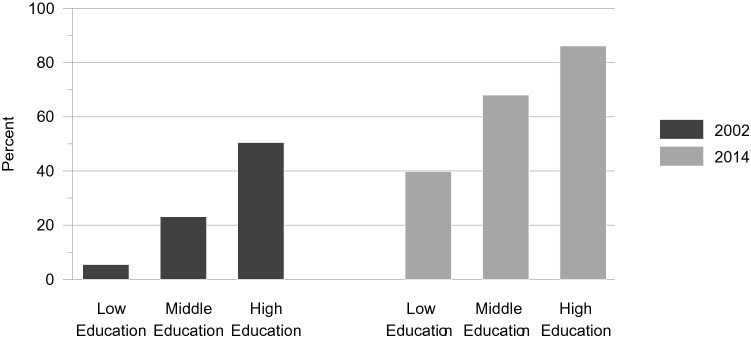
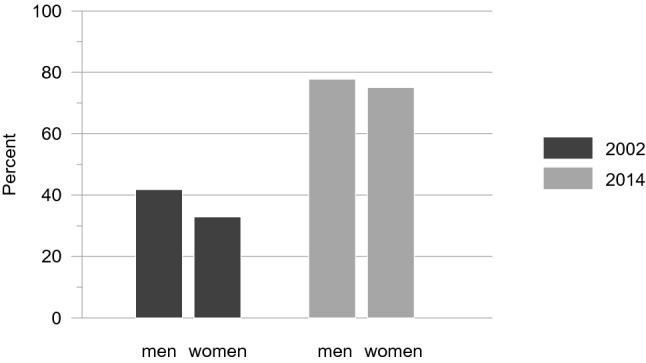
The internet is an indispensable aspect of modern society. It facilitates long distance communication, access to information, health care interventions, as well as multiple opportunities for social participation. Despite increasing pervasiveness of this technology, persistent inequalities exist in who has access to the internet. In particular, older adults lag behind in having internet access, thus putting them at risk for social exclusion. In order to gain a better understanding about the determinants of this , the current study contrasts influencing factors of internet access, comparing samples from 2002 to 2014 across age groups (40 to 54 years, 55 to 69 years and 70 to 85 years) using data from the German Ageing Survey (DEAS). Logistic regression confirmed that the likelihood of having internet access was lower with higher age at both time points. However, the percentages of people with internet access grew primarily in the middle and older age groups between 2002 and 2014. Furthermore, being male and having a higher education were both associated with greater odds of internet access. However, gender and education differences in internet access were significantly less pronounced in 2014 in contrast to 2002. Finally, both greater income and cognitive ability were associated with greater odds of internet access, while providing care for a grandchild was significantly associated with internet access only among the oldest age group. In an attempt towards bridging the grey digital divide, the current study serves as a basis for identifying groups mostly affected by this increasingly important form of social inequality.
互联网是现代社会不可或缺的一部分。它促进了远程通信、信息获取、医疗保健干预以及多种社会参与机会。尽管这项技术的普及程度不断提高,但在互联网接入方面仍存在持续的不平等现象。特别是,老年人在互联网接入方面滞后,因此面临社会排斥的风险。为了更好地理解这一现象的决定因素,本研究对比了互联网接入的影响因素,使用德国老龄化调查(DEAS)的数据,对2002年至2014年不同年龄组(40至54岁、55至69岁和70至85岁)的样本进行了比较。逻辑回归证实,在两个时间点,年龄越大,拥有互联网接入的可能性越低。然而,2002年至2014年期间,互联网接入人群的比例主要在中年和老年群体中增长。此外,男性和受过高等教育都与更高的互联网接入几率相关。然而,与2002年相比,2014年互联网接入方面的性别和教育差异明显不那么显著。最后,更高的收入和认知能力都与更高的互联网接入几率相关,而仅在最年长的年龄组中,照顾孙辈与互联网接入显著相关。为了弥合数字鸿沟,本研究为识别受这种日益重要的社会不平等形式影响最大的群体提供了依据。