Gao Ya, Theeuwes Jan
Department of Experimental and Applied Psychology, Vrije Universiteit Amsterdam, Van der Boechorststraat 7, 1081 BT, Amsterdam, The Netherlands.
Institute Brain and Behavior Amsterdam (iBBA), Amsterdam, the Netherlands.
Atten Percept Psychophys. 2020 Nov;82(8):3895-3906. doi: 10.3758/s13414-020-02115-x.
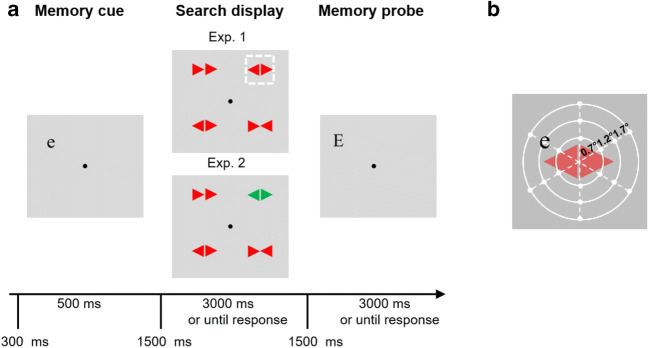
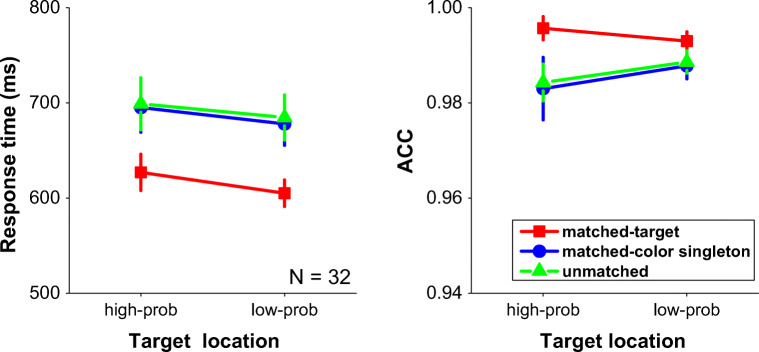
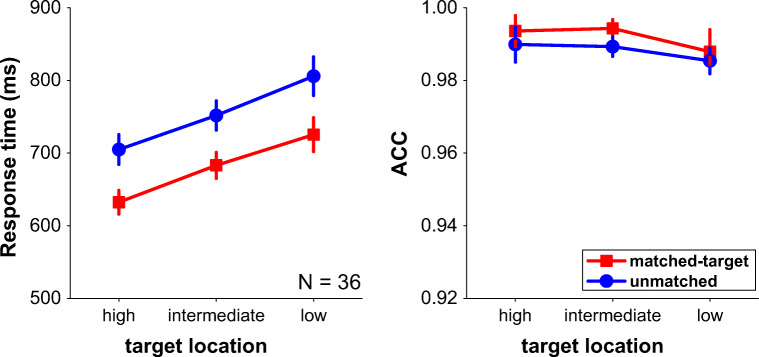
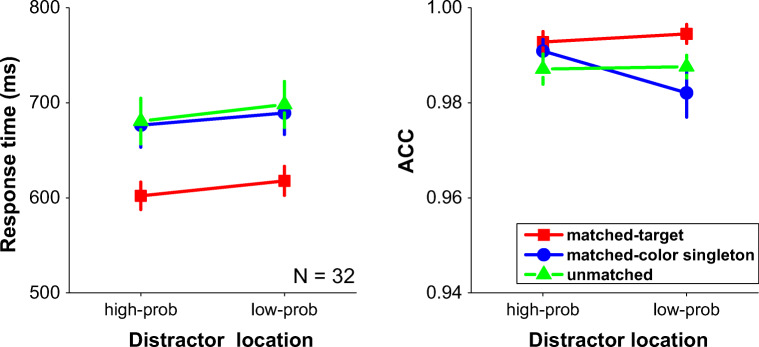
It is well known that spatial attention can be directed in a top-down way to task-relevant locations in space. In addition, through visual statistical learning (VSL), attention can be biased towards relevant (target) locations and away from irrelevant (distractor) locations. The present study investigates the interaction between the explicit task-relevant, top-down attention and the lingering attentional biases due to VSL. We wanted to determine the contribution of each of these two processes to attentional selection. In the current study, participants performed a search task while keeping a location in spatial working memory. In Experiment 1, the target appeared more often in one location, and appeared less often in other location. In Experiment 2, a color singleton distractor was presented more often in location than in all other locations. The results show that when the search target matched the location that was kept in working memory, participants were much faster at responding to the search target than when it did not match, signifying top-down attentional selection. Independent of this top-down effect, we found a clear effect of VSL as responses were even faster when target (Experiment 1) or the distractor (Experiment 2) was presented at a more likely location in visual field. We conclude that attentional selection is driven by implicit biases due to statistical learning and by explicit top-down processing, each process individually and independently modulating the neural activity within the spatial priority map.
众所周知,空间注意力可以通过自上而下的方式指向空间中与任务相关的位置。此外,通过视觉统计学习(VSL),注意力可以偏向相关(目标)位置,并远离不相关(干扰)位置。本研究调查了明确的与任务相关的自上而下注意力与VSL导致的持续注意力偏差之间的相互作用。我们想确定这两个过程对注意力选择的各自贡献。在当前研究中,参与者在保持空间工作记忆中的一个位置时执行搜索任务。在实验1中,目标在一个位置出现的频率更高,而在其他位置出现的频率更低。在实验2中,一个颜色独特的干扰项在一个位置出现的频率比在所有其他位置更高。结果表明,当搜索目标与工作记忆中保持的位置匹配时,参与者对搜索目标的反应比不匹配时快得多,这表明自上而下的注意力选择。与这种自上而下的效应无关,我们发现了VSL的明显效应,因为当目标(实验1)或干扰项(实验2)出现在视野中更可能的位置时,反应甚至更快。我们得出结论,注意力选择是由统计学习导致的隐性偏差和明确的自上而下处理驱动的,每个过程单独且独立地调节空间优先级地图内的神经活动。