Schemmel Jonas, Steinhagen Tina, Ziegler Matthias, Volbert Renate
Psychologische Hochschule Berlin, Berlin, Germany.
Institute for Psychology, Humboldt-Universität zu Berlin, Berlin, Germany.
Front Psychol. 2020 Aug 14;11:2021. doi: 10.3389/fpsyg.2020.02021. eCollection 2020.
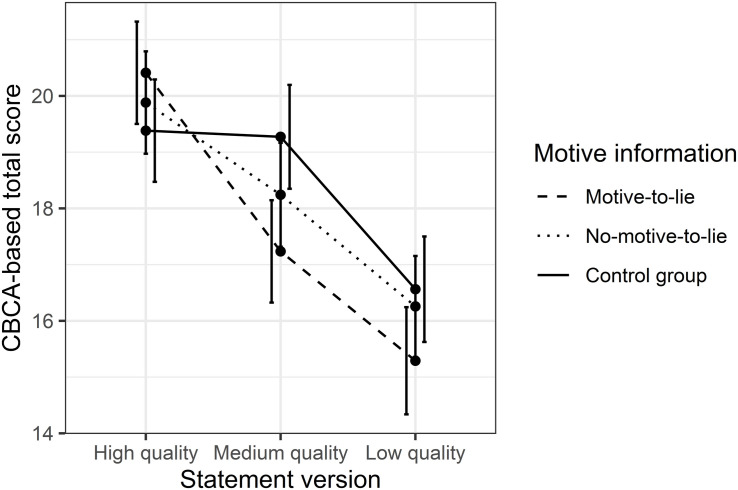
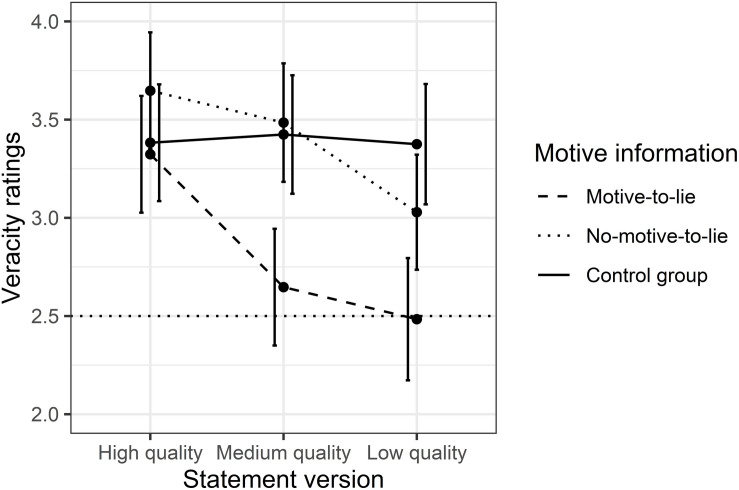
We investigated how information on a motive to lie impacts on the perceived content quality of a statement and its subsequent veracity rating. In an online study, 300 participants rated a statement about an alleged sexual harassment on a scale based on Criteria-based Content Analysis (CBCA) and judged its veracity. In a 3 × 3 between-subjects design, we varied prior information (motive to lie, no motive to lie, and no information on a motive), and presented three different statement versions of varying content quality (high, medium, and low). In addition to anticipating main effects of both independent variables (motive information and statement version), we predicted that the impact of motive information on both ratings would be highest for medium quality statements, because their assessment is especially ambiguous (interaction effect). Contrary to our hypotheses, results showed that participants were unaffected by motive information and accurately reproduced the manipulated quality differences between statement versions in their . In line with the expected interaction effect, decreased in the motive-to-lie group compared to controls, but only when the medium- and the low-quality statements were rated (truth ratings dropped from approximately 80 to 50%). Veracity ratings in both the no-motive-to-lie group and controls did not differ across statement versions (≥82% truth ratings). In sum, information on a motive to lie thus encouraged participants to consider content quality in their veracity judgments by being critical only of statements of medium and low quality. Otherwise, participants judged statements to be true irrespective of content quality.
我们研究了关于说谎动机的信息如何影响对陈述内容质量的感知及其后续的真实性评级。在一项在线研究中,300名参与者根据基于标准的内容分析(CBCA)对一项关于涉嫌性骚扰的陈述进行评分,并判断其真实性。在一个3×3的组间设计中,我们改变了先验信息(说谎动机、无说谎动机和无动机信息),并呈现了三种不同内容质量(高、中、低)的陈述版本。除了预期两个自变量(动机信息和陈述版本)的主效应外,我们还预测,动机信息对两种评级的影响在中等质量陈述中最高,因为对它们的评估特别模糊(交互效应)。与我们的假设相反,结果表明参与者不受动机信息的影响,并在他们的……中准确再现了陈述版本之间被操纵的质量差异。与预期的交互效应一致,与对照组相比,说谎动机组的……有所下降,但仅在对中等质量和低质量陈述进行评级时(真实性评级从约80%降至50%)。无说谎动机组和对照组的真实性评级在不同陈述版本之间没有差异(真实性评级≥82%)。总之,关于说谎动机的信息因此鼓励参与者在其真实性判断中考虑内容质量,仅对中等质量和低质量的陈述持批判态度。否则,参与者无论内容质量如何都判断陈述为真。