Fulop T, Larbi A, Hirokawa K, Cohen A A, Witkowski J M
Department of Geriatrics, Faculty of Medicine, Research Center on Aging, University of Sherbrooke, Sherbrooke, QC, J1K 2R1, Canada.
Research Center on Aging, Faculty of Medicine and Health Sciences, University of Sherbrooke, 3001, 12th Avenue North, Sherbrooke, Quebec, J1H 5N4, Canada.
Semin Immunopathol. 2020 Oct;42(5):521-536. doi: 10.1007/s00281-020-00818-9. Epub 2020 Sep 15.
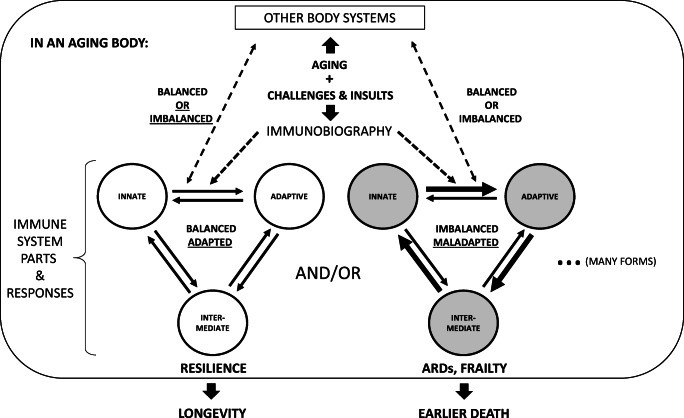
Alterations in the immune system with aging are considered to underlie many age-related diseases. However, many elderly individuals remain healthy until even a very advanced age. There is also an increase in numbers of centenarians and their apparent fitness. We should therefore change our unilaterally detrimental consideration of age-related immune changes. Recent data taking into consideration the immunobiography concept may allow for meaningful distinctions among various aging trajectories. This implies that the aging immune system has a homeodynamic characteristic balanced between adaptive and maladaptive aspects. The survival and health of an individual depends from the equilibrium of this balance. In this article, we highlight which parts of the aging of the immune system may be considered adaptive in contrast to those that may be maladaptive.
免疫系统随衰老发生的改变被认为是许多与年龄相关疾病的基础。然而,许多老年人即使到了很高龄仍保持健康。百岁老人的数量及其明显的健康状况也在增加。因此,我们应该改变对与年龄相关免疫变化的单方面有害看法。最近考虑免疫生物学概念的数据可能有助于对各种衰老轨迹进行有意义的区分。这意味着衰老的免疫系统具有在适应性和适应不良方面之间平衡的动态稳定特征。个体的生存和健康取决于这种平衡的均衡状态。在本文中,我们着重指出免疫系统衰老的哪些部分可被视为适应性的,哪些部分可能是适应不良的。