School of Public Health and Social Work, Queensland University of Technology, Brisbane, Australia.
Preventive Health Branch, Queensland Health, Queensland Government, Brisbane, Australia.
JMIR Mhealth Uhealth. 2020 Sep 16;8(9):e21243. doi: 10.2196/21243.
Australia and New Zealand have the highest skin cancer incidence rates worldwide, and sun exposure is the main risk factor for developing skin cancer. Sun exposure during childhood and adolescence is a critical factor in developing skin cancer later in life.
This study aims to test the effectiveness of wearable UV sensors to increase sun protection habits (SPH) and prevent sunburn in adolescents.
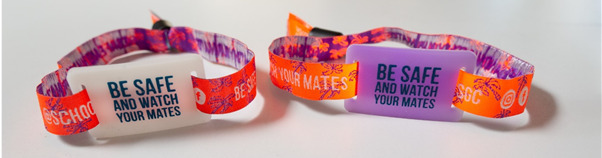
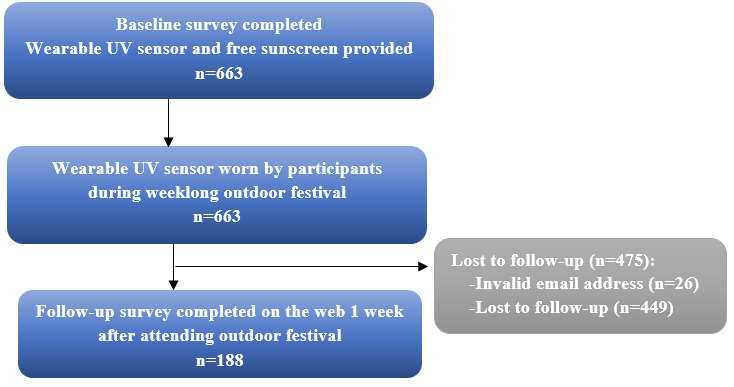
During the weeklong school leavers outdoor festival (November 2019) at the Gold Coast, Australia, registered attendees aged 15-19 years were recruited into the field study. Participants were provided with a wearable UV sensor and free sunscreen. The primary outcome was sun exposure practices using the SPH index. Secondary outcomes were self-reported sunburns, sunscreen use, and satisfaction with the wearable UV sensor.
A total of 663 participants were enrolled in the study, and complete data were available for 188 participants (188/663, 28.4% response rate). Participants provided with a wearable UV sensor significantly improved their use of sunglasses (P=.004) and sunscreen use both on the face (P<.001) and on other parts of the body (P=.005). However, the use of long-sleeve shirts (P<.001) and the use of a hat (P<.001) decreased. During the study period, 31.4% (59/188) of the participants reported receiving one or more sunburns. Satisfaction with the wearable UV sensor was high, with 73.4% (138/188) of participants reporting the UV sensor was helpful to remind them to use sun protection.
Devices that target health behaviors when outdoors, such as wearable UV sensors, may improve use of sunscreen and sunglasses in adolescents.
澳大利亚和新西兰拥有全球最高的皮肤癌发病率,而阳光暴露是导致皮肤癌的主要风险因素。儿童和青少年时期的阳光暴露是日后罹患皮肤癌的关键因素。
本研究旨在检验可穿戴式紫外线传感器在增加青少年防晒习惯(SPH)和预防晒伤方面的有效性。
在澳大利亚黄金海岸为期一周的离校生户外音乐节(2019 年 11 月)期间,招募了年龄在 15-19 岁的已注册参与者参与实地研究。参与者被提供了可穿戴式紫外线传感器和免费防晒霜。主要结果是使用 SPH 指数评估阳光暴露行为。次要结果是自我报告的晒伤、防晒霜使用情况和对可穿戴式紫外线传感器的满意度。
共有 663 名参与者参与了这项研究,其中 188 名参与者(188/663,28.4%的应答率)提供了完整的数据。提供可穿戴式紫外线传感器的参与者显著改善了他们对太阳镜的使用(P=.004)和防晒霜在面部(P<.001)和身体其他部位(P=.005)的使用。然而,长袖衬衫的使用(P<.001)和帽子的使用(P<.001)减少了。在研究期间,31.4%(59/188)的参与者报告收到了一次或多次晒伤。对可穿戴式紫外线传感器的满意度很高,73.4%(138/188)的参与者表示该传感器有助于提醒他们使用防晒措施。
当青少年在户外活动时,针对健康行为的设备,如可穿戴式紫外线传感器,可能会提高防晒霜和太阳镜的使用。