Wang Dingxue, Cao Xiaoqing, Han Yi, Yu Daping
Department of Oncology, The First Affiliated Hospital of Guizhou University of Traditional Chinese Medicine, Guiyang, 550001, People's Republic of China.
Department of Thoracic Surgery, Beijing Chest Hospital, Capital Medical University, Beijing Tuberculosis and Thoracic Tumor Research Institute, Beijing 101149, People's Republic of China.
Cancer Manag Res. 2020 Aug 31;12:7941-7948. doi: 10.2147/CMAR.S253052. eCollection 2020.
LncRNA SNHG9 has been shown to be an oncogenic lncRNA in glioblastoma, while its role in other cancers is unknown. The aim of this study was to investigate the role of SNHG9 in non-small cell lung cancer (NSCLC).
The differential expression of SNHG9 in NSCLC was first explored by analyzing the TCGA dataset, followed by measuring the expression levels of SNHG9 in paired NSCLC and non-tumor tissues by RT-qPCR. Expression of miR-21 was also determined by RT-qPCR. Correlations were analyzed by linear regression. The interaction between miR-21 and SNHG9 was detected using RNA pull-down. The expression relationship between SNHG9 and miR-21 was analyzed by SNHG9 or miR-21 overexpression experiments. The effects of overexpression of SNHG9 on the methylation of miR-21 were analyzed by methylation-specific PCR (MSP). Cell proliferation was evaluated by CCK-8 assay.
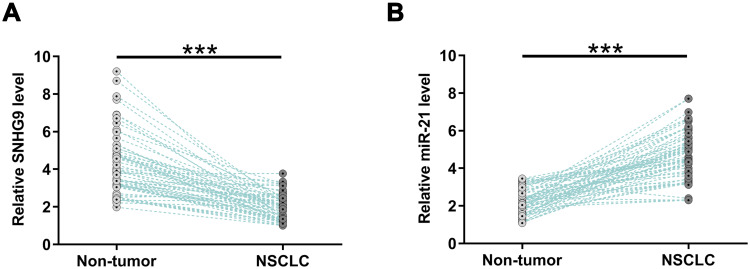
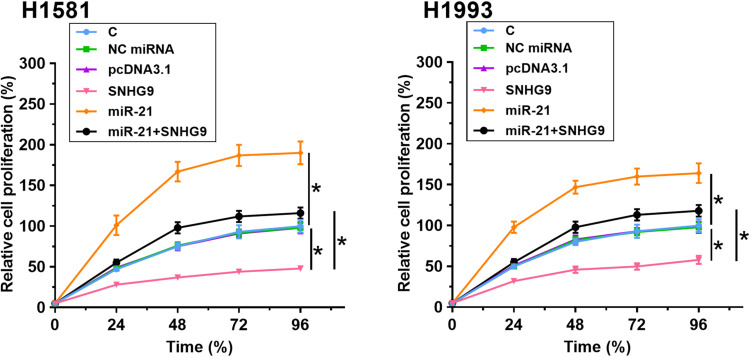
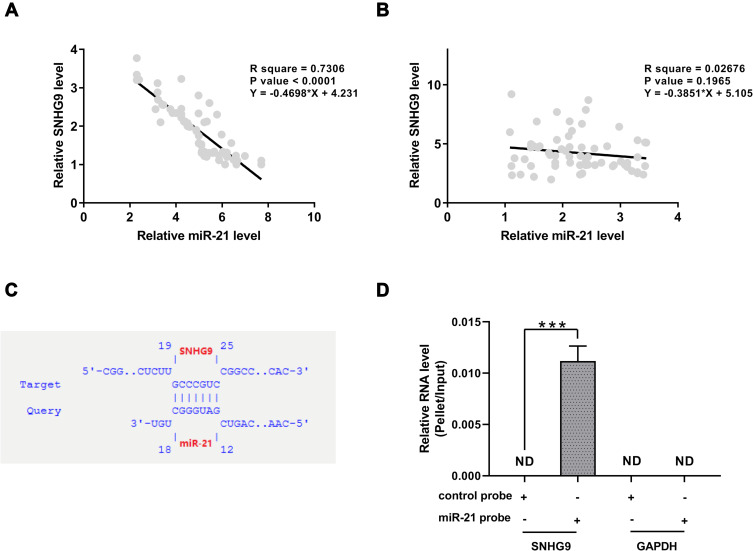
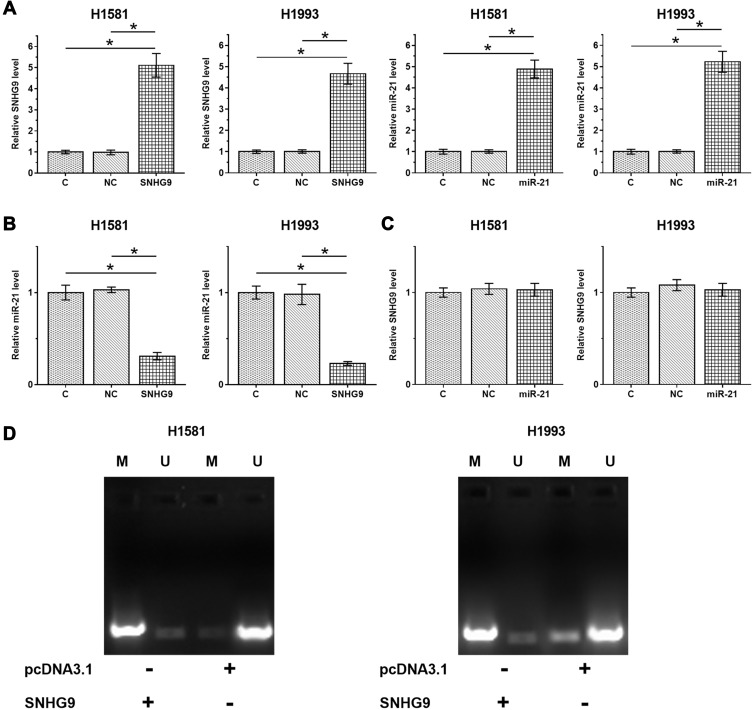
By analyzing the TCGA dataset, we observed downregulation of SNHG9 in NSCLC, which was confirmed by measuring the expression levels of SNHG9 in paired NSCLC tumor tissues and non-tumor tissues from NSCLC patients involved in this study. MiR-21 was upregulated in NSCLC tumor tissues and inversely correlated with SNHG9 in cancer tissues but not in non-tumor tissues. The interaction between SNHG9 and miR-21 was predicted by bioinformatic analyses, which was further verified by RNA pull-down. In NSCLC cells, overexpression of SNHG9 led to downregulated miR-21 and increased methylation of miR-21 gene. In contrast, miR-21 did not affect the expression of SNHG9. In addition, overexpression of SNHG9 attenuated the enhancing effects of miR-21 on NSCLC proliferation.
SNHG9 might downregulate miR-21 through methylation to suppress cancer cell proliferation.
长链非编码RNA SNHG9已被证明在胶质母细胞瘤中是一种致癌性长链非编码RNA,但其在其他癌症中的作用尚不清楚。本研究旨在探讨SNHG9在非小细胞肺癌(NSCLC)中的作用。
首先通过分析TCGA数据集探讨SNHG9在NSCLC中的差异表达,随后通过RT-qPCR检测配对的NSCLC组织和非肿瘤组织中SNHG9的表达水平。同时也通过RT-qPCR测定miR-21的表达。通过线性回归分析相关性。使用RNA下拉实验检测miR-21与SNHG9之间的相互作用。通过SNHG9或miR-21过表达实验分析SNHG9与miR-21之间的表达关系。通过甲基化特异性PCR(MSP)分析SNHG9过表达对miR-21甲基化的影响。通过CCK-8法评估细胞增殖。
通过分析TCGA数据集,我们观察到NSCLC中SNHG9表达下调,这在本研究中参与的NSCLC患者的配对肿瘤组织和非肿瘤组织中SNHG9表达水平的检测中得到证实。miR-21在NSCLC肿瘤组织中上调,且在癌组织中与SNHG9呈负相关,但在非肿瘤组织中无此相关性。通过生物信息学分析预测了SNHG9与miR-21之间的相互作用,并通过RNA下拉实验进一步验证。在NSCLC细胞中,SNHG9过表达导致miR-21表达下调和miR-21基因甲基化增加。相反,miR-21不影响SNHG9的表达。此外,SNHG9过表达减弱了miR-21对NSCLC增殖的促进作用。
SNHG9可能通过甲基化下调miR-21以抑制癌细胞增殖。