Cotton Wayne, Dudley Dean, Peralta Louisa, Werkhoven Thea
The University of Sydney, NSW 2006, Australia.
Macquarie University, NSW, Australia.
Prev Med Rep. 2020 Aug 13;20:101178. doi: 10.1016/j.pmedr.2020.101178. eCollection 2020 Dec.
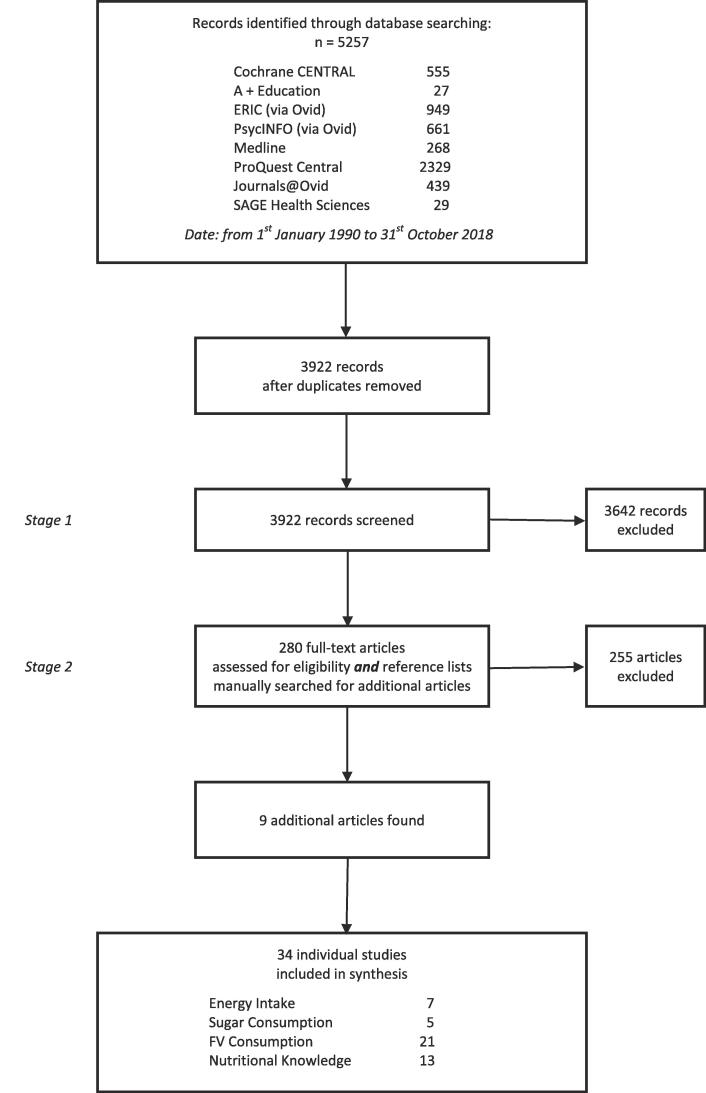
Research shows that schools can make a positive impact on children's nutritional outcomes. However, it is also reported that schools and teaching staff note many barriers, which may restrict nutritional education programming and delivery. This is concerning, considering the view that teachers are the key agents for promoting health and nutrition within schools. The purpose of the updated systematic review and meta-analysis was to ascertain the impact that nutrition education programs have on elementary-aged students' energy intake, fruit, vegetable, sugar consumption and nutritional knowledge. A systematic literature search was conducted using electronic databases (The Cochrane Central Register of Controlled Trials (CENTRAL); A + Education; ERIC; PsycINFO; MEDLINE; ProQuest Central, Journals@Ovid and SAGE Health Sciences Full-Text Collection) from 1990 to 31st October 2018. This process yielded 34 studies for inclusion in this systematic review and meta-analysis. Of these studies, seven studies had a focus on energy intake, five had a focus on sugar consumption, 21 of the studies looked at fruit and vegetable consumption and 13 studies focused on nutritional knowledge. The results suggest that the teaching of nutrition education in elementary schools by qualified teachers can make an important contribution to the knowledge and dietary habits of children. The small and medium effect sizes indicate that prudent, evidence-based decisions need to be made by policy makers and pedagogues as to the teaching strategies employed when delivering nutrition education programs to elementary-aged students. The review is reported in accordance to the Preferred Reporting Items for Systematic Reviews and Meta-Analyses guidelines (van Sluijs et al., 2007).
研究表明,学校能够对儿童的营养状况产生积极影响。然而,也有报告指出,学校和教师指出存在许多障碍,这些障碍可能会限制营养教育计划的制定和实施。鉴于教师被视为学校内促进健康和营养的关键因素,这一情况令人担忧。更新后的系统评价和荟萃分析的目的是确定营养教育计划对小学生能量摄入、水果、蔬菜、糖的消费以及营养知识的影响。我们使用电子数据库(考克兰对照试验中心注册库(CENTRAL);A+教育;教育资源信息中心(ERIC);心理学文摘数据库(PsycINFO);医学期刊数据库(MEDLINE);ProQuest Central、Ovid电子期刊全文数据库(Journals@Ovid)和SAGE健康科学全文数据库)进行了系统的文献检索,检索时间跨度为1990年至2018年10月31日。这一过程产生了34项研究,纳入了本系统评价和荟萃分析。在这些研究中,有7项研究关注能量摄入,5项关注糖的消费,21项研究着眼于水果和蔬菜的消费,13项研究关注营养知识。结果表明,由合格教师在小学开展营养教育能够对儿童的知识和饮食习惯做出重要贡献。中小效应量表明,政策制定者和教育工作者在为小学生提供营养教育计划时,需要就所采用的教学策略做出审慎、基于证据的决策。本评价是按照系统评价和荟萃分析的首选报告项目指南(van Sluijs等人,2007年)进行报告的。