Bayer AG, Wuppertal, Germany.
University of Witten/Herdecke, Witten, Germany.
Eur J Heart Fail. 2021 May;23(5):743-750. doi: 10.1002/ejhf.2001. Epub 2020 Oct 9.
Arginine vasopressin (AVP) mediates deleterious effects via vascular V1a and renal V2 receptors in heart failure (HF). Despite positive short-term decongestive effects in phase II HF studies, selective V2 receptor antagonism has shown no long-term mortality benefit, potentially related to unopposed V1a receptor activation. We compared the novel dual V1a/V2 receptor antagonist pecavaptan with the selective V2 receptor antagonist tolvaptan in pre-clinical HF models.
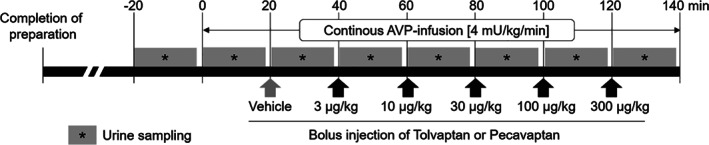
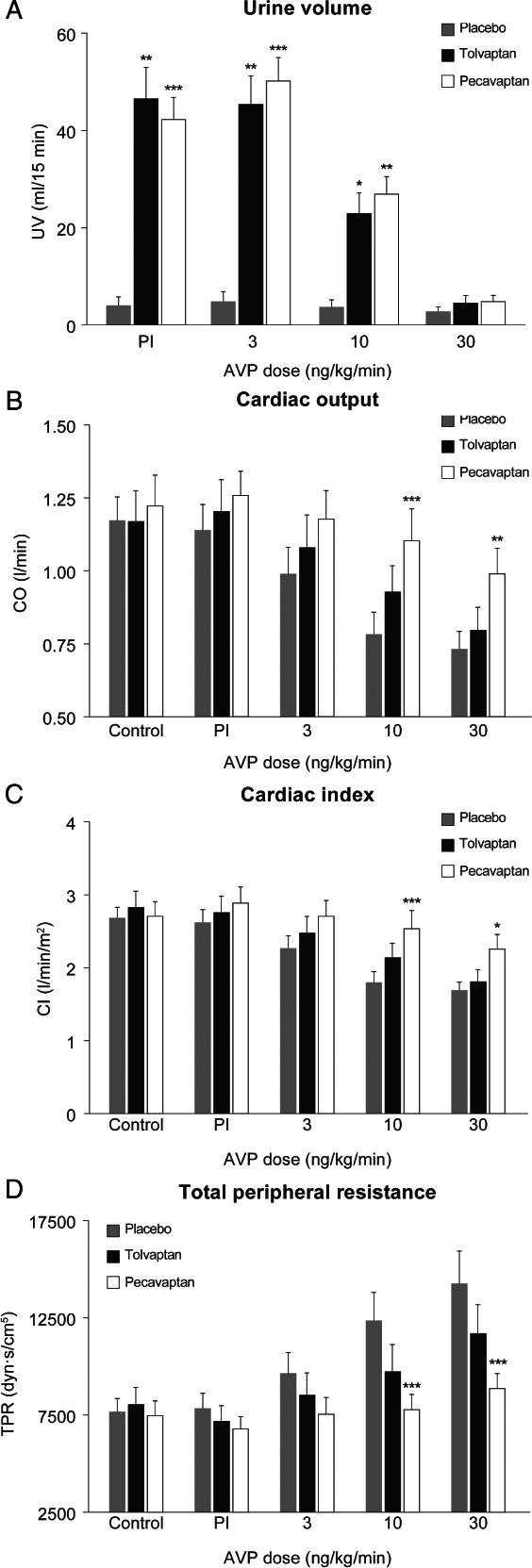
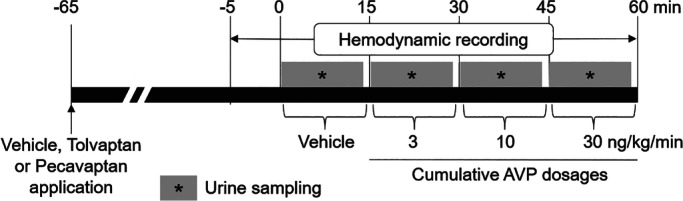
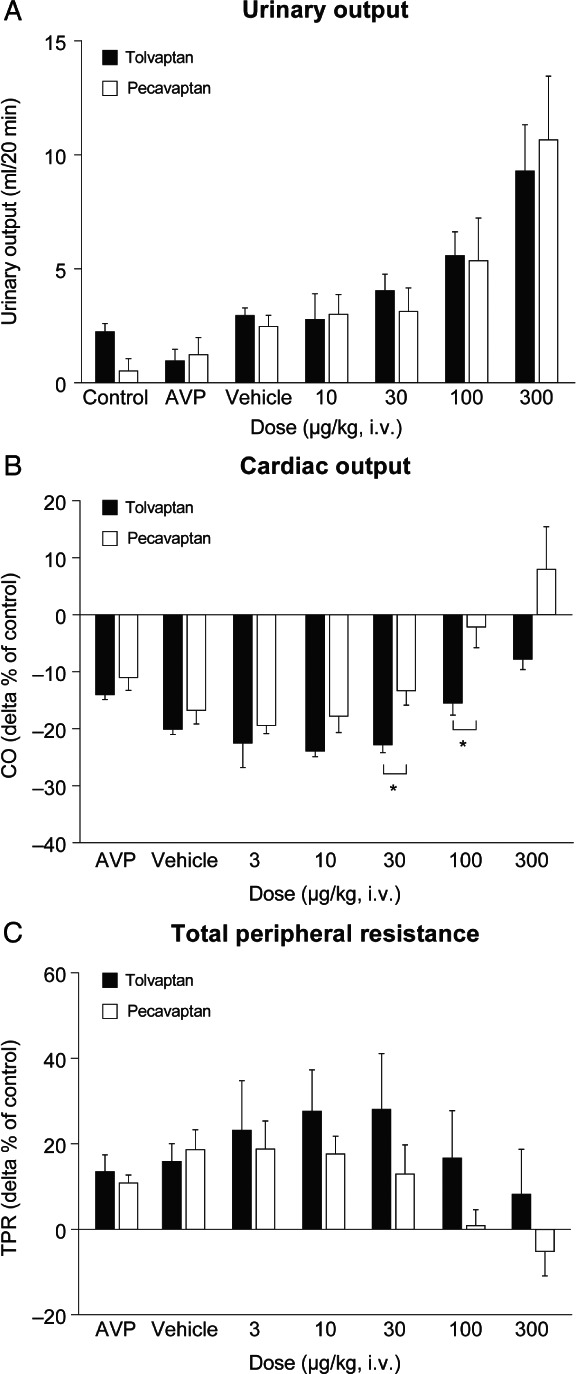
In vitro IC50 determination in recombinant cell lines revealed similar receptor selectivity profiles (V2:V1a) of tolvaptan and pecavaptan for human and dog AVP receptors, respectively. Two canine models were used to compare haemodynamic and aquaretic effects: (i) anaesthetised dogs with tachypacing-induced HF, and (ii) conscious telemetric dogs with a non-invasive cardiac output (CO) monitor. Tolvaptan and pecavaptan exhibited no differences in urinary output. In HF dogs, pecavaptan counteracted the AVP-induced increase in afterload and decrease in CO (pecavaptan: 1.83 ± 0.31 L/min; vs. tolvaptan: 1.46 ± 0.07 L/min, P < 0.05). In conscious telemetric animals, pecavaptan led to a significant increase in CO (+0.26 ± 0.17 L/min, P = 0.0086 vs. placebo), in cardiac index (+0.58 ± 0.39 L/min/m , P = 0.009 vs. placebo) and a significant decrease in total peripheral resistance (-5348.6 ± 3601.3 dyn × s/cm , P < 0.0001 vs. placebo), whereas tolvaptan was without any significant effect.
Simultaneous blockade of vascular V1a and renal V2 receptors efficiently induces aquaresis and counteracts AVP-mediated haemodynamic aggravation in HF models. Dual V1a/V2 antagonism may lead to improved outcomes in HF.
血管加压素(AVP)通过心力衰竭(HF)中的血管 V1a 和肾脏 V2 受体介导有害作用。尽管在 HF 二期研究中具有短期利尿作用,但选择性 V2 受体拮抗剂并未显示出长期死亡率获益,这可能与未拮抗的 V1a 受体激活有关。我们比较了新型双重 V1a/V2 受体拮抗剂培维索坦(pecavaptan)与选择性 V2 受体拮抗剂托伐普坦(tolvaptan)在临床前 HF 模型中的作用。
在重组细胞系中测定 IC50 发现,托伐普坦和培维索坦对人和犬 AVP 受体的受体选择性相似(V2:V1a)。使用两种犬模型比较血流动力学和利尿作用:(i)麻醉犬心动过速诱导的 HF,(ii)带有非侵入性心输出量(CO)监测的清醒遥测犬。托伐普坦和培维索坦在尿量方面没有差异。在 HF 犬中,培维索坦拮抗 AVP 引起的后负荷增加和 CO 降低(培维索坦:1.83±0.31 L/min;托伐普坦:1.46±0.07 L/min,P<0.05)。在清醒遥测动物中,培维索坦导致 CO 显著增加(+0.26±0.17 L/min,P=0.0086 与安慰剂相比),心指数(+0.58±0.39 L/min/m,P=0.009 与安慰剂相比)和总外周阻力显著降低(-5348.6±3601.3 dyn×s/cm,P<0.0001 与安慰剂相比),而托伐普坦则没有任何显著作用。
同时阻断血管 V1a 和肾脏 V2 受体可有效诱导利尿,并在心衰模型中拮抗 AVP 介导的血流动力学恶化。双重 V1a/V2 拮抗作用可能导致 HF 结局改善。