Chen Jiayang, See Kay Choong
Yong Loo Lin School of Medicine, National University of Singapore, Singapore, Singapore.
Division of Respiratory & Critical Care Medicine, Department of Medicine, National University Hospital, Singapore, Singapore.
J Med Internet Res. 2020 Oct 27;22(10):e21476. doi: 10.2196/21476.
COVID-19 was first discovered in December 2019 and has since evolved into a pandemic.
To address this global health crisis, artificial intelligence (AI) has been deployed at various levels of the health care system. However, AI has both potential benefits and limitations. We therefore conducted a review of AI applications for COVID-19.
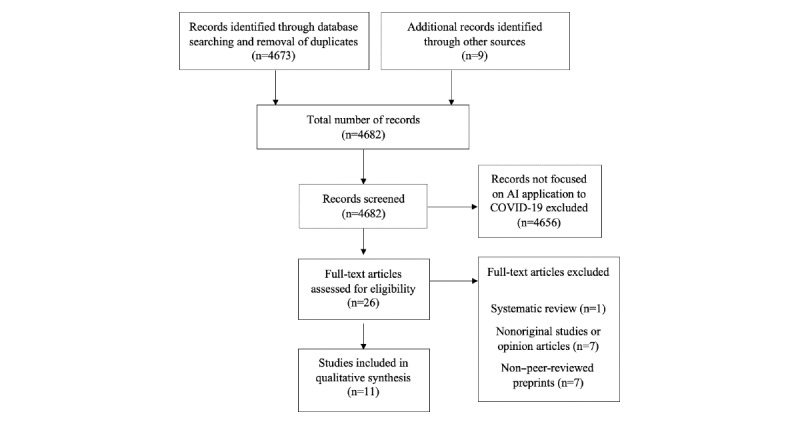
We performed an extensive search of the PubMed and EMBASE databases for COVID-19-related English-language studies published between December 1, 2019, and March 31, 2020. We supplemented the database search with reference list checks. A thematic analysis and narrative review of AI applications for COVID-19 was conducted.
In total, 11 papers were included for review. AI was applied to COVID-19 in four areas: diagnosis, public health, clinical decision making, and therapeutics. We identified several limitations including insufficient data, omission of multimodal methods of AI-based assessment, delay in realization of benefits, poor internal/external validation, inability to be used by laypersons, inability to be used in resource-poor settings, presence of ethical pitfalls, and presence of legal barriers. AI could potentially be explored in four other areas: surveillance, combination with big data, operation of other core clinical services, and management of patients with COVID-19.
In view of the continuing increase in the number of cases, and given that multiple waves of infections may occur, there is a need for effective methods to help control the COVID-19 pandemic. Despite its shortcomings, AI holds the potential to greatly augment existing human efforts, which may otherwise be overwhelmed by high patient numbers.
2019年12月首次发现新型冠状病毒肺炎(COVID-19),此后它演变成了一场大流行病。
为应对这一全球健康危机,人工智能(AI)已在医疗保健系统的各个层面得到应用。然而,人工智能既有潜在的益处,也有局限性。因此,我们对人工智能在COVID-19中的应用进行了综述。
我们对PubMed和EMBASE数据库进行了广泛检索,以查找2019年12月1日至2020年3月31日期间发表的与COVID-19相关的英文研究。我们通过检查参考文献列表对数据库搜索进行了补充。对人工智能在COVID-19中的应用进行了主题分析和叙述性综述。
总共纳入11篇论文进行综述。人工智能在四个领域应用于COVID-19:诊断、公共卫生、临床决策和治疗。我们确定了几个局限性,包括数据不足、遗漏基于人工智能的多模态评估方法、效益实现延迟、内部/外部验证不佳、非专业人员无法使用、无法在资源匮乏地区使用、存在伦理陷阱以及存在法律障碍。人工智能还可能在其他四个领域进行探索:监测、与大数据结合、其他核心临床服务的运营以及COVID-19患者的管理。
鉴于病例数量持续增加,并且可能会出现多波感染,需要有效的方法来帮助控制COVID-19大流行。尽管存在缺点,但人工智能有潜力极大地增强现有的人力,否则可能会被大量患者压垮。