Department of Cardiovascular Medicine, The Second Affiliated Hospital of Nanchang University, No. 1 Minde Road, Nanchang, 330006, Jiangxi, China.
Zheyuan township hospital, Wuyuan, Jiangxi, China.
Cardiovasc Diabetol. 2020 Sep 18;19(1):139. doi: 10.1186/s12933-020-01124-2.
Data are limited on whether TyG index is an independent predictor of arterial stiffness in hypertensive patients. The purpose of this study was to assess the association between the TyG index and arterial stiffness, and examined whether there were effect modifiers, in hypertensive patients.
This study included 4718 hypertensive adults, a subset of the China H-type Hypertension Registry Study. The TyG index was calculated as ln[fasting triglycerides (mg/dL) × fasting glucose (mg/dL)/2]. Arterial stiffness was determined by measuring brachial-ankle pulse wave velocity (baPWV).
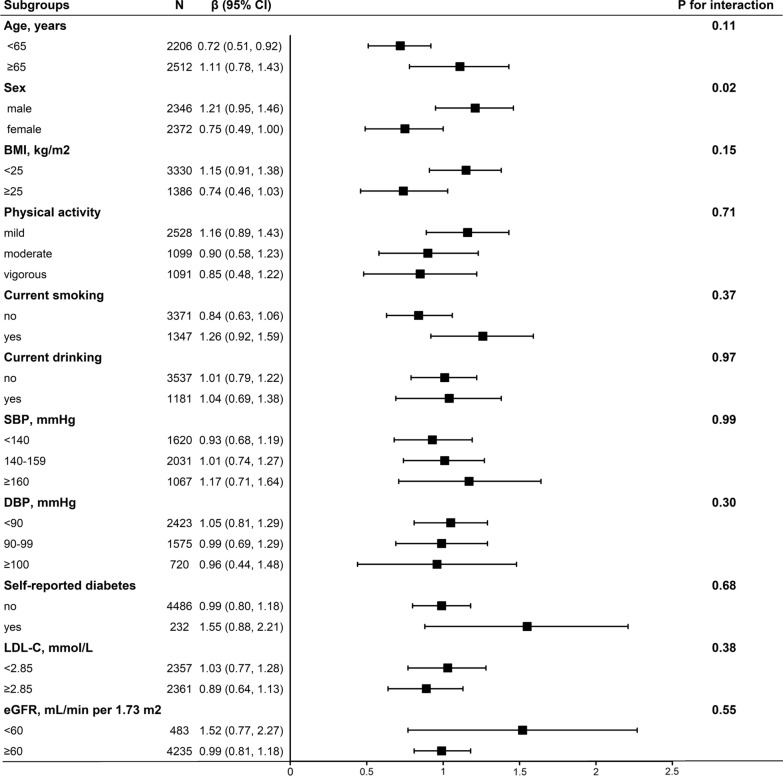
The overall mean TyG index was 8.84. Multivariate linear regression analyses showed that TyG index was independently and positively associated with baPWV (β, 1.02; 95% confidence interval [CI] 0.83, 1.20). Consistently, Multiple logistic analyses showed a positive association between TyG index risk of elevated baPWV (> 75th percentile) (odds ratio [OR], 2.12; 95% CI 1.80, 2.50). Analyses using restricted cubic spline confirmed that the associations of TyG index with baPWV and elevated baPWV were linear. Subgroup analyses showed that stronger associations between TyG index and baPWV were detected in men (all P for interaction < 0.05).
TyG index was independently and positively associated with baPWV and elevated baPWV among hypertensive patients, especially in men. The data suggest that TyG index may serve as a simple and effective tool for arterial stiffness risk assessment in daily clinical practice.
关于 TyG 指数是否是高血压患者动脉僵硬的独立预测因子,相关数据有限。本研究旨在评估 TyG 指数与动脉僵硬之间的相关性,并检查是否存在效应修饰因子,在高血压患者中。
本研究纳入了中国 H 型高血压登记研究的 4718 例高血压成年人。TyG 指数计算方法为 ln[空腹甘油三酯(mg/dL)×空腹血糖(mg/dL)/2]。通过测量肱踝脉搏波速度(baPWV)来确定动脉僵硬。
总体平均 TyG 指数为 8.84。多变量线性回归分析显示,TyG 指数与 baPWV 呈独立正相关(β,1.02;95%置信区间 [CI] 0.83,1.20)。同样,多元逻辑分析显示 TyG 指数与升高的 baPWV(>第 75 百分位)的风险之间存在正相关(比值比 [OR],2.12;95% CI 1.80,2.50)。受限立方样条分析证实了 TyG 指数与 baPWV 和升高的 baPWV 之间的关联呈线性。亚组分析显示,TyG 指数与 baPWV 之间的关联在男性中更强(所有交互 P 值均<0.05)。
TyG 指数与高血压患者的 baPWV 和升高的 baPWV 呈独立正相关,尤其是在男性中。这些数据表明,TyG 指数可能是日常临床实践中评估动脉僵硬风险的一种简单有效的工具。