Su Yongkang, Wang Shuxia, Sun Jin, Zhang Yan, Ma Shouyuan, Li Man, Zhang Anhang, Cheng Bokai, Cai Shuang, Bao Qiligeer, Zhu Ping
Medical School of Chinese People's Liberation Army, Beijing, China.
Department of Geriatrics, The Second Medical Centre, National Clinical Research Center for Geriatric Diseases, Chinese People's Liberation Army General Hospital, Beijing, China.
Front Cardiovasc Med. 2021 Sep 13;8:737899. doi: 10.3389/fcvm.2021.737899. eCollection 2021.
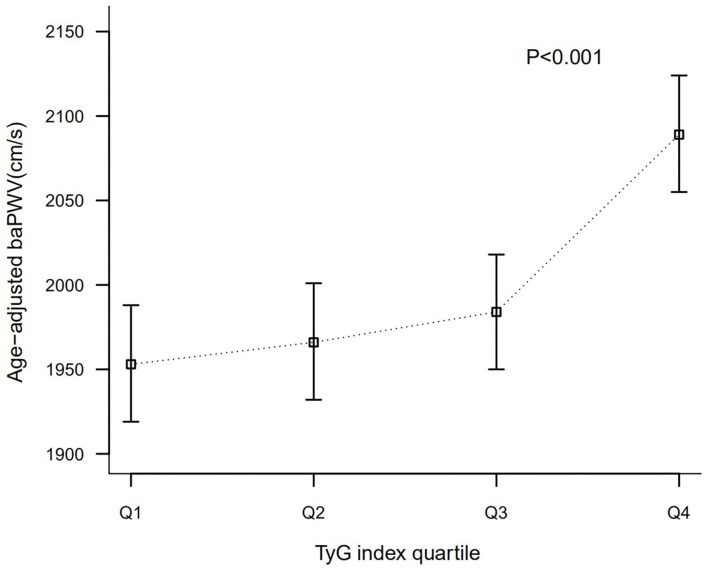
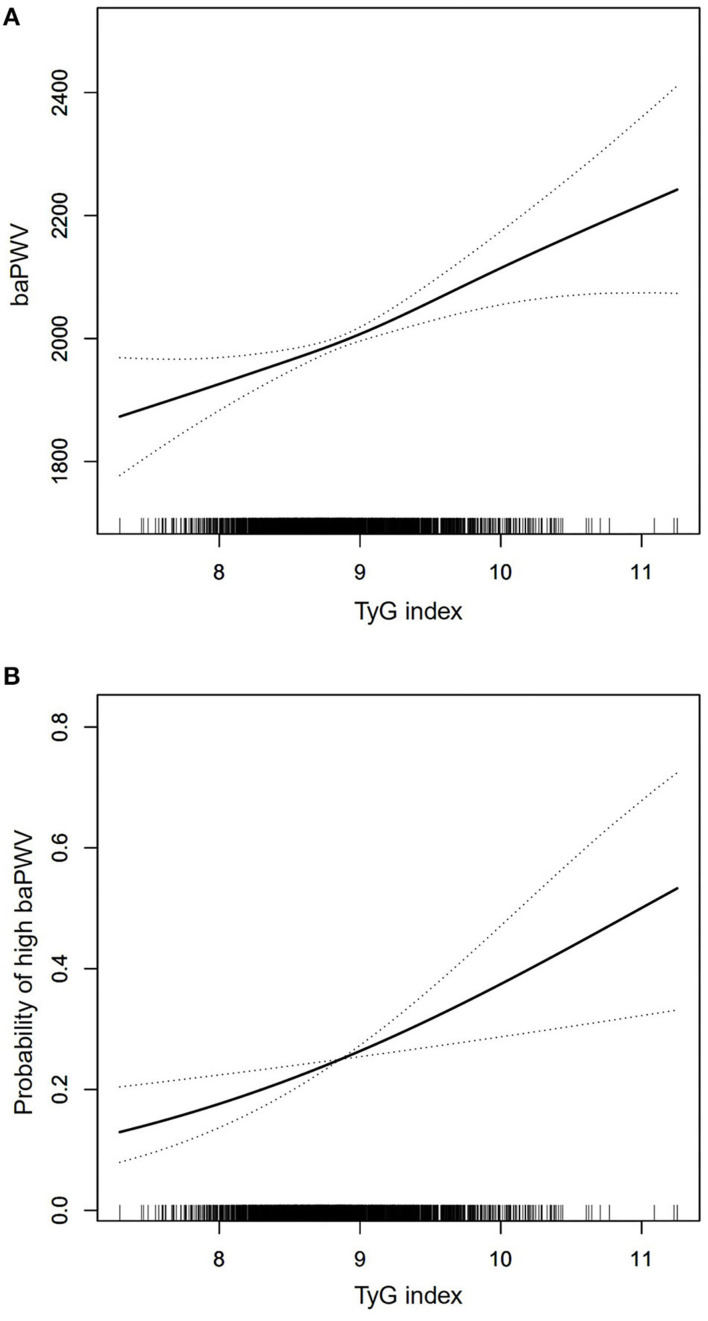
The population of older adults is growing rapidly with the increasing pace of aging worldwide. The triglyceride glucose (TyG) index has been a convenient and reliable surrogate marker of insulin resistance (IR). This study aimed to determine the association between the TyG index and arterial stiffness assessed by brachial-ankle pulse wave velocity (baPWV) in Chinese older adults. A total of 2,035 participants aged 60 years or above were enrolled. Demographic, anthropometric, and cardiovascular risk factors were collected. TyG index was calculated using ln (fasting triglycerides [mg/dL] × fasting glucose [mg/dL]/2). Arterial stiffness was measured using baPWV. The participants, with the mean [standard deviation (SD)] age of 71.32 (6.75) years, the female proportion of 39.65%, the mean (SD) baPWV of 1,998 (437) cm/s, and the mean (SD) TyG index of 8.86 (0.54), were divided into four groups according to TyG index quartiles. Age-adjusted baPWV presented an increasing trend according to TyG index quartiles. In the fully adjusted linear regression model, the baPWV increased 49 cm/s, with the 95% confidence interval (CI) from 24 to 75 cm/s, per-SD increase in the TyG index. In the fully-adjusted logistic regression model, the odds ratio (95% CI) of high baPWV (>75th percentile) was 1.32 (1.09, 1.60) for each SD increase in the TyG index. The generalized additive model analysis also confirmed the significant association of the TyG index with baPWV and high baPWV. The TyG index is significantly associated with arterial stiffness assessed by baPWV in Chinese older adults.
随着全球老龄化步伐的加快,老年人口正在迅速增长。甘油三酯葡萄糖(TyG)指数一直是胰岛素抵抗(IR)便捷且可靠的替代指标。本研究旨在确定中国老年人中TyG指数与通过臂踝脉搏波速度(baPWV)评估的动脉僵硬度之间的关联。共纳入2035名60岁及以上的参与者。收集了人口统计学、人体测量学和心血管危险因素。TyG指数通过ln(空腹甘油三酯[mg/dL]×空腹血糖[mg/dL]/2)计算得出。动脉僵硬度采用baPWV进行测量。参与者的平均[标准差(SD)]年龄为71.32(6.75)岁,女性比例为39.65%,平均(SD)baPWV为1998(437)cm/s,平均(SD)TyG指数为8.86(0.54),根据TyG指数四分位数分为四组。年龄调整后的baPWV根据TyG指数四分位数呈上升趋势。在完全调整的线性回归模型中,TyG指数每增加1个标准差,baPWV增加49 cm/s,95%置信区间(CI)为24至75 cm/s。在完全调整的逻辑回归模型中,TyG指数每增加1个标准差,高baPWV(>第75百分位数)的优势比(95%CI)为1.32(1.09,1.60)。广义相加模型分析也证实了TyG指数与baPWV及高baPWV之间存在显著关联。在中国老年人中,TyG指数与通过baPWV评估的动脉僵硬度显著相关。