Cao Junyu, Herman Alexander B, West Geoffrey B, Poe Gina, Savage Van M
Department of Information, Risk and Operations Management, McCombs School of Business, The University of Texas at Austin, TX, USA.
Department of Psychiatry, University of Minnesota, Minneapolis, MN, USA.
Sci Adv. 2020 Sep 18;6(38). doi: 10.1126/sciadv.aba0398. Print 2020 Sep.
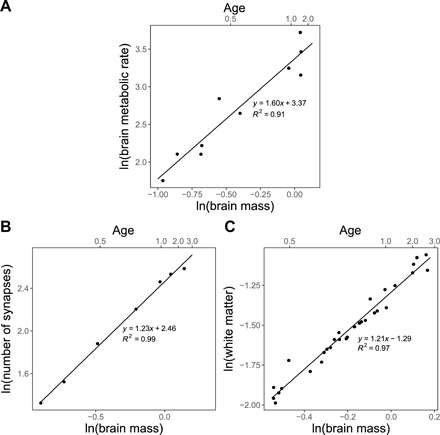
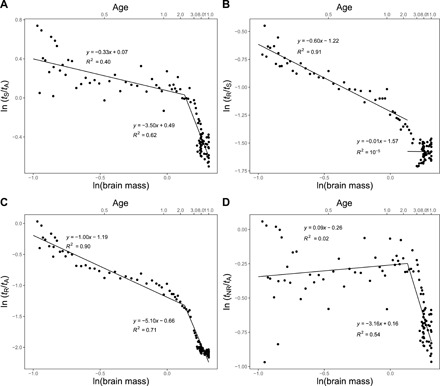
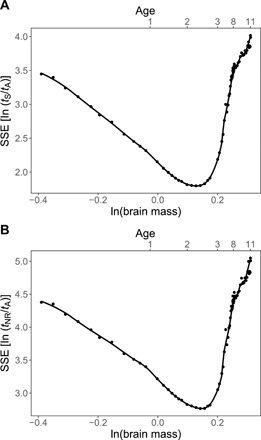
Sleep serves disparate functions, most notably neural repair, metabolite clearance and circuit reorganization. Yet the relative importance remains hotly debated. Here, we create a novel mechanistic framework for understanding and predicting how sleep changes during ontogeny and across phylogeny. We use this theory to quantitatively distinguish between sleep used for neural reorganization versus repair. Our findings reveal an abrupt transition, between 2 and 3 years of age in humans. Specifically, our results show that differences in sleep across phylogeny and during late ontogeny (after 2 or 3 years in humans) are primarily due to sleep functioning for repair or clearance, while changes in sleep during early ontogeny (before 2 or 3 years) primarily support neural reorganization and learning. Moreover, our analysis shows that neuroplastic reorganization occurs primarily in REM sleep but not in NREM. This developmental transition suggests a complex interplay between developmental and evolutionary constraints on sleep.
睡眠具有多种不同的功能,最显著的是神经修复、代谢物清除和神经回路重组。然而,其相对重要性仍存在激烈争论。在此,我们创建了一个新颖的机制框架,用于理解和预测睡眠在个体发育过程以及系统发育过程中是如何变化的。我们运用这一理论来定量区分用于神经重组的睡眠和用于修复的睡眠。我们的研究结果揭示了人类在2至3岁之间的一个突然转变。具体而言,我们的结果表明,系统发育过程以及个体发育后期(人类2或3岁之后)的睡眠差异主要归因于用于修复或清除的睡眠功能,而个体发育早期(2或3岁之前)的睡眠变化主要支持神经重组和学习。此外,我们的分析表明,神经可塑性重组主要发生在快速眼动睡眠中,而非非快速眼动睡眠中。这种发育转变表明了发育和进化对睡眠的限制之间存在复杂的相互作用。