Chemical Engineering, School for Engineering of Matter, Transport and Energy, Arizona State University, Tempe, AZ 85224, USA.
School of Biological and Health Systems Engineering, Arizona State University, Tempe, AZ 85287, USA.
Cells. 2020 Sep 17;9(9):2113. doi: 10.3390/cells9092113.
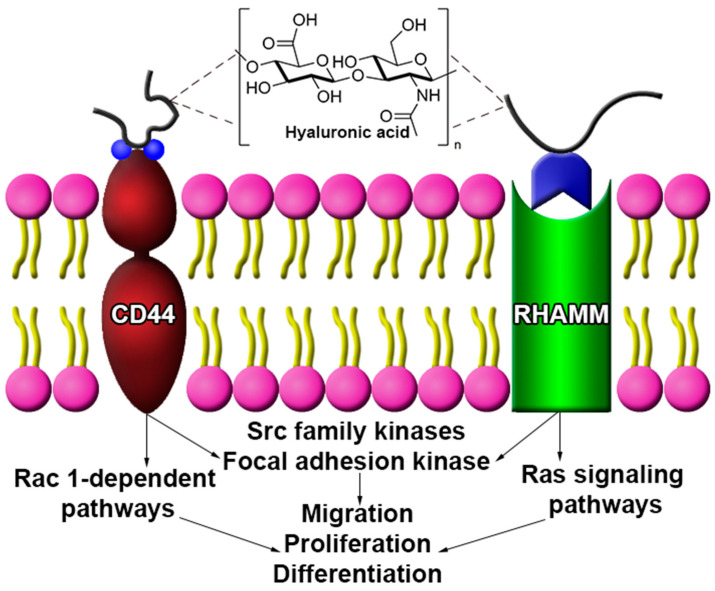
Hyaluronic acid (HA) is a primary component of the brain extracellular matrix and functions through cellular receptors to regulate cell behavior within the central nervous system (CNS). These behaviors, such as migration, proliferation, differentiation, and inflammation contribute to maintenance and homeostasis of the CNS. However, such equilibrium is disrupted following injury or disease leading to significantly altered extracellular matrix milieu and cell functions. This imbalance thereby inhibits inherent homeostatic processes that support critical tissue health and functionality in the CNS. To mitigate the damage sustained by injury/disease, HA-based tissue engineering constructs have been investigated for CNS regenerative medicine applications. HA's effectiveness in tissue healing and regeneration is primarily attributed to its impact on cell signaling and the ease of customizing chemical and mechanical properties. This review focuses on recent findings to highlight the applications of HA-based materials in CNS regenerative medicine.
透明质酸(HA)是大脑细胞外基质的主要成分,通过细胞受体发挥作用,调节中枢神经系统(CNS)内的细胞行为。这些行为,如迁移、增殖、分化和炎症,有助于中枢神经系统的维持和内稳态。然而,在损伤或疾病后,这种平衡被打破,导致细胞外基质环境和细胞功能发生显著改变。这种失衡从而抑制了支持中枢神经系统重要组织健康和功能的固有内稳态过程。为了减轻损伤/疾病造成的损害,人们研究了基于 HA 的组织工程构建体在中枢神经系统再生医学中的应用。HA 在组织愈合和再生中的有效性主要归因于其对细胞信号的影响,以及易于定制化学和机械性能。本综述重点介绍了最近的研究结果,以强调基于 HA 的材料在中枢神经系统再生医学中的应用。