Wyss Institute for Biologically Inspired Engineering, Harvard University, Boston, MA 02115.
Division of Infectious Diseases, Department of Pediatrics, Boston Children's Hospital, Boston, MA 02115.
Proc Natl Acad Sci U S A. 2020 Oct 13;117(41):25722-25731. doi: 10.1073/pnas.2010196117. Epub 2020 Sep 21.
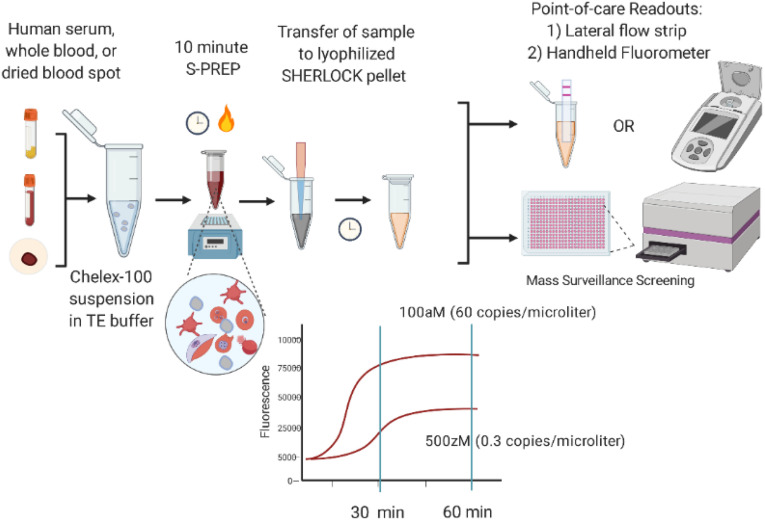
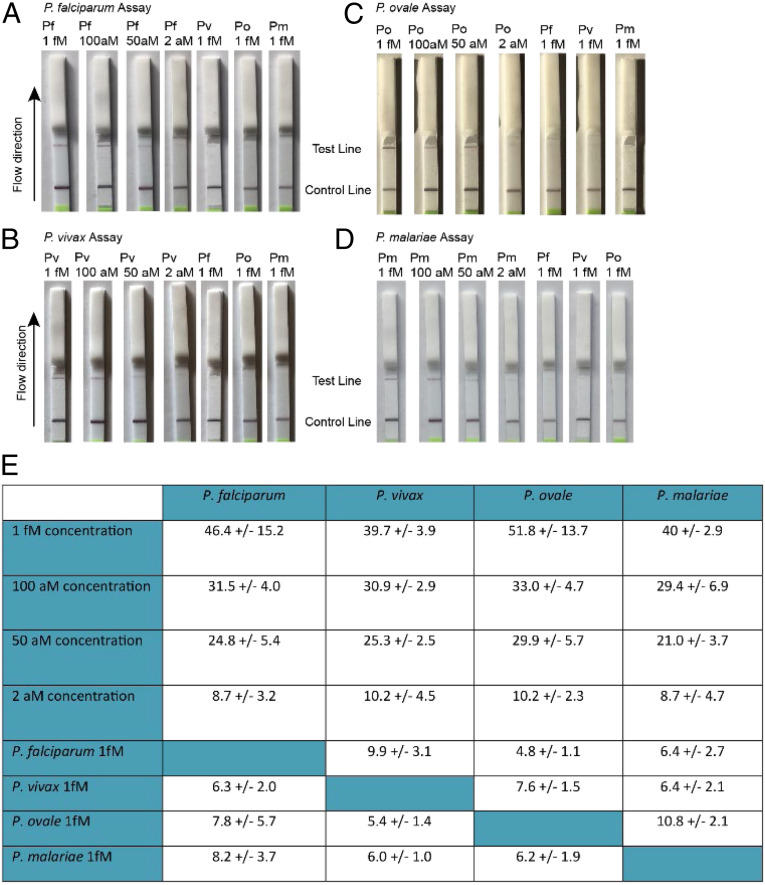
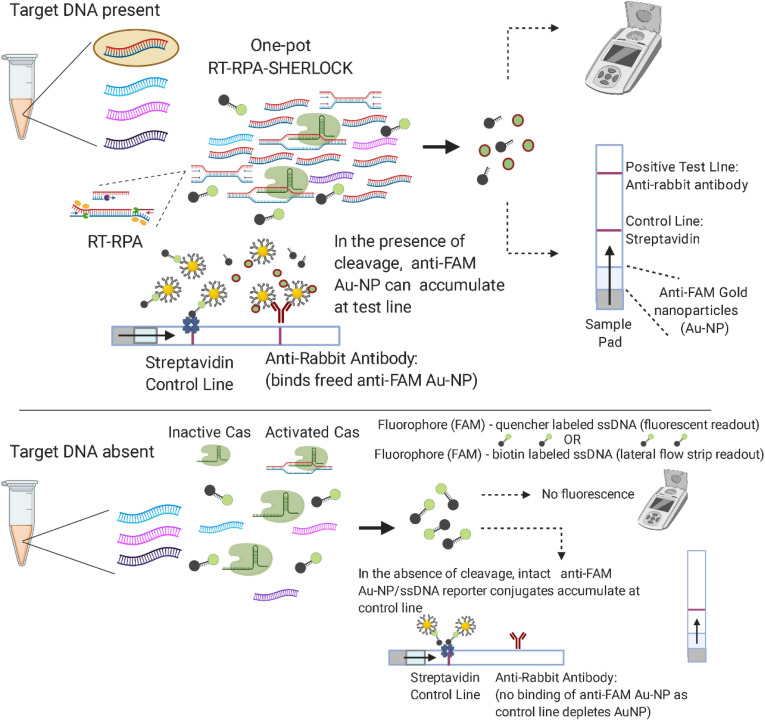
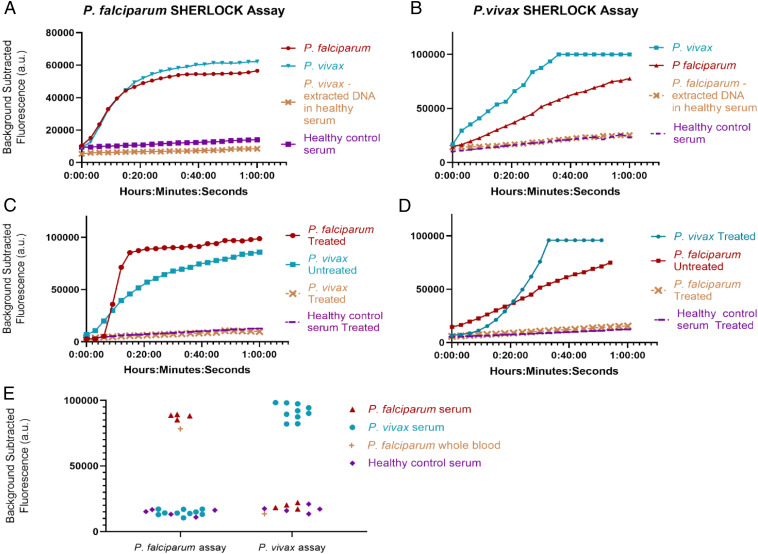
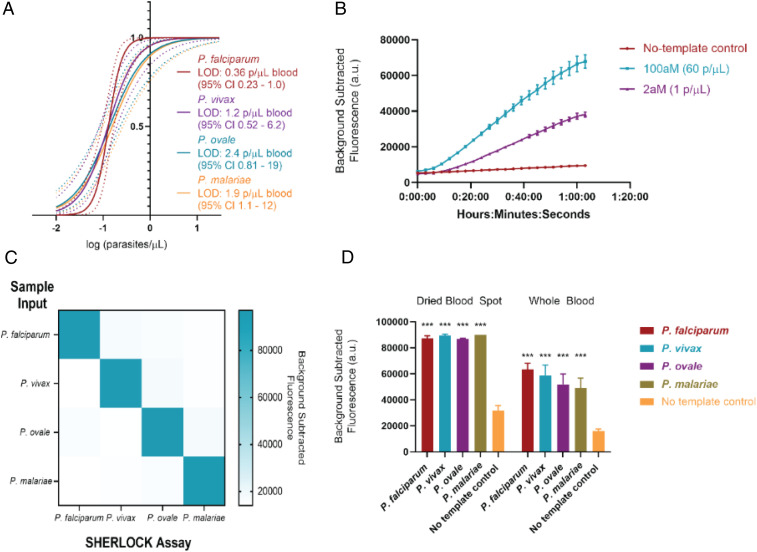
Asymptomatic carriers of parasites hamper malaria control and eradication. Achieving malaria eradication requires ultrasensitive diagnostics for low parasite density infections (<100 parasites per microliter blood) that work in resource-limited settings (RLS). Sensitive point-of-care diagnostics are also lacking for nonfalciparum malaria, which is characterized by lower density infections and may require additional therapy for radical cure. Molecular methods, such as PCR, have high sensitivity and specificity, but remain high-complexity technologies impractical for RLS. Here we describe a CRISPR-based diagnostic for ultrasensitive detection and differentiation of , , , and , using the nucleic acid detection platform SHERLOCK (specific high-sensitivity enzymatic reporter unlocking). We present a streamlined, field-applicable, diagnostic comprised of a 10-min SHERLOCK parasite rapid extraction protocol, followed by SHERLOCK for 60 min for species-specific detection via fluorescent or lateral flow strip readout. We optimized one-pot, lyophilized, isothermal assays with a simplified sample preparation method independent of nucleic acid extraction, and showed that these assays are capable of detection below two parasites per microliter blood, a limit of detection suggested by the World Health Organization. Our and assays exhibited 100% sensitivity and specificity on clinical samples (5 and 10 samples). This work establishes a field-applicable diagnostic for ultrasensitive detection of asymptomatic carriers as well as a rapid point-of-care clinical diagnostic for nonfalciparum malaria species and low parasite density infections.
寄生虫无症状携带者阻碍疟疾控制和消灭。实现疟疾消除需要超灵敏诊断,以检测资源有限环境(RLS)中低寄生虫密度感染(<100 个寄生虫/微升血液)。对于非恶性疟原虫疟疾也缺乏敏感的即时检测诊断方法,其特点是感染密度较低,可能需要额外的根治性治疗。分子方法,如 PCR,具有高灵敏度和特异性,但仍然是高复杂性技术,不适用于 RLS。在这里,我们描述了一种基于 CRISPR 的诊断方法,用于超灵敏检测和区分 、 、 、 和 ,使用核酸检测平台 SHERLOCK(特异性高灵敏度酶报告解锁)。我们提出了一种简化的、适用于现场的诊断方法,包括 10 分钟的 SHERLOCK 寄生虫快速提取方案,然后是 60 分钟的 SHERLOCK 进行物种特异性检测,通过荧光或侧流条带读取进行检测。我们优化了一种一锅、冻干、等温测定方法,具有简化的样本制备方法,不依赖核酸提取,并表明这些测定方法能够检测到每微升血液低于两个寄生虫,这是世界卫生组织建议的检测下限。我们的 和 检测方法在临床样本上表现出 100%的灵敏度和特异性(5 个和 10 个样本)。这项工作建立了一种适用于现场的超灵敏无症状携带者检测诊断方法,以及一种用于非恶性疟原虫疟疾和低寄生虫密度感染的快速即时护理临床诊断方法。