Division of Cardiology, Xiamen Cardiovascular Hospital, Xiamen University, Xiamen, Fujian, China.
Division of Echocardiography, Xiamen Cardiovascular Hospital, Xiamen University, Xiamen, Fujian, China.
Clin Cardiol. 2020 Dec;43(12):1460-1468. doi: 10.1002/clc.23462. Epub 2020 Sep 22.
Left bundle branch pacing (LBBP) has been suggested as an alternative means to deliver cardiac resynchronization therapy (CRT).
LBBP may deliver resynchronization therapy along with an advantage over traditional biventricular (BiV) pacing in clinical outcomes.
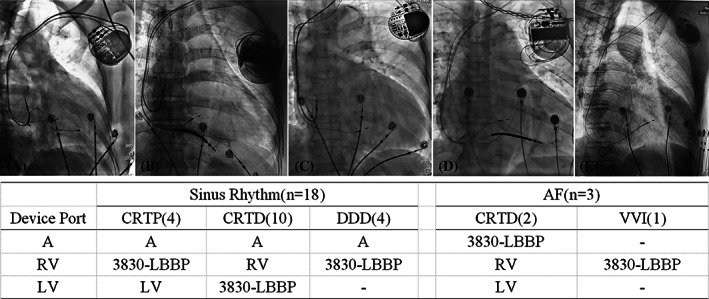
Heart failure patients who presented LBBB morphology according to Strauss's criteria and received successful CRT procedure were enrolled in the present study. Propensity score matching was applied to match patients into LBBP-CRT group and BiV-CRT group. Then, the electrographic data, the echocardiographic data and New York heart association (NYHA) class were compared between the groups.
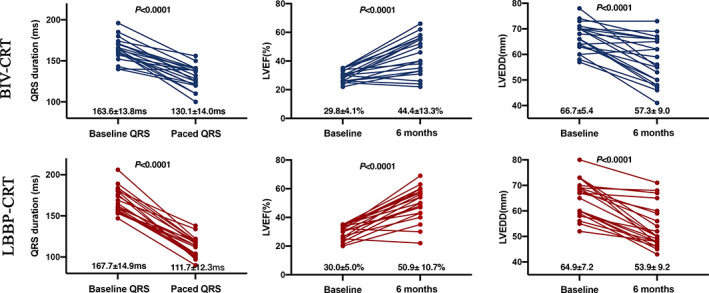
Twenty-one patients with successful LBBP procedure and another 21 matched patients with successful BiV-CRT procedure were finally enrolled in the study. The QRS duration (QRSd) was narrowed from 167.7 ± 14.9 ms to 111.7 ± 12.3 ms (P < .0001) in the LBBP-CRT group and from 163.6 ± 13.8 ms to 130.1 ± 14.0 ms (P < .0001) in the BiV-CRT group. A trend toward better left ventricular ejection fraction (LVEF) was recorded in the LBBP-CRT group (50.9 ± 10.7% vs 44.4 ± 13.3%, P = .12) compared to that in the BiV-CRT group at the 6-month follow-up. A trend toward better echocardiographic response was documented in patients receiving LBBP-CRT procedure (90.5% vs 80.9%, P = .43) and more super CRT response was documented in the LBBP-CRT group (80.9% vs 57.1%, P = .09) compared to that in the BiV-CRT group.
LBBP-CRT can dramatically improve the electrical synchrony in heart failure patients with LBBB. Meanwhile, compared with the traditional BiV-CRT, it has a tendency to significantly improve LVEF and enhance the NYHA cardiac function scores.
左束支起搏(LBBP)已被提议作为提供心脏再同步治疗(CRT)的替代方法。
LBBP 可以提供与传统双心室(BiV)起搏相比具有优势的再同步治疗。
根据施特劳斯标准呈现 LBBB 形态并接受成功 CRT 程序的心力衰竭患者被纳入本研究。应用倾向评分匹配将患者匹配到 LBBP-CRT 组和 BiV-CRT 组。然后比较两组的心电图数据、超声心动图数据和纽约心脏协会(NYHA)分级。
成功完成 LBBP 程序的 21 例患者和成功完成 BiV-CRT 程序的另外 21 例匹配患者最终被纳入研究。LBBP-CRT 组的 QRS 时限(QRSd)从 167.7±14.9ms 缩短至 111.7±12.3ms(P<0.0001),BiV-CRT 组从 163.6±13.8ms 缩短至 130.1±14.0ms(P<0.0001)。与 BiV-CRT 组相比,LBBP-CRT 组的左心室射血分数(LVEF)有改善趋势(50.9±10.7%比 44.4±13.3%,P=0.12)。与 BiV-CRT 组相比,接受 LBBP-CRT 治疗的患者超声心动图反应更好(90.5%比 80.9%,P=0.43),并且 LBBP-CRT 组的超级 CRT 反应更好(80.9%比 57.1%,P=0.09)。
LBBP-CRT 可显著改善 LBBB 心力衰竭患者的电同步性。同时,与传统的 BiV-CRT 相比,它有明显改善 LVEF 和增强 NYHA 心功能评分的趋势。