Department of Radiology, Hospital del Mar, Passeig Maritim 23-25, 08003, Barcelona, Spain.
Department of Radiology, Hospital Germans Trias i Pujol, Carretera de Canyet S/N, 08916, Badalona, Spain.
Eur Radiol. 2021 Apr;31(4):1915-1922. doi: 10.1007/s00330-020-07300-y. Epub 2020 Sep 22.
To describe imaging and laboratory findings of confirmed PE diagnosed in COVID-19 patients and to evaluate the characteristics of COVID-19 patients with clinical PE suspicion. Characteristics of patients with COVID-19 and PE suspicion who required admission to the intensive care unit (ICU) were also analysed.
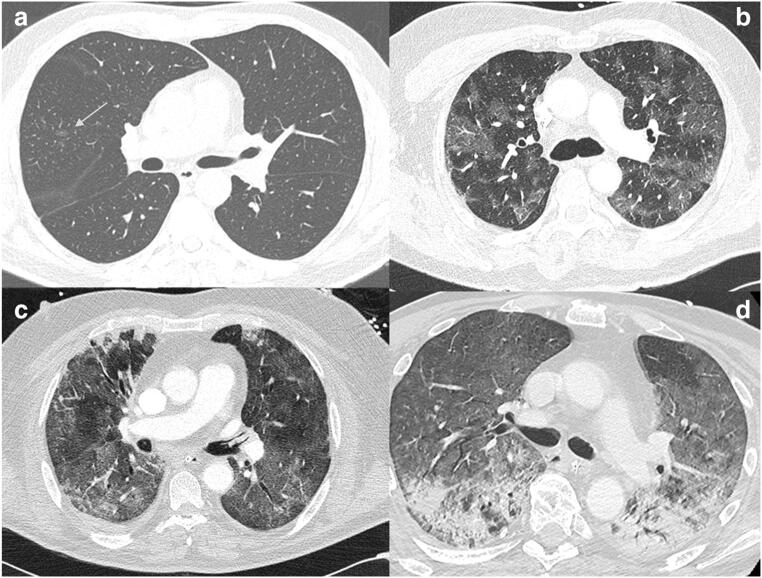
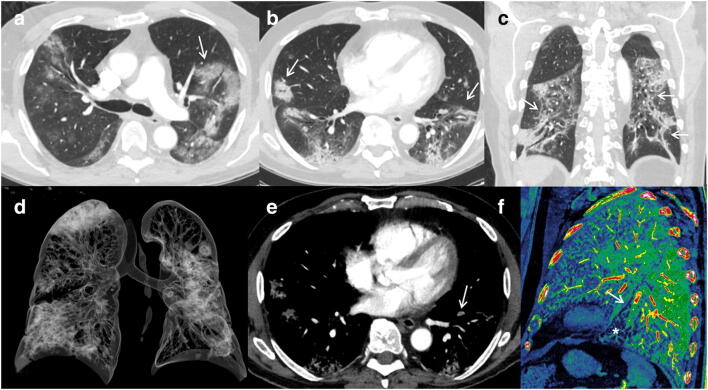
A retrospective study from March 18, 2020, until April 11, 2020. Inclusion criteria were patients with suspected PE and positive real-time reverse-transcription polymerase chain reaction (RT-PCR) for SARS-CoV-2. Exclusion criteria were negative or inconclusive RT-PCR and other chest CT indications. CTPA features were evaluated and severity scores, presence, and localisation of PE were reported. D-dimer and IL-6 determinations, ICU admission, and previous antithrombotic treatment were registered.
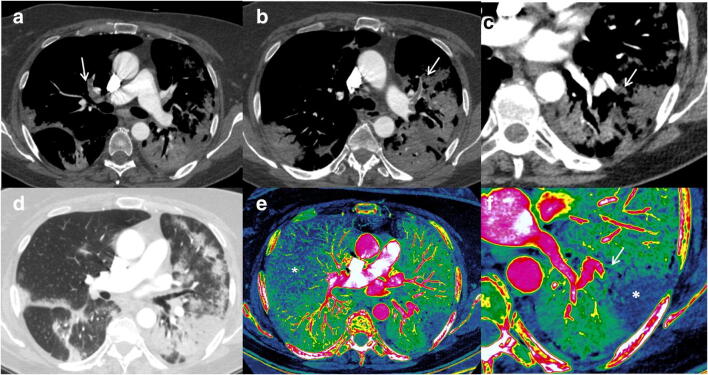
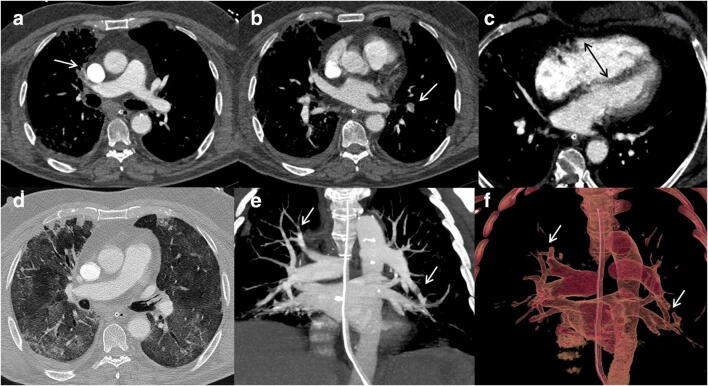
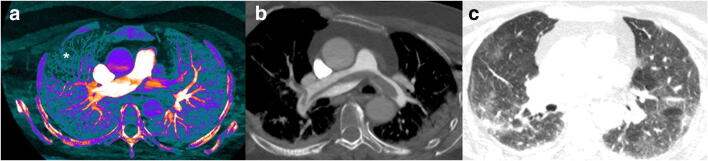
Forty-seven PE suspicions with confirmed COVID-19 underwent CTPA. Sixteen patients were diagnosed with PE with a predominant segmental distribution. Statistically significant differences were found in the highest D-dimer determination in patients with PE and ICU admission regarding elevated IL-6 values.
PE in COVID-19 patients in our series might predominantly affect segmental arteries and the right lung. Results suggest that the higher the D-dimer concentration, the greater the likelihood of PE. Both assumptions should be assessed in future studies with a larger sample size.
• On CT pulmonary angiography, pulmonary embolism in COVID-19 patients seems to be predominantly distributed in segmental arteries of the right lung, an assumption that needs to be approached in future research. • Only the highest intraindividual determination of d-dimer from admission to CT scan seems to differentiate patients with pulmonary embolism from patients with a negative CTPA. However, interindividual variability calls for future studies to establish cut-off values in COVID-19 patients. • Further studies with larger sample sizes are needed to determine whether the presence of PE could increase the risk of intensive care unit (ICU) admission in COVID-19 patients.
描述 COVID-19 患者中确诊的肺栓塞(PE)的影像学和实验室检查结果,并评估有临床 PE 疑似的 COVID-19 患者的特征。还分析了需要入住重症监护病房(ICU)的 COVID-19 患者和有 PE 疑似的患者的特征。
这是一项回顾性研究,时间为 2020 年 3 月 18 日至 2020 年 4 月 11 日。纳入标准为疑似 PE 且 SARS-CoV-2 实时逆转录聚合酶链反应(RT-PCR)阳性的患者。排除标准为 RT-PCR 阴性或不确定以及其他胸部 CT 指征。评估 CTPA 特征并报告 PE 的严重程度评分、存在和定位。登记 D-二聚体和 IL-6 测定值、入住 ICU 和以前的抗血栓治疗情况。
47 例疑似 PE 且 COVID-19 确诊的患者接受了 CTPA。16 例患者被诊断为 PE,主要分布为节段性。在 PE 患者和入住 ICU 的患者中,D-二聚体最高值存在统计学显著差异,IL-6 值升高。
在本系列研究中,COVID-19 患者中的 PE 可能主要影响段动脉和右肺。结果表明,D-二聚体浓度越高,发生 PE 的可能性越大。这些假设都需要在未来更大样本量的研究中进行评估。
在 CT 肺动脉造影中,COVID-19 患者中的肺栓塞似乎主要分布在右肺的段动脉,这一假设需要在未来的研究中进一步探讨。
只有从入院到 CT 扫描的 D-二聚体个体内最高测定值似乎可以区分有肺栓塞的患者和 CTPA 阴性的患者。然而,个体间的差异需要进一步的研究来确定 COVID-19 患者的截断值。
进一步的研究需要更大的样本量,以确定 PE 的存在是否会增加 COVID-19 患者入住 ICU 的风险。