Centre for Genomic Pathogen Surveillance, Wellcome Genome Campus, Hinxton, CB10 1SA Cambridge, United Kingdom;
Centre for Genomic Pathogen Surveillance, Wellcome Genome Campus, Hinxton, CB10 1SA Cambridge, United Kingdom.
Proc Natl Acad Sci U S A. 2020 Oct 6;117(40):25043-25054. doi: 10.1073/pnas.2003407117. Epub 2020 Sep 23.
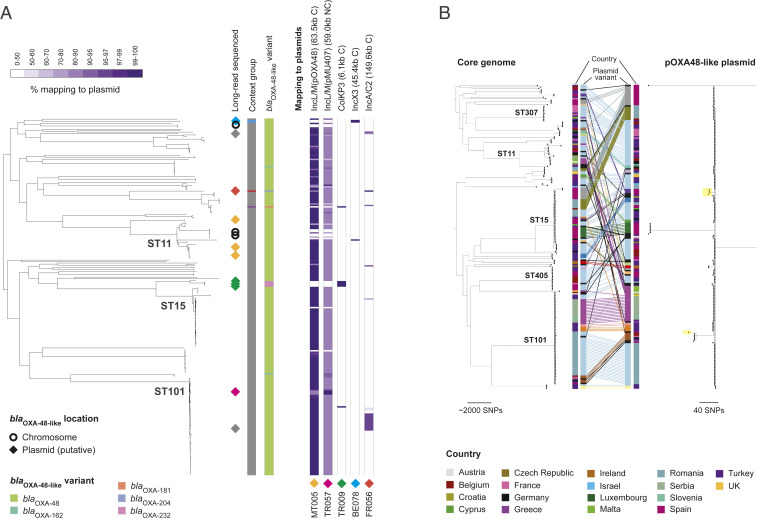
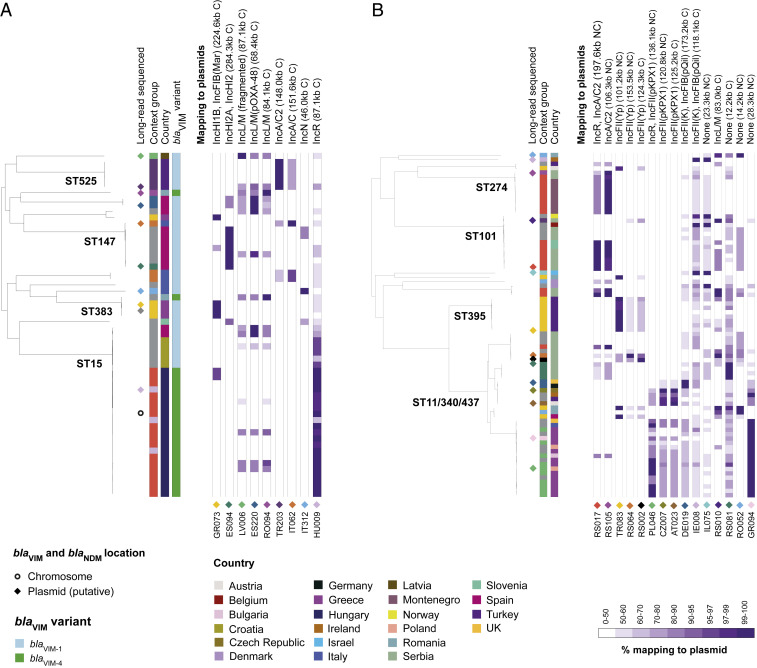
Molecular and genomic surveillance systems for bacterial pathogens currently rely on tracking clonally evolving lineages. By contrast, plasmids are usually excluded or analyzed with low-resolution techniques, despite being the primary vectors of antibiotic resistance genes across many key pathogens. Here, we used a combination of long- and short-read sequence data of isolates ( = 1,717) from a European survey to perform an integrated, continent-wide study of chromosomal and plasmid diversity. This revealed three contrasting modes of dissemination used by carbapenemase genes, which confer resistance to last-line carbapenems. First, genes have spread primarily via the single epidemic pOXA-48-like plasmid, which emerged recently in clinical settings and spread rapidly to numerous lineages. Second, and genes have spread via transient associations of many diverse plasmids with numerous lineages. Third, genes have transmitted predominantly by stable association with one successful clonal lineage (ST258/512) yet have been mobilized among diverse plasmids within this lineage. We show that these plasmids, which include pKpQIL-like and IncX3 plasmids, have a long association (and are coevolving) with the lineage, although frequent recombination and rearrangement events between them have led to a complex array of mosaic plasmids carrying Taken altogether, these results reveal the diverse trajectories of antibiotic resistance genes in clinical settings, summarized as using one plasmid/multiple lineages, multiple plasmids/multiple lineages, and multiple plasmids/one lineage. Our study provides a framework for the much needed incorporation of plasmid data into genomic surveillance systems, an essential step toward a more comprehensive understanding of resistance spread.
目前,用于细菌病原体的分子和基因组监测系统依赖于跟踪克隆进化谱系。相比之下,尽管质粒是许多关键病原体中抗生素耐药基因的主要载体,但通常会被排除或使用低分辨率技术进行分析。在这里,我们使用来自欧洲调查的 株(= 1,717)的长读和短读序列数据的组合,对染色体和质粒多样性进行了一次综合的、全大陆范围的研究。这揭示了三种不同的碳青霉烯酶基因传播模式,这些基因赋予了对最后一线碳青霉烯类药物的耐药性。首先, 基因主要通过单一流行的 pOXA-48 样质粒传播,该质粒最近在临床环境中出现并迅速传播到许多谱系。其次, 和 基因通过许多不同质粒与许多谱系的短暂关联传播。第三, 基因主要通过与一个成功的克隆谱系(ST258/512)的稳定关联传播,但在该谱系内已被动员到不同的质粒中。我们表明,这些质粒包括 pKpQIL 样和 IncX3 质粒,与谱系有着长期的关联(并且正在共同进化),尽管它们之间频繁的重组和重排事件导致了携带 的复杂马赛克质粒。总的来说,这些结果揭示了临床环境中抗生素耐药基因的不同轨迹,概括为一种质粒/多种谱系、多种质粒/多种谱系和多种质粒/一种谱系。我们的研究为将质粒数据纳入基因组监测系统提供了一个框架,这是更全面了解耐药性传播的必要步骤。