N Amirrah Ibrahim, Mohd Razip Wee Mohd Farhanulhakim, Tabata Yasuhiko, Bt Hj Idrus Ruszymah, Nordin Abid, Fauzi Mh Busra
Centre for Tissue Engineering and Regenerative Medicine, UKM Medical Centre, Jalan Yaacob Latiff, Bandar Tun Razak, Cheras, Kuala Lumpur 56000, Malaysia.
Institute of Microengineering and Nanoelectronics, Universiti Kebangsaan Malaysia, Bangi 43600, Selangor, Malaysia.
Polymers (Basel). 2020 Sep 22;12(9):2168. doi: 10.3390/polym12092168.
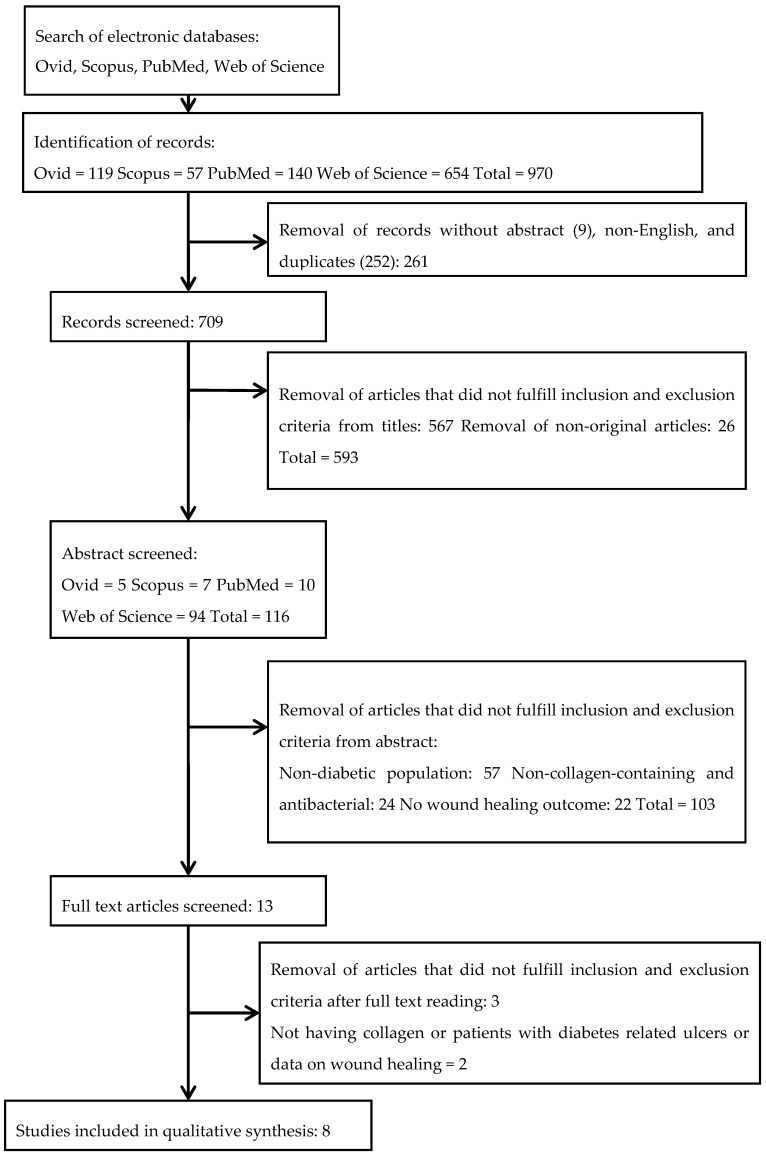
Diabetic foot ulcer (DFU) is a chronic wound frequently delayed from severe infection. Wound dressing provides an essential barrier between the ulcer and the external environment. This review aimed to analyse the effectiveness of antibacterial collagen-based dressing for DFU treatment in a clinical setting. An electronic search in four databases, namely, Scopus, PubMed, Ovid MEDLINE(R), and ISI Web of Science, was performed to obtain relevant articles published within the last ten years. The published studies were included if they reported evidence of (1) collagen-based antibacterial dressing or (2) wound healing for diabetic ulcers, and (3) were written in English. Both randomised and non-randomised clinical trials were included. The search for relevant clinical studies () identified eight related references discussing the effectiveness of collagen-based antibacterial wound dressings for DFU comprising collagen impregnated with polyhexamethylene biguanide ( = 2), gentamicin ( = 3), combined-cellulose and silver ( = 1), gentian violet/methylene blue mixed ( = 1), and silver ( = 1). The clinical data were limited by small sample sizes and multiple aetiologies of chronic wounds. The evidence was not robust enough for a conclusive statement, although most of the studies reported positive outcomes for the use of collagen dressings loaded with antibacterial properties for DFU wound healing. This study emphasises the importance of having standardised clinical trials, larger sample sizes, and accurate reporting for reliable statistical evidence confirming DFU treatment efficiency.
糖尿病足溃疡(DFU)是一种常因严重感染而延迟愈合的慢性伤口。伤口敷料在溃疡与外部环境之间提供了一道重要屏障。本综述旨在分析基于胶原蛋白的抗菌敷料在临床环境中治疗DFU的有效性。在四个数据库,即Scopus、PubMed、Ovid MEDLINE(R)和ISI Web of Science中进行了电子检索,以获取过去十年内发表的相关文章。如果已发表的研究报告了以下证据,则将其纳入:(1)基于胶原蛋白的抗菌敷料;(2)糖尿病溃疡的伤口愈合情况;(3)文章为英文撰写。随机和非随机临床试验均被纳入。对相关临床研究的检索共识别出八篇相关参考文献,讨论了基于胶原蛋白的抗菌伤口敷料对DFU的有效性,其中包括浸渍聚六亚甲基双胍的胶原蛋白(n = 2)、庆大霉素(n = 3)、纤维素与银的组合(n = 1)、龙胆紫/亚甲蓝混合物(n = 1)以及银(n = 1)。临床数据受限于样本量小和慢性伤口的多种病因。尽管大多数研究报告了使用具有抗菌特性的胶原蛋白敷料促进DFU伤口愈合的积极结果,但证据不足以得出确凿结论。本研究强调了进行标准化临床试验、扩大样本量以及准确报告以获得确认DFU治疗效果的可靠统计证据的重要性。