Ryoo Eell
Department of Pediatrics, Gachon University Gil Medical Center, Incheon, Korea.
Clin Exp Pediatr. 2021 Jun;64(6):260-268. doi: 10.3345/cep.2020.01256. Epub 2020 Sep 18.
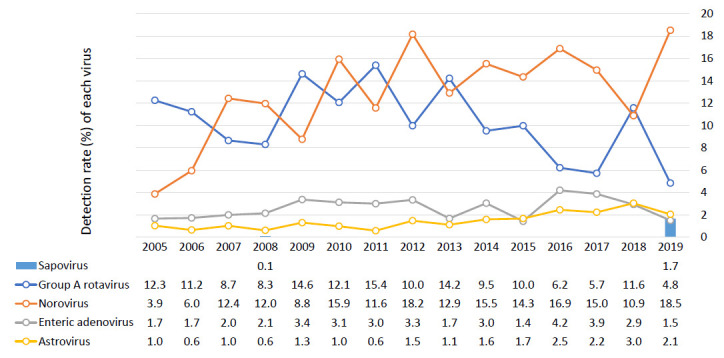
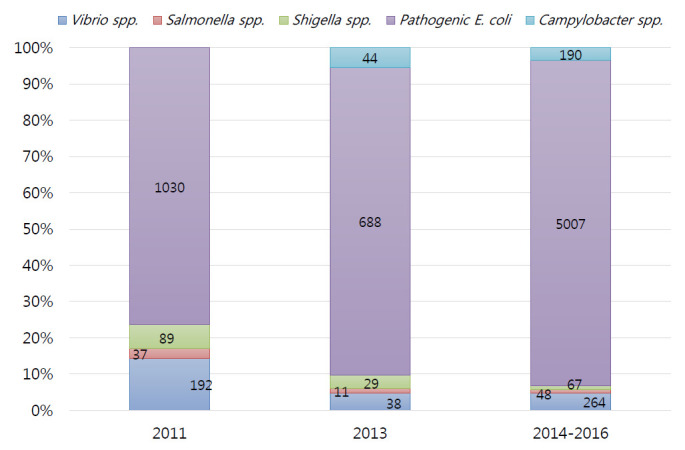
Since the 2000s, the major causes of acute gastroenteritis in children in Korea have been identified by classifying the pathogens into viruses, bacteria, and protozoa. For viruses, the detection rate is 20%-30%, and norovirus is being increasingly detected to account for the majority of viral gastroenteritis cases. In addition, despite the dissemination of the rotavirus vaccine, many rotavirus infections persist, and its seasonal distribution is changing. The detection rate of bacterial pathogens is 3%- 20%, with Escherichia coli and Salmonella spp. infections being the most common, while the incidences of Bacillus cereus and Campylobacter spp. infections are gradually increasing. Owing to intermittent outbreaks of gastroenteritis caused by individual bacteria as well as the inflow of causative bacteria, such as E. coli, Vibrio spp., and Campylobacter spp., from overseas, continuous surveillance of and research into the characteristics and serotypes of each bacterium are needed.
自21世纪以来,韩国通过将病原体分为病毒、细菌和原生动物,确定了儿童急性肠胃炎的主要病因。对于病毒,检出率为20%-30%,诺如病毒的检出率越来越高,占病毒性肠胃炎病例的大多数。此外,尽管轮状病毒疫苗已广泛接种,但仍有许多轮状病毒感染病例,其季节性分布也在发生变化。细菌性病原体的检出率为3%-20%,其中大肠杆菌和沙门氏菌感染最为常见,而蜡样芽孢杆菌和弯曲杆菌感染的发生率正在逐渐上升。由于个别细菌引起的肠胃炎间歇性爆发以及诸如大肠杆菌、弧菌和弯曲杆菌等致病细菌从海外流入,因此需要对每种细菌的特征和血清型进行持续监测和研究。