Criado-Gonzalez Miryam, Iqbal Muhammad Haseeb, Carvalho Alain, Schmutz Marc, Jierry Loïc, Schaaf Pierre, Boulmedais Fouzia
Université de Strasbourg, CNRS, Institut Charles Sadron UPR 22, Strasbourg, France.
Institut National de la Santé et de la Recherche Médicale, UMR-S 1121, "Biomatériaux et Bioingénierie", Strasbourg, France.
Front Bioeng Biotechnol. 2020 Aug 7;8:938. doi: 10.3389/fbioe.2020.00938. eCollection 2020.
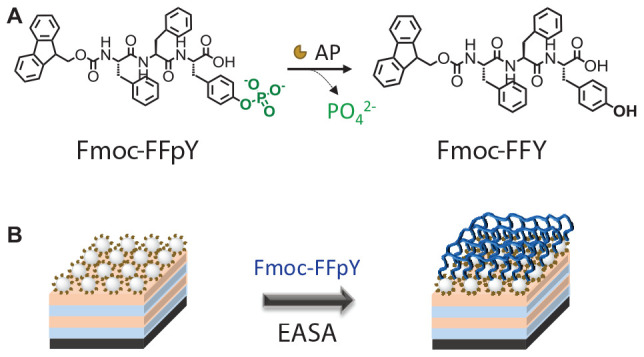
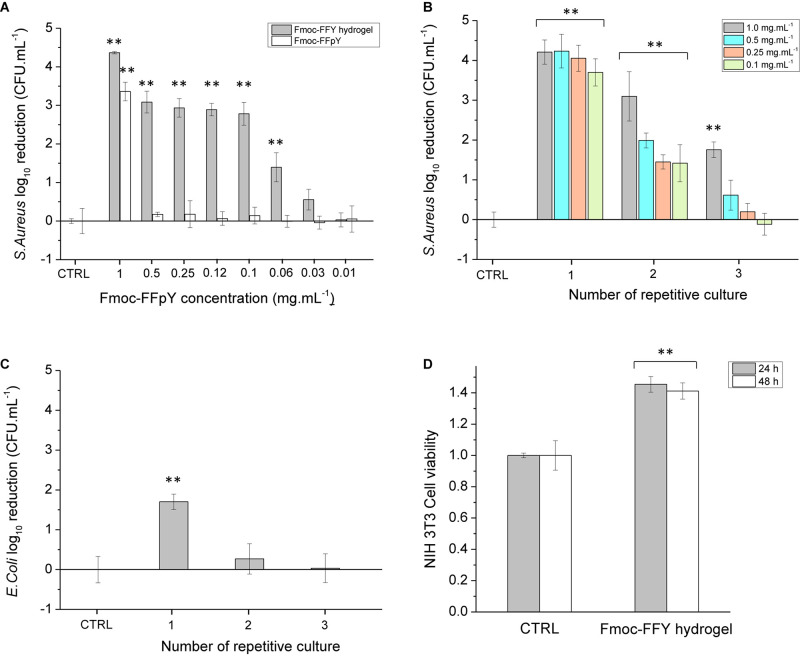
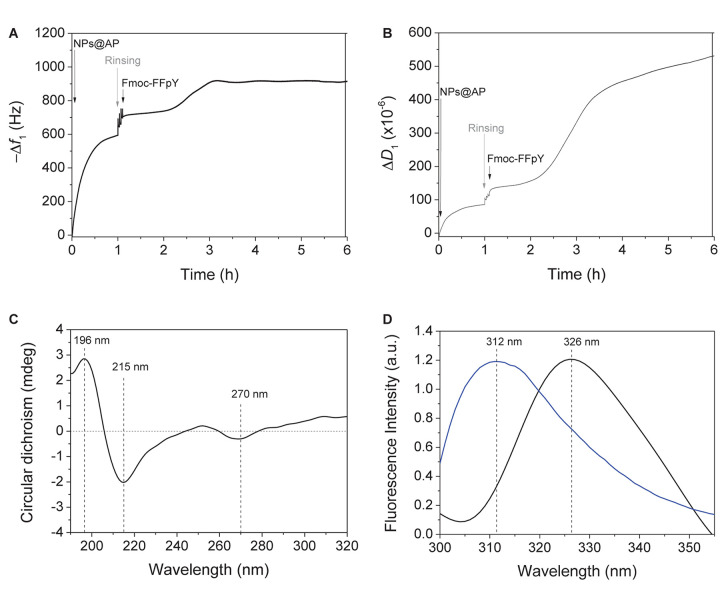
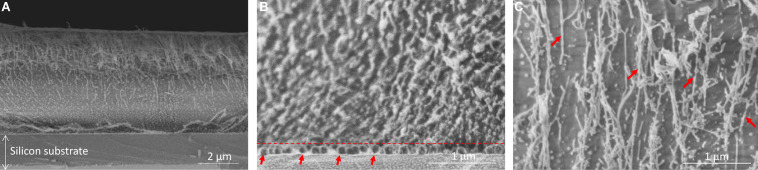
In western countries, one patient on twenty will develop a nosocomial infection during his hospitalization at health care facilities. Classical antibiotics being less and less effective, this phenomenon is expanding year after year. Prevention of bacteria colonization of implantable medical devices constitutes a major medical and financial issue. In this study, we developed an antibacterial coating based on self-assembled Fmoc-tripeptide. Fmoc-FFpY peptides (F: phenylalanine; Y: tyrosine; p: PO ) are dephosphorylated enzymatically into Fmoc-FFY by action of alkaline phosphatase functionalized silica nanoparticles (NPs@AP), previously deposited on a surface. Fmoc-FFY peptides then self-assemble through π-π stacking interactions, hydrogen bonds and hydrophobic interactions adopting β-sheets secondary structures. The obtained hydrogel coatings show fibrillary structures observed by cryo-scanning electron microscopy with a thickness of few micrometers. At low concentration (≤0.5 mg.mL), self-assembled Fmoc-FFY has a superior antibacterial activity than Fmoc-FFpY peptide in solution. After 24 h of incubation, Fmoc-FFY hydrogel coatings fully inhibit the development of Gram-positive . The antibacterial effect is maintained on an model of repetitive infection in the case of . This coating could serve in infections were Gram positive bacteria are prevalent, e.g., intravascular catheter infections. This work gives new insights toward the design of an alternative antimicrobial coating.
在西方国家,每二十名患者中就有一名在医疗机构住院期间会发生医院感染。由于传统抗生素的疗效越来越差,这种现象逐年扩大。预防可植入医疗器械的细菌定植是一个重大的医学和财务问题。在本研究中,我们开发了一种基于自组装芴甲氧羰基三肽的抗菌涂层。芴甲氧羰基-苯丙氨酸-苯丙氨酸-磷酸酪氨酸肽(F:苯丙氨酸;Y:酪氨酸;p:磷酸)在预先沉积在表面的碱性磷酸酶功能化二氧化硅纳米颗粒(NPs@AP)的作用下,通过酶促作用去磷酸化成为芴甲氧羰基-苯丙氨酸-苯丙氨酸-酪氨酸。然后,芴甲氧羰基-苯丙氨酸-苯丙氨酸-酪氨酸肽通过π-π堆积相互作用、氢键和疏水相互作用自组装,形成β-折叠二级结构。通过低温扫描电子显微镜观察,所得水凝胶涂层呈现出纤维状结构,厚度为几微米。在低浓度(≤0.5mg/mL)下,自组装的芴甲氧羰基-苯丙氨酸-苯丙氨酸-酪氨酸在溶液中的抗菌活性优于芴甲氧羰基-苯丙氨酸-苯丙氨酸-磷酸酪氨酸肽。孵育24小时后,芴甲氧羰基-苯丙氨酸-苯丙氨酸-酪氨酸水凝胶涂层完全抑制革兰氏阳性菌的生长。在重复感染模型中,对于……而言,抗菌效果得以维持。这种涂层可用于革兰氏阳性菌普遍存在的感染,例如血管内导管感染。这项工作为设计替代抗菌涂层提供了新的见解。