Wang Ke-Wei, Dong Ming
Department of Gastrointestinal Surgery, the First Affiliated Hospital of China Medical University, Shenyang 110001, Liaoning Province, China.
World J Gastroenterol. 2020 Sep 14;26(34):5090-5100. doi: 10.3748/wjg.v26.i34.5090.
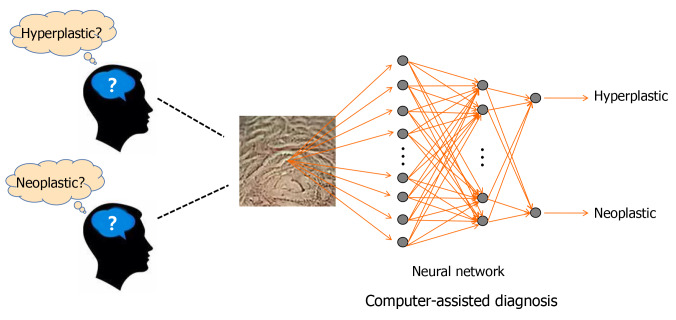
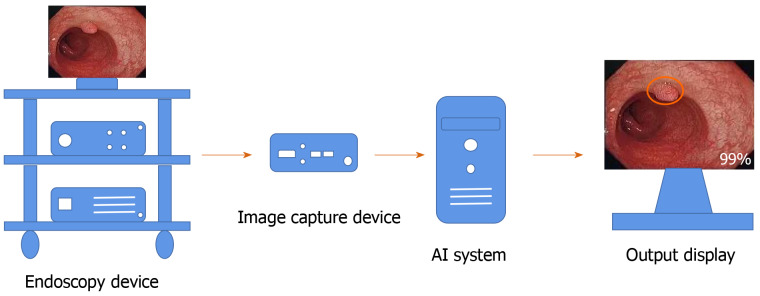
Since the advent of artificial intelligence (AI) technology, it has been constantly studied and has achieved rapid development. The AI assistant system is expected to improve the quality of automatic polyp detection and classification. It could also help prevent endoscopists from missing polyps and make an accurate optical diagnosis. These functions provided by AI could result in a higher adenoma detection rate and decrease the cost of polypectomy for hyperplastic polyps. In addition, AI has good performance in the staging, diagnosis, and segmentation of colorectal cancer. This article provides an overview of recent research focusing on the application of AI in colorectal polyps and cancer and highlights the advances achieved.
自人工智能(AI)技术出现以来,它一直在不断研究并取得了快速发展。人工智能辅助系统有望提高息肉自动检测和分类的质量。它还可以帮助内镜医师避免漏诊息肉并做出准确的光学诊断。人工智能提供的这些功能可以提高腺瘤检测率,并降低增生性息肉的息肉切除成本。此外,人工智能在结直肠癌的分期、诊断和分割方面表现良好。本文概述了近期关于人工智能在结直肠息肉和癌症中的应用的研究,并突出了所取得的进展。