Ma Han, Liu Zhong-Xin, Zhang Jing-Jing, Wu Feng-Tian, Xu Cheng-Fu, Shen Zhe, Yu Chao-Hui, Li You-Ming
Department of Gastroenterology, The First Affiliated Hospital, Zhejiang University School of Medicine, Hangzhou 310003, Zhejiang Province, China.
College of Computer Science and Technology, Zhejiang University, Hangzhou 310058, Zhejiang Province, China.
World J Gastroenterol. 2020 Sep 14;26(34):5156-5168. doi: 10.3748/wjg.v26.i34.5156.
Efforts should be made to develop a deep-learning diagnosis system to distinguish pancreatic cancer from benign tissue due to the high morbidity of pancreatic cancer.
To identify pancreatic cancer in computed tomography (CT) images automatically by constructing a convolutional neural network (CNN) classifier.
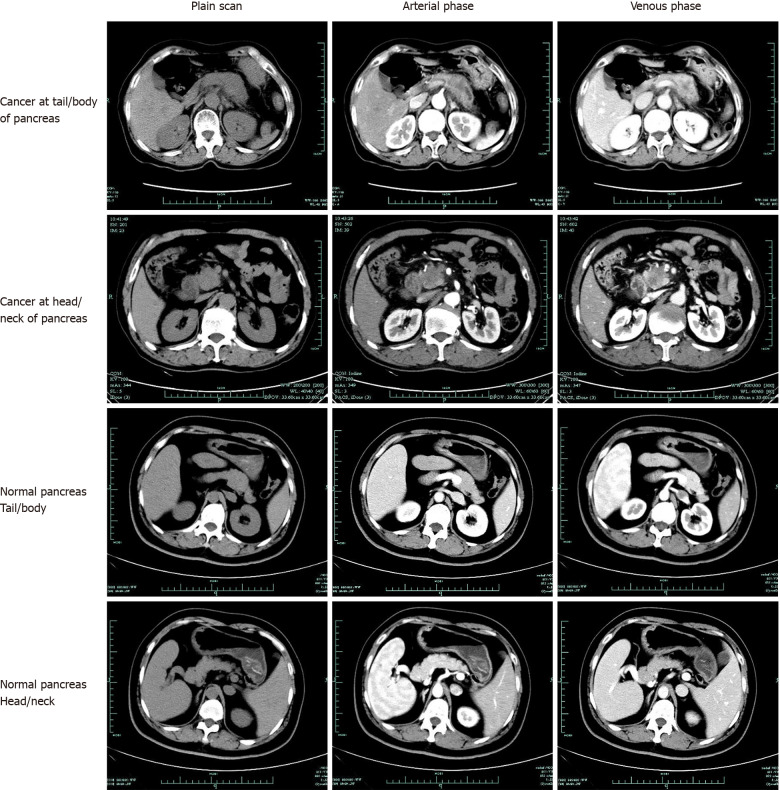
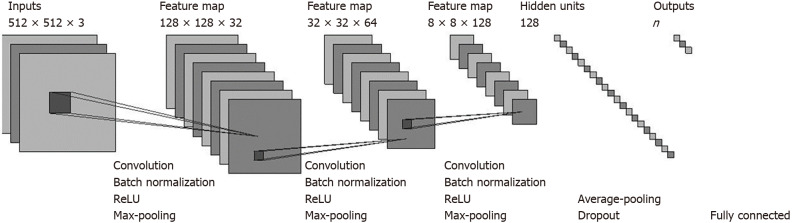
A CNN model was constructed using a dataset of 3494 CT images obtained from 222 patients with pathologically confirmed pancreatic cancer and 3751 CT images from 190 patients with normal pancreas from June 2017 to June 2018. We established three datasets from these images according to the image phases, evaluated the approach in terms of binary classification (., cancer or not) and ternary classification (., no cancer, cancer at tail/body, cancer at head/neck of the pancreas) using 10-fold cross validation, and measured the effectiveness of the model with regard to the accuracy, sensitivity, and specificity.
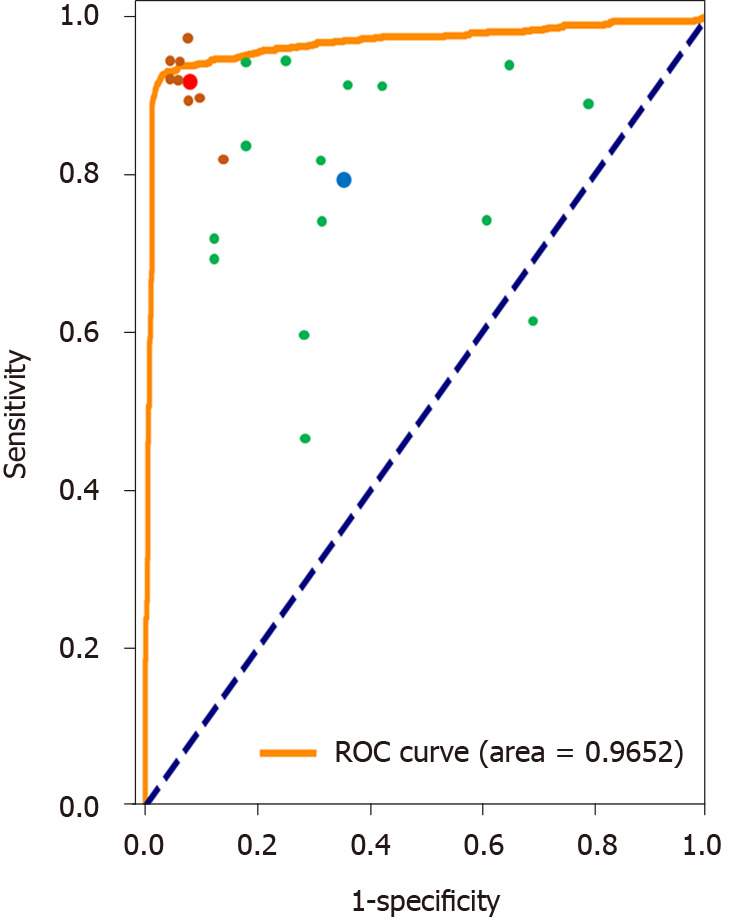
The overall diagnostic accuracy of the trained binary classifier was 95.47%, 95.76%, 95.15% on the plain scan, arterial phase, and venous phase, respectively. The sensitivity was 91.58%, 94.08%, 92.28% on three phases, with no significant differences ( = 0.914, = 0.633). Considering that the plain phase had same sensitivity, easier access, and lower radiation compared with arterial phase and venous phase , it is more sufficient for the binary classifier. Its accuracy on plain scans was 95.47%, sensitivity was 91.58%, and specificity was 98.27%. The CNN and board-certified gastroenterologists achieved higher accuracies than trainees on plain scan diagnosis ( = 21.534, < 0.001; = 9.524, < 0.05; respectively). However, the difference between CNN and gastroenterologists was not significant ( = 0.759, = 0.384). In the trained ternary classifier, the overall diagnostic accuracy of the ternary classifier CNN was 82.06%, 79.06%, and 78.80% on plain phase, arterial phase, and venous phase, respectively. The sensitivity scores for detecting cancers in the tail were 52.51%, 41.10% and, 36.03%, while sensitivity for cancers in the head was 46.21%, 85.24% and 72.87% on three phases, respectively. Difference in sensitivity for cancers in the head among the three phases was significant ( = 16.651, < 0.001), with arterial phase having the highest sensitivity.
We proposed a deep learning-based pancreatic cancer classifier trained on medium-sized datasets of CT images. It was suitable for screening purposes in pancreatic cancer detection.
由于胰腺癌发病率高,应努力开发一种深度学习诊断系统,以区分胰腺癌与良性组织。
通过构建卷积神经网络(CNN)分类器,自动在计算机断层扫描(CT)图像中识别胰腺癌。
使用2017年6月至2018年6月期间从222例经病理证实的胰腺癌患者获得的3494张CT图像数据集和190例正常胰腺患者的3751张CT图像构建CNN模型。我们根据图像阶段从这些图像中建立了三个数据集,使用10折交叉验证在二元分类(即癌症与否)和三元分类(即无癌症、胰腺尾部/体部癌症、胰腺头部/颈部癌症)方面评估该方法,并测量模型在准确性、敏感性和特异性方面的有效性。
训练后的二元分类器在平扫、动脉期和静脉期的总体诊断准确率分别为95.47%、95.76%、95.15%。在三个阶段的敏感性分别为91.58%、94.08%、92.28%,无显著差异(P = 0.914,P = 0.633)。考虑到平扫与动脉期和静脉期相比具有相同的敏感性、更容易获取且辐射更低,对于二元分类器来说更充分。其在平扫上的准确率为95.47%,敏感性为91.58%,特异性为98.27%。在平扫诊断方面,CNN和获得委员会认证的胃肠病学家的准确率高于实习医生(分别为P = 21.534,P < 0.001;P = 9.524,P < 0.05)。然而,CNN与胃肠病学家之间的差异不显著(P = 0.759,P = 0.384)。在训练后的三元分类器中,三元分类器CNN在平扫期、动脉期和静脉期的总体诊断准确率分别为82.06%、79.06%、78.80%。在三个阶段检测胰腺尾部癌症的敏感性分数分别为52.