Department of Applied Mathematics, University of Waterloo, Waterloo, Ontario, Canada ON N2L 3G1.
School of Environmental Sciences, University of Guelph, Guelph, Ontario, Canada ON N1G 2W1.
J R Soc Interface. 2020 Sep;17(170):20200482. doi: 10.1098/rsif.2020.0482. Epub 2020 Sep 30.
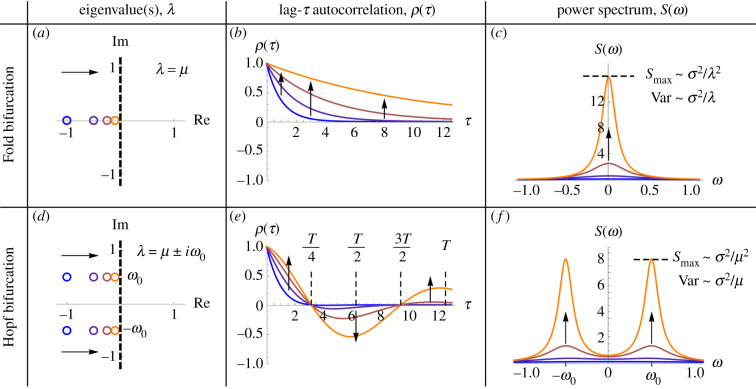
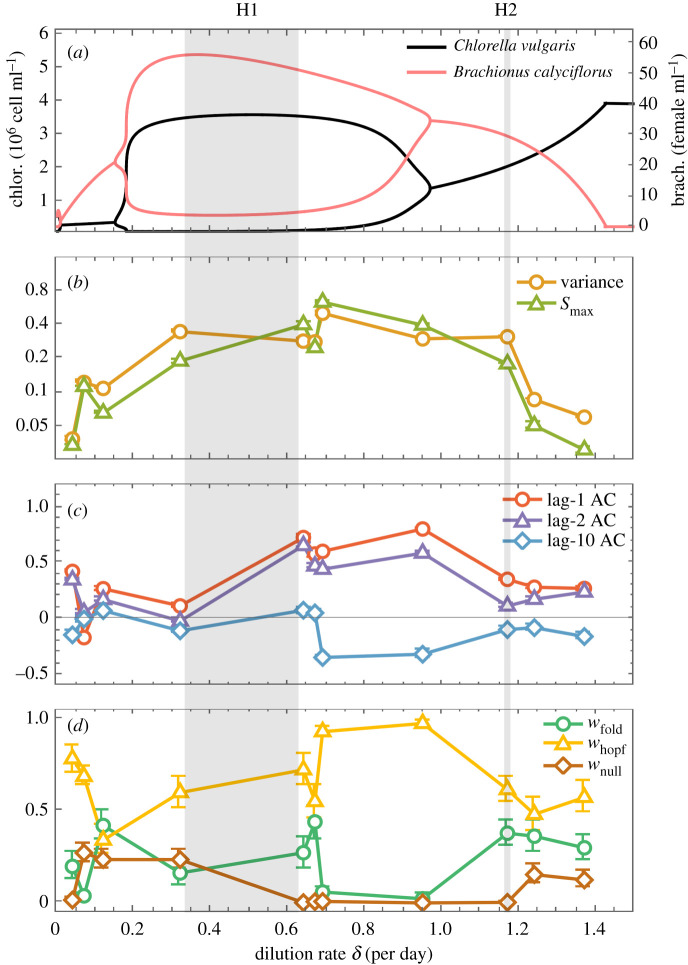
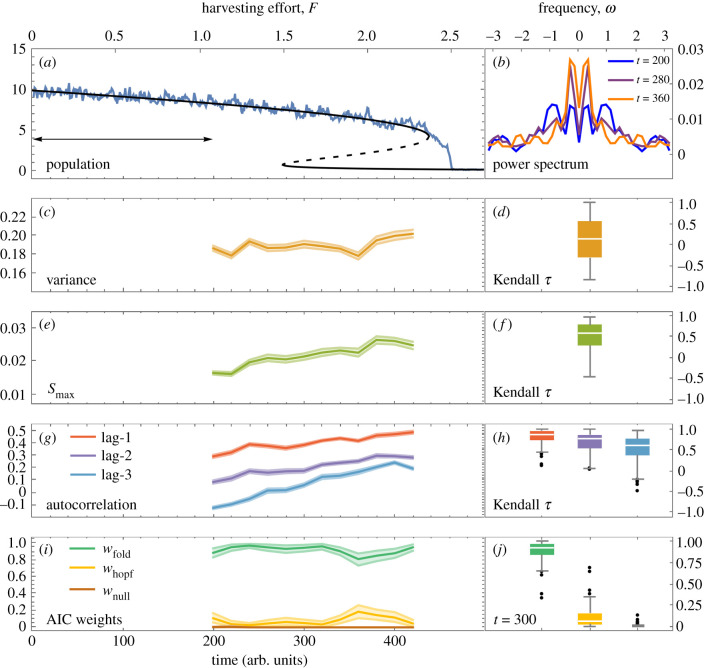
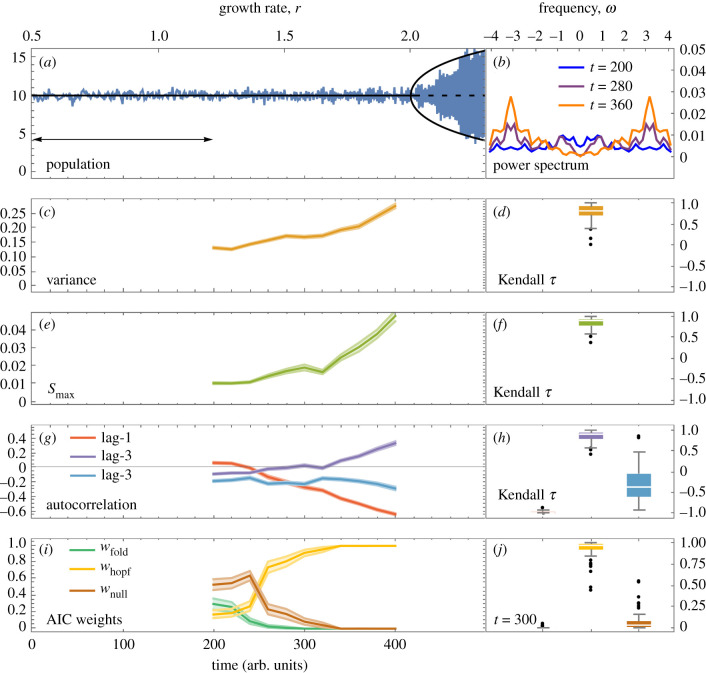
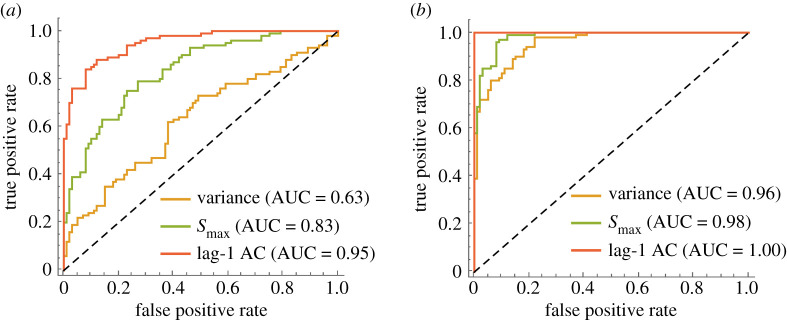
Theory and observation tell us that many complex systems exhibit tipping points-thresholds involving an abrupt and irreversible transition to a contrasting dynamical regime. Such events are commonly referred to as critical transitions. Current research seeks to develop early warning signals (EWS) of critical transitions that could help prevent undesirable events such as ecosystem collapse. However, conventional EWS do not indicate the type of transition, since they are based on the generic phenomena of critical slowing down. For instance, they may fail to distinguish the onset of oscillations (e.g. Hopf bifurcation) from a transition to a distant attractor (e.g. Fold bifurcation). Moreover, conventional EWS are less reliable in systems with density-dependent noise. Other EWS based on the power spectrum (spectral EWS) have been proposed, but they rely upon spectral reddening, which does not occur prior to critical transitions with an oscillatory component. Here, we use Ornstein-Uhlenbeck theory to derive analytic approximations for EWS prior to each type of local bifurcation, thereby creating new spectral EWS that provide greater sensitivity to transition proximity; higher robustness to density-dependent noise and bifurcation type; and clues to the type of approaching transition. We demonstrate the advantage of applying these spectral EWS in concert with conventional EWS using a population model, and show that they provide a characteristic signal prior to two different Hopf bifurcations in data from a predator-prey chemostat experiment. The ability to better infer and differentiate the nature of upcoming transitions in complex systems will help humanity manage critical transitions in the Anthropocene Era.
理论和观测告诉我们,许多复杂系统表现出临界点——涉及到突然且不可逆的向对比动态状态转变的阈值。这些事件通常被称为关键转变。当前的研究旨在开发关键转变的预警信号(EWS),以帮助防止生态系统崩溃等不良事件。然而,传统的 EWS 并没有指示转变的类型,因为它们基于临界减速的一般现象。例如,它们可能无法区分振荡的开始(例如,Hopf 分岔)与到遥远吸引子的转变(例如,折叠分岔)。此外,在具有密度依赖噪声的系统中,传统的 EWS 不太可靠。已经提出了基于功率谱的其他 EWS(谱 EWS),但它们依赖于谱变红,而在具有振荡分量的关键转变之前不会发生这种情况。在这里,我们使用 Ornstein-Uhlenbeck 理论来推导每种局部分岔之前的 EWS 的解析近似,从而创建新的谱 EWS,这些 EWS 提供了对转变接近程度更高的敏感性;对密度依赖噪声和分岔类型更高的鲁棒性;并为接近的转变类型提供线索。我们通过使用种群模型展示了应用这些谱 EWS 与传统 EWS 相结合的优势,并展示了它们在来自捕食者-猎物恒化器实验的数据中,在两个不同的 Hopf 分岔之前提供了特征信号。在复杂系统中更好地推断和区分即将到来的转变的性质的能力将有助于人类管理人类世时代的关键转变。