Division of Human Nutrition and Health, Wageningen University & Research (WUR), Stippeneng 4, 6708, WE, Wageningen, The Netherlands.
Department of Gastroenterology and Hepatology, Hospital Gelderse Vallei, Ede, The Netherlands.
BMC Gastroenterol. 2020 Sep 29;20(1):316. doi: 10.1186/s12876-020-01435-4.
Diet may play a role in disease status in patients with inflammatory bowel disease. We tested whether the inflammatory potential of diet, based on a summation of pro- and anti-inflammatory nutrients, is associated with disease activity in patients with Crohn's disease and ulcerative colitis.
Participants completed a disease activity questionnaire (short Crohn's Disease Activity (sCDAI) or Patient Simple Clinical Colitis Activity Index (P-SCCAI)) and a Food Frequency Questionnaire (FFQ). FFQ data were used to calculate the Dietary Inflammatory Index (DII) which enables categorization of individuals' diets according to their inflammatory potential on a continuum from pro- to anti-inflammatory. Associations with disease activity were investigated by multiple linear regression.
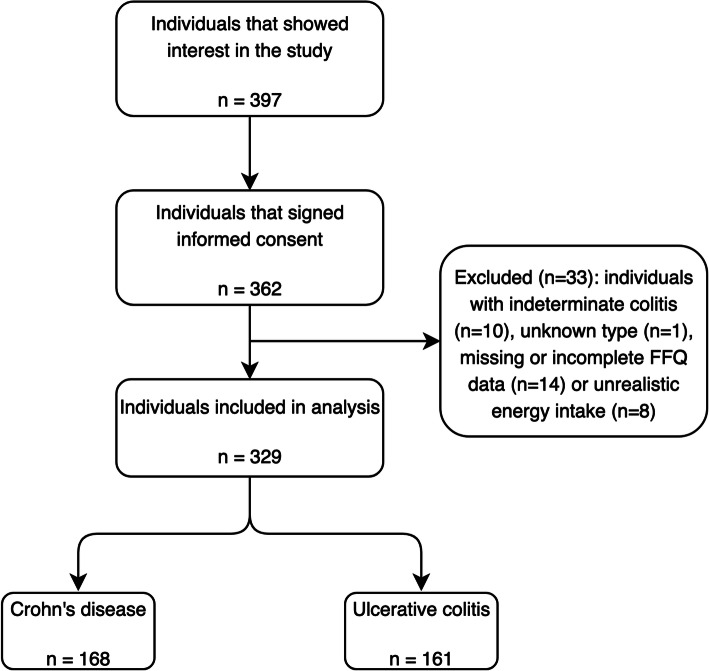
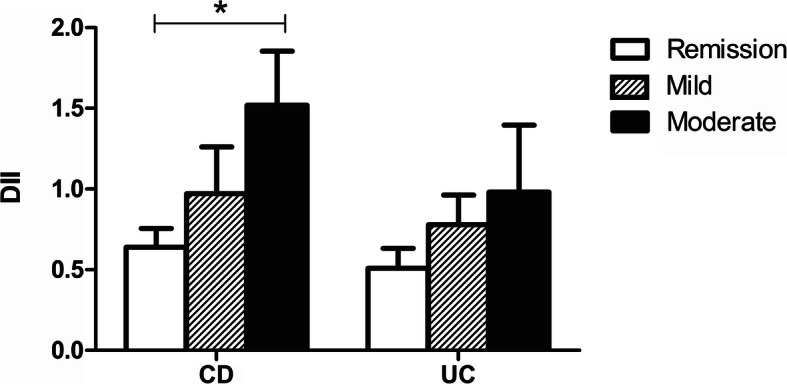
The analysis included 329 participants; 168 with Crohn's disease (median sCDAI score 93 [IQR 47-156]), and 161 with ulcerative colitis (median P-SCCAI score 1 [IQR 1-3]). Mean DII was 0.71 ± 1.33, suggesting a slightly pro-inflammatory diet. In Crohn's disease, the DII was positively associated with disease activity, even after adjustment for confounders (p = 0.008). The mean DII was significantly different between participants in remission and with mild and moderately active disease (0.64, 0.97 and 1.52 respectively, p = 0.027). In ulcerative colitis, the association was not significant.
Disease activity was higher in IBD participants with a more pro-inflammatory diet with statistical significance in Crohn's disease. Although the direction of causality is not clear, this association strengthens the role for diet in medical treatment, which should be tested in an intervention study.
饮食可能在炎症性肠病患者的疾病状况中起作用。我们测试了基于促炎和抗炎营养素总和的饮食炎症潜力是否与克罗恩病和溃疡性结肠炎患者的疾病活动相关。
参与者完成了疾病活动问卷(简短克罗恩病活动(sCDAI)或患者简单临床结肠炎活动指数(P-SCCAI))和食物频率问卷(FFQ)。FFQ 数据用于计算饮食炎症指数(DII),该指数可根据个体饮食的炎症潜力在从促炎到抗炎的连续体上对个体饮食进行分类。通过多元线性回归研究疾病活动的相关性。
该分析包括 329 名参与者;168 名患有克罗恩病(中位数 sCDAI 评分 93 [四分位距 47-156]),161 名患有溃疡性结肠炎(中位数 P-SCCAI 评分 1 [四分位距 1-3])。DII 的平均值为 0.71±1.33,表明饮食略呈促炎状态。在克罗恩病中,即使在调整混杂因素后,DII 与疾病活动呈正相关(p=0.008)。缓解期和轻度及中度活跃期患者的 DII 平均值差异有统计学意义(分别为 0.64、0.97 和 1.52,p=0.027)。在溃疡性结肠炎中,相关性不显著。
炎症性肠病患者的饮食炎症潜力较高,其疾病活动度也较高,在克罗恩病中具有统计学意义。尽管因果关系尚不清楚,但这种关联加强了饮食在医学治疗中的作用,这应在干预研究中进行测试。