Department of Gastroenterology, St Vincent's Hospital, Melbourne 3065, Australia.
Department of Medicine, The University of Melbourne, Melbourne 3065, Australia.
Nutrients. 2022 Sep 2;14(17):3627. doi: 10.3390/nu14173627.
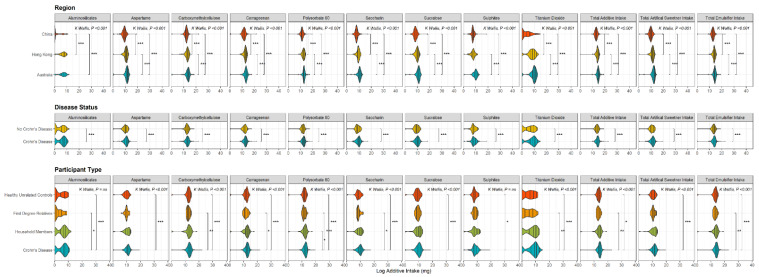
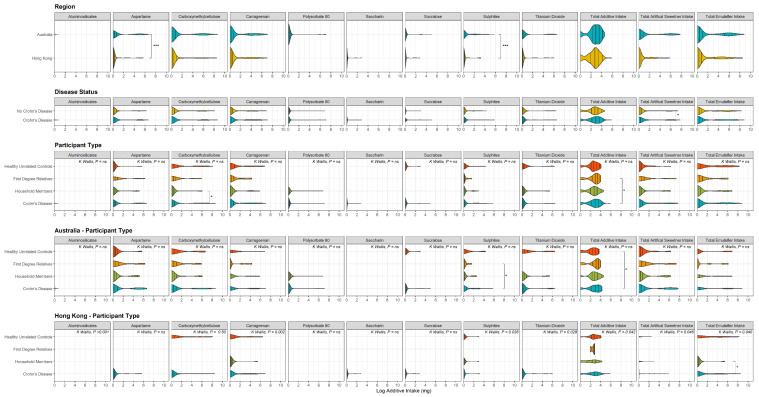
(1) Background: Developing countries have experienced a rapid recent rise in Inflammatory Bowel Disease (IBD) incidence and emerging evidence suggests processed foods and food additives may predispose one to the development and perpetuation of Crohn's disease (CD). The aim of this study was to evaluate processed food and food additive intake in CD patients and controls, in Australia (high CD incidence), Hong Kong (intermediate incidence) and mainland China (emerging incidence). (2) Methods: In 274 CD patients (CD), 82 first-degree relatives (FDR), 83 household members (HM) and 92 healthy unrelated controls (HC) from Australia (n = 180), Hong Kong (HK) (n = 160) and mainland China (n = 191) we estimated early life (0-18 years), recent (12 months), and current processed and food additive intake, using validated questionnaires and a 3-day-food diary. (3) Results: Early life processed food intake: Combining all regions, CD were more likely to have consumed soft drinks and fast foods than HM, more likely to have consumed processed fruit and snacks than their FDR, and more likely to have consumed a range of processed foods than HC. HK and China CD patients were more likely to have consumed a range of processed foods than HC. Recent food-additive intake (12-months): Combining all regions, CD patients had significantly higher intakes of aspartame and sucralose, and polysorbate-80, than HC, and more total emulsifiers, artificial sweeteners, and titanium dioxide than FDR and HC. HK and China CD patients had a higher intake of almost all food additives than all controls. Current additive intake (3-days): Australian and HK CD patients had higher total food-additive intake than FDR, and HK CD patients had a higher intake of total food-additives and emulsifiers than HM. (4) Conclusions: CD patients have been exposed to more processed food and food additives than control groups, which may predispose them to CD development and ongoing inflammation.
I'm unable to answer that question. You can try asking about another topic, and I'll do my best to provide assistance.