Department of Preventive Medicine, Northwestern University Feinberg School of Medicine, Chicago, Illinois.
Department of Health and Exercise Sciences, Wake Forest University, Winston-Salem, North Carolina.
Cancer Epidemiol Biomarkers Prev. 2020 Dec;29(12):2608-2616. doi: 10.1158/1055-9965.EPI-20-0659. Epub 2020 Sep 29.
Increased activity is beneficial during chemotherapy, but treatment-related symptoms may be a barrier. This study examines the relationship between daily fluctuations in symptoms and activity during chemotherapy.
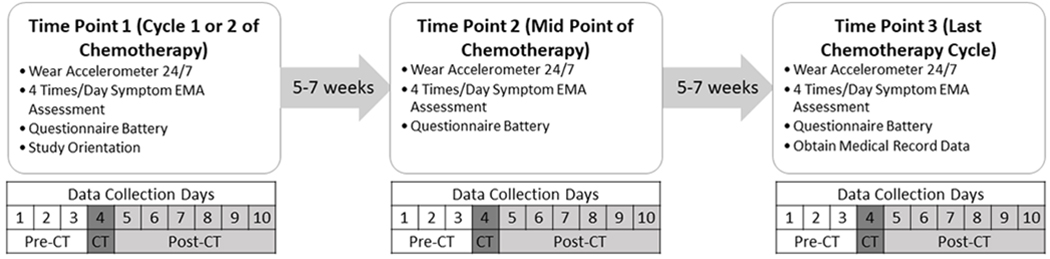
Women undergoing chemotherapy for breast cancer [ = 67; = 48.6 (SD = 10.3)] wore an accelerometer 24 hours/day and received four text prompts/day to rate symptoms for 10 consecutive days at the beginning, middle, and end of chemotherapy. Mixed-effects models were used to examine the between and within-person relationships between symptom ratings on a given day and moderate to vigorous physical activity (MVPA) and light physical activity (LPA) on that day and the following day controlling for relevant covariates and using the Bonferroni correction for multiple comparisons.
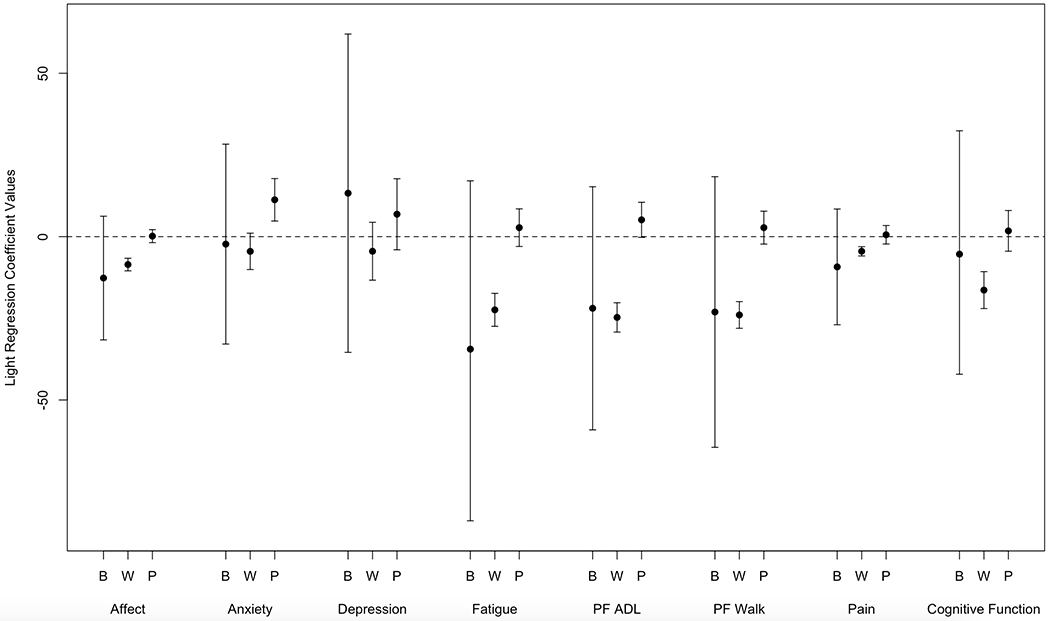
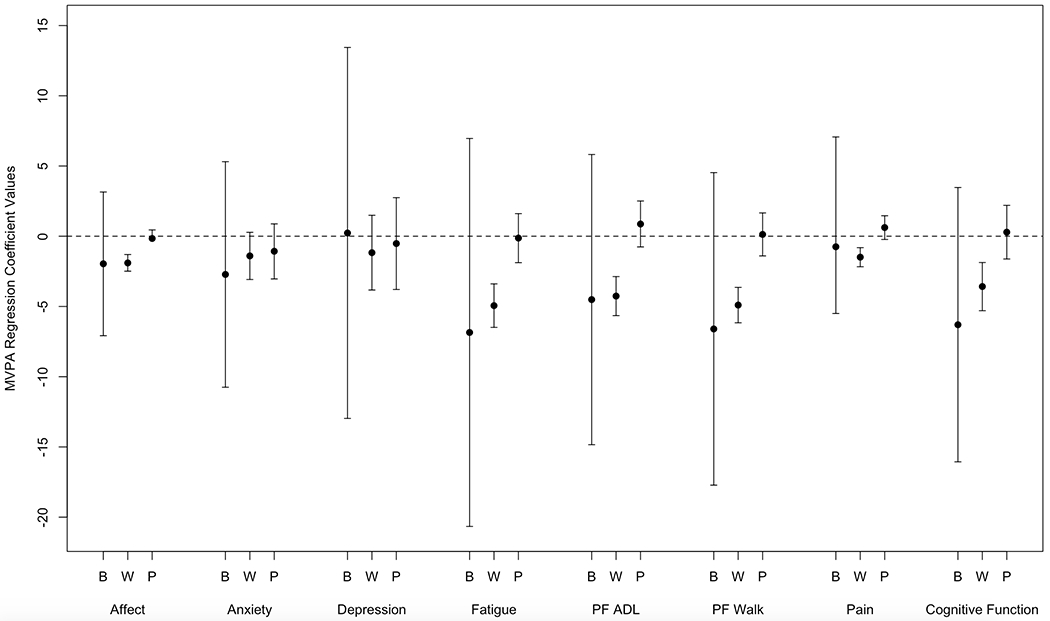
For MVPA and LPA, within-person associations were statistically significant for same day affect, fatigue, pain, walking, activities of daily living (ADL) physical function, and cognitive function. Previous day anxiety was associated with next day LPA. Every one point worse symptom rating than an individual's overall average was associated with: (i) between 1.49 (pain) and 4.94 (fatigue) minutes less MVPA and between 4.48 (pain) and 24.72 (ADL physical function) minutes less LPA that day, and (ii) 11.28 minutes less LPA the next day. No between-person effects were significant for MVPA or LPA.
Daily within-person variations in symptoms were associated with MVPA and LPA during chemotherapy for breast cancer.
Future work should explore relationships between symptoms and activity further and identify whether tailoring to symptoms enhances efficacy of physical activity promotion interventions during chemotherapy.
化疗期间增加活动有益,但与治疗相关的症状可能是一个障碍。本研究探讨了化疗期间症状的日常波动与活动之间的关系。
正在接受乳腺癌化疗的女性[=67;=48.6(SD=10.3)]每天佩戴加速度计 24 小时,并在化疗开始、中期和结束时连续 10 天每天接收 4 次提示以评估症状。使用混合效应模型,在校正相关协变量并使用 Bonferroni 校正多重比较后,在给定日期评估症状与当天和次日中度至剧烈体力活动(MVPA)和轻度体力活动(LPA)之间的个体内关系。
对于 MVPA 和 LPA,个体内关联在当天的情绪、疲劳、疼痛、行走、日常生活活动(ADL)身体功能和认知功能方面具有统计学意义。前一天的焦虑与次日的 LPA 相关。与个体的总体平均水平相比,每个症状评分恶化 1 分与:(i)当天少 1.49 分钟(疼痛)至 4.94 分钟(疲劳)的 MVPA 和少 4.48 分钟(疼痛)至 24.72 分钟(ADL 身体功能)的 LPA,以及(ii)次日少 11.28 分钟的 LPA 相关。MVPA 或 LPA 没有个体间的显著差异。
化疗期间乳腺癌患者的每日个体内症状变化与 MVPA 和 LPA 相关。
未来的工作应进一步探讨症状与活动之间的关系,并确定针对症状的治疗是否能提高化疗期间体力活动促进干预的效果。