Ma Shujuan, Zhang Jiayue, Zeng Minyan, Yun Qingping, Guo Wei, Zheng Yixiang, Zhao Shi, Wang Maggie H, Yang Zuyao
Department of Epidemiology and Health Statistics, Xiangya School of Public Health, Central South University, Changsha, China.
Peking University Shenzhen Hospital, Shenzhen, China.
J Med Internet Res. 2020 Oct 12;22(10):e19994. doi: 10.2196/19994.
The estimates of several key epidemiological parameters of the COVID-19 pandemic are often based on small sample sizes or are inaccurate for various reasons.
The aim of this study is to obtain more robust estimates of the incubation period, serial interval, frequency of presymptomatic transmission, and basic reproduction number (R) of COVID-19 based on a large case series.
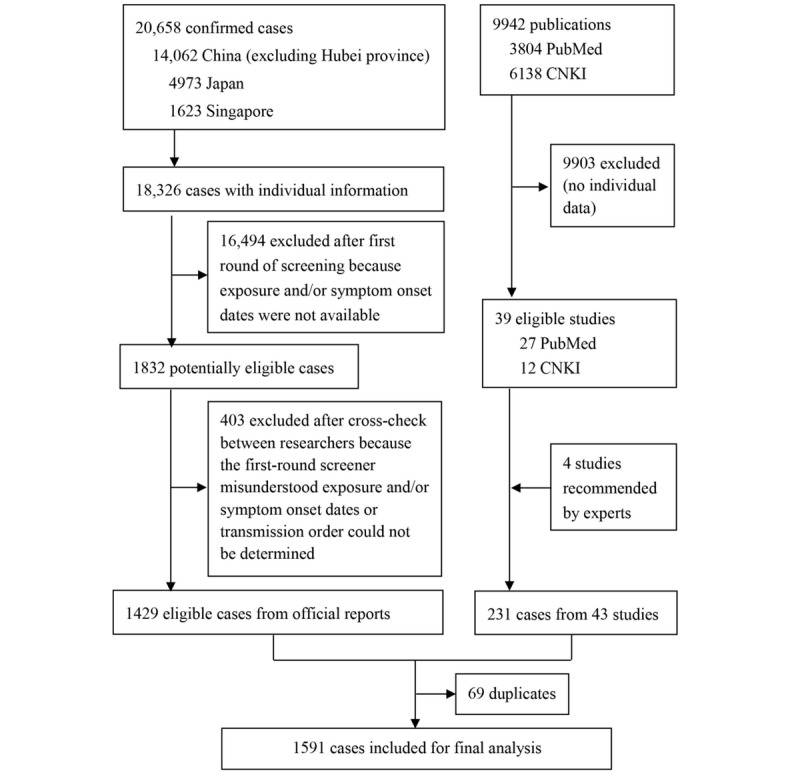
We systematically retrieved and screened 20,658 reports of laboratory-confirmed COVID-19 cases released by the health authorities of China, Japan, and Singapore. In addition, 9942 publications were retrieved from PubMed and China National Knowledge Infrastructure (CNKI) through April 8, 2020. To be eligible, a report had to contain individual data that allowed for accurate estimation of at least one parameter. Widely used models such as gamma distributions were fitted to the data sets and the results with the best-fitting values were presented.
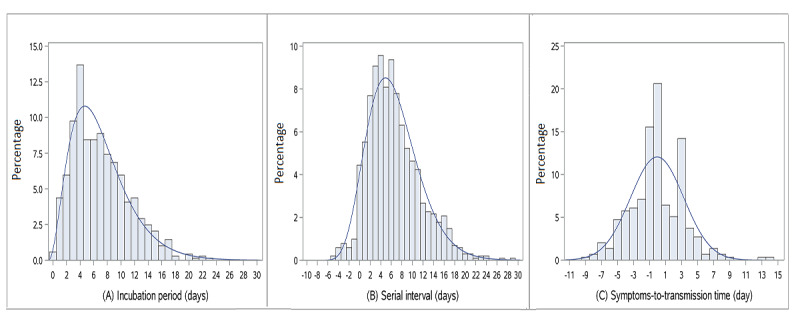
In total, 1591 cases were included for the final analysis. The mean incubation period (n=687) and mean serial interval (n=1015 pairs) were estimated to be 7.04 (SD 4.27) days and 6.49 (SD 4.90) days, respectively. In 40 cases (5.82%), the incubation period was longer than 14 days. In 32 infector-infectee pairs (3.15%), infectees' symptom onsets occurred before those of infectors. Presymptomatic transmission occurred in 129 of 296 infector-infectee pairs (43.58%). R was estimated to be 1.85 (95% CI 1.37-2.60).
This study provides robust estimates of several epidemiological parameters of COVID-19. The findings support the current practice of 14-day quarantine of persons with potential exposure, but also suggest the need for additional measures. Presymptomatic transmission together with the asymptomatic transmission reported by previous studies highlight the importance of adequate testing, strict quarantine, and social distancing.
新冠疫情几个关键流行病学参数的估计往往基于小样本量,或因各种原因不准确。
本研究旨在基于一个大型病例系列,更可靠地估计新冠病毒的潜伏期、传播间隔、症状出现前传播频率和基本再生数(R)。
我们系统检索并筛选了中国、日本和新加坡卫生当局发布的20658例实验室确诊新冠病例报告。此外,截至2020年4月8日,从PubMed和中国知网(CNKI)检索到9942篇出版物。符合条件的报告必须包含能够准确估计至少一个参数的个体数据。将伽马分布等广泛使用的模型应用于数据集,并给出拟合度最佳值的结果。
最终纳入1591例进行分析。平均潜伏期(n = 687)和平均传播间隔(n = 1015对)估计分别为7.04(标准差4.27)天和6.49(标准差4.90)天。40例(5.82%)潜伏期超过14天。在32对感染源-感染者配对中(3.15%),感染者症状出现时间早于感染源。296对感染源-感染者配对中有129对(43.58%)出现症状前传播。R估计为1.85(95%可信区间1.37 - 2.60)。
本研究提供了新冠病毒几个流行病学参数的可靠估计。研究结果支持目前对有潜在接触者进行14天隔离的做法,但也表明需要采取额外措施。症状出现前传播以及先前研究报告的无症状传播凸显了充分检测、严格隔离和保持社交距离的重要性。