Center for Child Health Research, Faculty of Medicine and Health Technology, Tampere University, Tampere, Finland.
Department of Public Health, School of Public Health and Family Medicine, College of Medicine, University of Malawi, Blantyre, Malawi.
PLoS One. 2020 Oct 1;15(10):e0239613. doi: 10.1371/journal.pone.0239613. eCollection 2020.
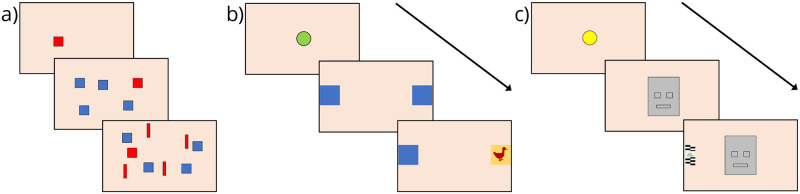
Theoretical and empirical considerations suggest that individual differences in infant visual attention correlate with variations in cognitive skills later in childhood. Here we tested this hypothesis in infants from rural Malawi (n = 198-377, depending on analysis), who were assessed with eye tracking tests of visual orienting, anticipatory looks, and attention to faces at 9 months, and more conventional tests of cognitive control (A-not-B), motor, language, and socioemotional development at 18 months. The results showed no associations between measures of infant attention at 9 months and cognitive skills at 18 months, either in analyses linking infant visual orienting with broad cognitive outcomes or analyses linking specific constructs between the two time points (i.e., switching of anticipatory looks and manual reaching responses), as correlations varied between -0.08 and 0.14. Measures of physical growth, and family socioeconomic characteristics were also not correlated with cognitive outcomes at 18 months in the current sample (correlations between -0.10 and 0.19). The results do not support the use of the current tests of infant visual attention as a predictive tool for 18-month-old infants' cognitive skills in the Malawian setting. The results are discussed in light of the potential limitations of the employed infant tests as well as potentially unique characteristics of early cognitive development in low-resource settings.
理论和经验表明,婴儿视觉注意力的个体差异与儿童后期认知技能的变化相关。在这里,我们在马拉维农村地区的婴儿中测试了这一假设(分析时的样本量为 198-377 个),这些婴儿在 9 个月大时接受了视觉定向、预期注视和面孔注意力的眼动跟踪测试,在 18 个月大时接受了认知控制(A 不 B)、运动、语言和社会情感发展的更传统测试。结果表明,在将婴儿视觉定向与广泛的认知结果联系起来的分析中,或者在将两个时间点之间的特定结构联系起来的分析中(即预期注视的转换和手动到达反应),9 个月大的婴儿注意力测量值与 18 个月大的认知技能之间均无关联,相关系数在-0.08 到 0.14 之间变化。在当前样本中,身体生长和家庭社会经济特征与 18 个月时的认知结果也没有相关性(相关系数在-0.10 到 0.19 之间)。结果不支持将当前的婴儿视觉注意力测试用作马拉维环境中 18 个月大婴儿认知技能的预测工具。结果结合了所采用的婴儿测试的潜在局限性以及资源匮乏环境中早期认知发展的潜在独特特征进行了讨论。