Shi Xiao-Jing, Wei Yongjun, Ji Boyang
Laboratory Animal Center, State Key Laboratory of Esophageal Cancer Prevention and Treatment, Academy of Medical Science, Zhengzhou University, Zhengzhou, China.
School of Pharmaceutical Sciences, Key Laboratory of Advanced Drug Preparation Technologies, Ministry of Education, Zhengzhou University, Zhengzhou, China.
Front Mol Biosci. 2020 Aug 26;7:203. doi: 10.3389/fmolb.2020.00203. eCollection 2020.
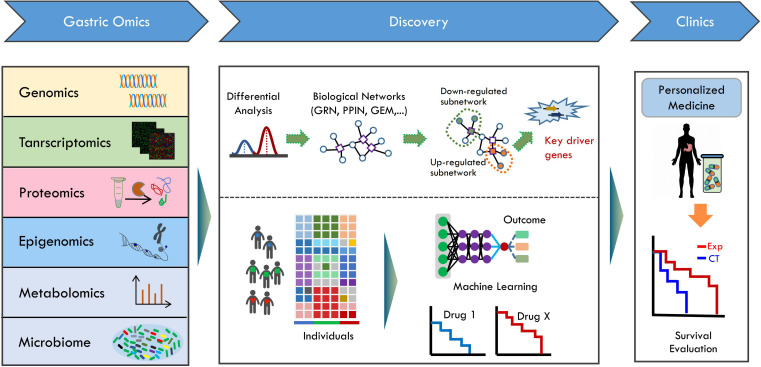
Gastric cancer is the fifth most diagnosed cancer in the world, affecting more than a million people and causing nearly 783,000 deaths each year. The prognosis of advanced gastric cancer remains extremely poor despite the use of surgery and adjuvant therapy. Therefore, understanding the mechanism of gastric cancer development, and the discovery of novel diagnostic biomarkers and therapeutics are major goals in gastric cancer research. Here, we review recent progress in application of omics technologies in gastric cancer research, with special focus on the utilization of systems biology approaches to integrate multi-omics data. In addition, the association between gastrointestinal microbiota and gastric cancer are discussed, which may offer insights in exploring the novel microbiota-targeted therapeutics. Finally, the application of data-driven systems biology and machine learning approaches could provide a predictive understanding of gastric cancer, and pave the way to the development of novel biomarkers and rational design of cancer therapeutics.
胃癌是全球第五大最常被诊断出的癌症,每年影响超过100万人,并导致近78.3万人死亡。尽管采用了手术和辅助治疗,但晚期胃癌的预后仍然极差。因此,了解胃癌发生的机制以及发现新的诊断生物标志物和治疗方法是胃癌研究的主要目标。在此,我们综述了组学技术在胃癌研究中的最新进展,特别关注利用系统生物学方法整合多组学数据。此外,还讨论了胃肠道微生物群与胃癌之间的关联,这可能为探索新型微生物群靶向治疗方法提供思路。最后,数据驱动的系统生物学和机器学习方法的应用可以提供对胃癌的预测性理解,并为新型生物标志物的开发和癌症治疗的合理设计铺平道路。