Aghili Mahdi, Khalili Nastaran, Khalili Neda, Babaei Mohammad, Farhan Farshid, Haddad Peiman, Salarvand Samaneh, Keshvari Amir, Fazeli Mohammad Sadegh, Mohammadi Negin, Ghalehtaki Reza
Radiation Oncology Research Center, Cancer Institute, Tehran University of Medical Sciences, Tehran, Iran.
School of Medicine, Tehran University of Medical Sciences, Tehran, Iran.
Radiat Oncol J. 2020 Jun;38(2):119-128. doi: 10.3857/roj.2020.00115. Epub 2020 Jun 5.
Colorectal cancer is becoming an increasing concern in the middle-aged population of Iran. This study aimed to compare the preliminary results of short-course and long-course neoadjuvant chemoradiotherapy treatment for rectal cancer patients.
Patients in group I received three-dimensional conformational radiotherapy with a dose of 25 Gy/5 fractions in 1 week plus concurrent XELOX regimen (capecitabine 625 mg/m2 from day 1-5 twice daily and oxaliplatin 50 mg/m2 on day 1 once daily). Patients in group II received a total dose of 50-50.4 Gy/25-28 fractions for 5 to 5.5 weeks plus capecitabine 825 mg/m2 twice daily. Both groups underwent delayed surgery at least 8 weeks after radiotherapy completion. The pathological response was assessed with tumor regression grade.
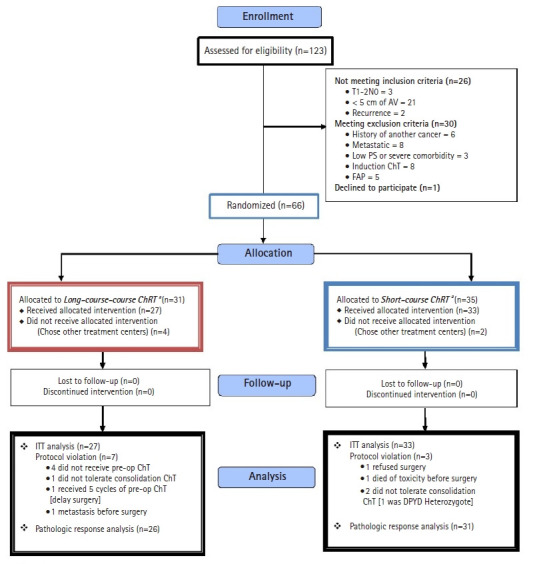
In this preliminary report on complications and pathological response, 66 patients were randomized into study groups. Mean duration of radiotherapy in the two groups was 5 ± 1 days (range, 5 to 8 days) and 38 ± 6 days (range, 30 to 58 days). The median follow-up was 18 months. Pathological complete response was achieved in 32.3% and 23.1% of patients in the short-course and long-course groups, respectively (p = 0.558). Overall, acute grade 3 or higher treatment-related toxicities occurred in 24.2% and 22.2% of patients in group I and II, respectively (p = 0.551). No acute grade 4 or 5 adverse events were observed in either group. Within one month of surgery, no significant difference was seen regarding grade ≥3 postoperative complications (p = 0.333).
For patients with rectal cancer located 5 cm above the anal verge, short-course radiotherapy with concurrent and consolidation chemotherapy and delayed surgery is not different in terms of acute toxicity, postoperative morbidity, complete resection, and pathological response compared to long-course chemoradiotherapy.
在伊朗中年人群中,结直肠癌正日益受到关注。本研究旨在比较直肠癌患者短程和长程新辅助放化疗的初步结果。
第一组患者接受三维适形放疗,剂量为25 Gy/5次,1周内完成,同时联合XELOX方案(卡培他滨625 mg/m²,第1 - 5天,每日2次;奥沙利铂50 mg/m²,第1天,每日1次)。第二组患者接受总剂量50 - 50.4 Gy/25 - 28次,为期5至5.5周,同时卡培他滨825 mg/m²,每日2次。两组均在放疗结束后至少8周进行延迟手术。通过肿瘤退缩分级评估病理反应。
在这份关于并发症和病理反应的初步报告中,66例患者被随机分为研究组。两组放疗的平均持续时间分别为5±1天(范围5至8天)和38±6天(范围30至58天)。中位随访时间为18个月。短程组和长程组分别有32.3%和23.1%的患者达到病理完全缓解(p = 0.558)。总体而言,第一组和第二组分别有24.2%和22.2%的患者发生3级或更高等级的急性治疗相关毒性反应(p = 0.551)。两组均未观察到4级或5级急性不良事件。在术后1个月内,≥3级术后并发症方面无显著差异(p = 0.333)。
对于距肛缘5 cm以上的直肠癌患者,与长程放化疗相比,短程放疗联合同步和巩固化疗以及延迟手术在急性毒性、术后发病率、完全切除率和病理反应方面并无差异。