Jobe Timothy O, Rahimzadeh Karvansara Parisa, Zenzen Ivan, Kopriva Stanislav
Institute for Plant Sciences, Cluster of Excellence on Plant Sciences (CEPLAS), University of Cologne, Cologne, Germany.
Front Plant Sci. 2020 Aug 18;11:1267. doi: 10.3389/fpls.2020.01267. eCollection 2020.
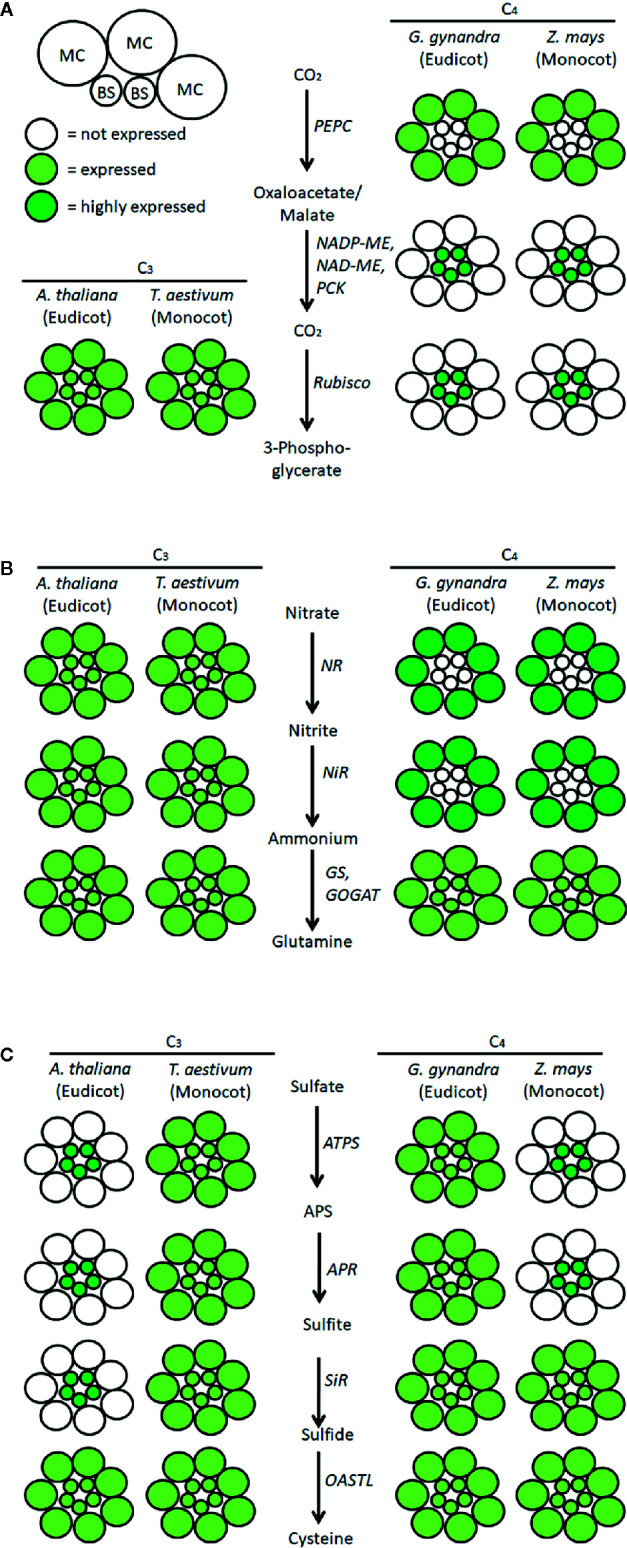
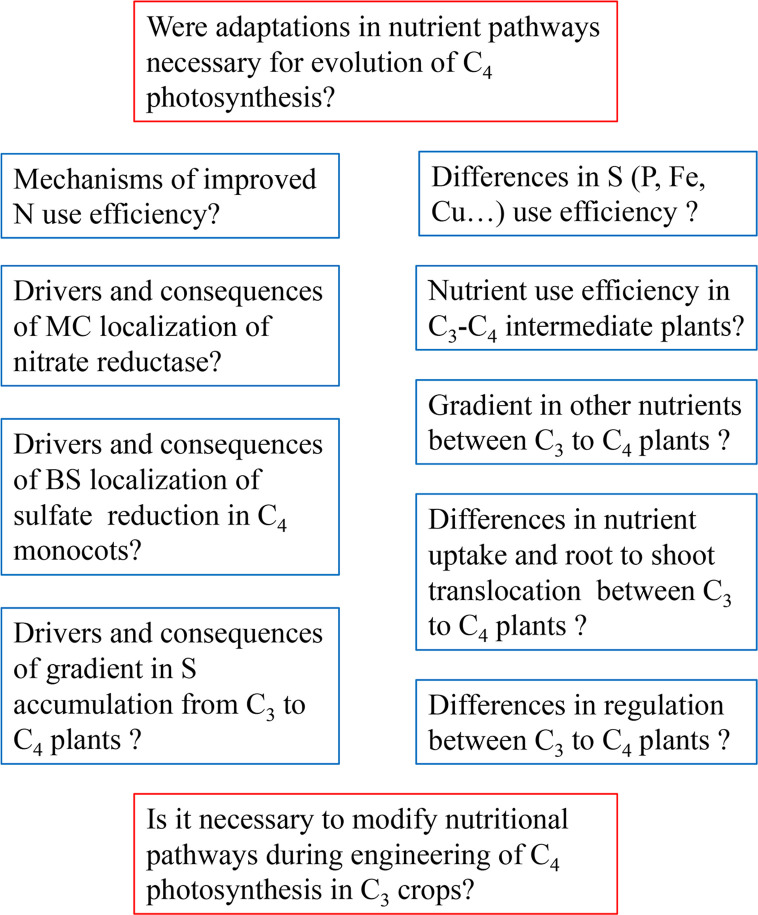
Global climate change is a challenge for efforts to ensure food security for future generations. It will affect crop yields through changes in temperature and precipitation, as well as the nutritional quality of crops. Increased atmospheric CO leads to a penalty in the content of proteins and micronutrients in most staple crops, with the possible exception of C crops. It is essential to understand the control of nutrient homeostasis to mitigate this penalty. However, despite the importance of mineral nutrition for plant performance, comparably less is known about the regulation of nutrient uptake and homeostasis in C plants than in C plants and mineral nutrition has not been a strong focus of the C research. Here we review what is known about C specific features of nitrogen and sulfur assimilation as well as of homeostasis of other essential elements. We identify the major knowledge gaps and urgent questions for future research. We argue that adaptations in mineral nutrition were an integral part of the evolution of C photosynthesis and should be considered in the attempts to engineer C photosynthetic mechanisms into C crops.
全球气候变化是确保子孙后代粮食安全所面临的一项挑战。它将通过温度和降水的变化影响作物产量,以及作物的营养品质。大气中二氧化碳含量增加会导致大多数主粮作物的蛋白质和微量营养素含量降低,C4作物可能除外。了解养分稳态的调控对于减轻这种不利影响至关重要。然而,尽管矿质营养对植物生长表现很重要,但与C3植物相比,人们对C4植物中养分吸收和稳态的调控了解相对较少,而且矿质营养并非C4研究的重点。在这里,我们综述了关于C4植物氮和硫同化以及其他必需元素稳态的已知特性。我们确定了主要的知识空白和未来研究的紧迫问题。我们认为,矿质营养的适应性变化是C4光合作用进化的一个组成部分,在将C4光合机制引入C3作物的尝试中应予以考虑。