Okada Shoko, Gregg Christina M, Allen Robert Silas, Menon Amratha, Hussain Dawar, Gillespie Vanessa, Johnston Ema, Byrne Keren, Colgrave Michelle Lisa, Wood Craig C
Land and Water, Commonwealth Scientific and Industrial Research Organisation, Acton, ACT, Australia.
Agriculture and Food, Commonwealth Scientific and Industrial Research Organisation, Acton, ACT, Australia.
Front Plant Sci. 2020 Sep 10;11:552160. doi: 10.3389/fpls.2020.552160. eCollection 2020.
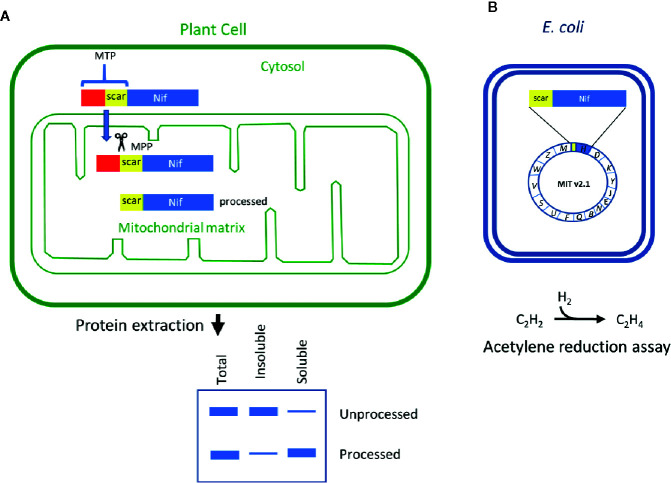
While industrial nitrogen fertilizer is intrinsic to modern agriculture, it is expensive and environmentally harmful. One approach to reduce fertilizer usage is to engineer the bacterial nitrogenase enzyme complex within plant mitochondria, a location that may support enzyme function. Our current strategy involves fusing a mitochondrial targeting peptide (MTP) to nitrogenase (Nif) proteins, enabling their import to the mitochondrial matrix. However, the process of import modifies the N-terminus of each Nif protein and may impact nitrogenase assembly and function. Here we present our workflow assessing the mitochondrial processing, solubility and relative abundance of 16 Nif proteins targeted to the mitochondrial matrix in leaf. We found that processing and abundance of MTP::Nif proteins varied considerably, despite using the same constitutive promoter and MTP across all Nif proteins tested. Assessment of the solubility for all MTP::Nif proteins when targeted to plant mitochondria found NifF, M, N, S, U, W, X, Y, and Z were soluble, while NifB, E, H, J, K, Q, and V were mostly insoluble. The functional consequence of the N-terminal modifications required for mitochondrial targeting of Nif proteins was tested using a bacterial nitrogenase assay. With the exception of NifM, the Nif proteins generally tolerated the N-terminal extension. Proteomic analysis of Nif proteins expressed in bacteria found that the relative abundance of NifM with an N-terminal extension was increased ~50-fold, while that of the other Nif proteins was not influenced by the N-terminal extension. Based on the solubility, processing and functional assessments, our workflow identified that NifF, N, S, U, W, Y, and Z successfully met these criteria. For the remaining Nif proteins, their limitations will need to be addressed before proceeding towards assembly of a complete set of plant-ready Nif proteins for reconstituting nitrogenase in plant mitochondria.
虽然工业氮肥是现代农业不可或缺的,但它价格昂贵且对环境有害。减少化肥使用的一种方法是对植物线粒体内的细菌固氮酶复合物进行工程改造,线粒体这个位置可能支持酶的功能。我们目前的策略是将线粒体靶向肽(MTP)与固氮酶(Nif)蛋白融合,使其能够导入线粒体基质。然而,导入过程会修饰每个Nif蛋白的N端,可能会影响固氮酶的组装和功能。在这里,我们展示了我们的工作流程,用于评估靶向叶片线粒体基质的16种Nif蛋白的线粒体加工、溶解性和相对丰度。我们发现,尽管在所有测试的Nif蛋白中使用了相同的组成型启动子和MTP,但MTP::Nif蛋白的加工和丰度差异很大。当靶向植物线粒体时,对所有MTP::Nif蛋白的溶解性评估发现,NifF、M、N、S、U、W、X、Y和Z是可溶的,而NifB、E、H、J、K、Q和V大多是不可溶的。使用细菌固氮酶测定法测试了Nif蛋白线粒体靶向所需的N端修饰的功能后果。除了NifM,Nif蛋白通常能耐受N端延伸。对在细菌中表达的Nif蛋白进行蛋白质组学分析发现,具有N端延伸的NifM的相对丰度增加了约50倍,而其他Nif蛋白的相对丰度不受N端延伸的影响。基于溶解性、加工和功能评估,我们 的工作流程确定NifF、N、S、U、W、Y和Z成功满足了这些标准。对于其余的Nif蛋白,在着手组装一套完整的可用于植物的Nif蛋白以在植物线粒体中重建固氮酶之前,需要解决它们的局限性。