Maiz-Fernández Sheila, Pérez-Álvarez Leyre, Ruiz-Rubio Leire, Vilas-Vilela Jose Luis, Lanceros-Mendez Senentxu
BCMaterials, Basque Center for Materials, Applications and Nanostructures, UPV/EHU Science Park, 48940 Leioa, Spain.
Macromolecular Chemistry Group (LABQUIMAC), Department of Physical Chemistry, Faculty of Science and Technology, University of the Basque Country, UPV/EHU, Barrio Sarriena, s/n, 48940 Leioa, Spain.
Polymers (Basel). 2020 Oct 1;12(10):2261. doi: 10.3390/polym12102261.
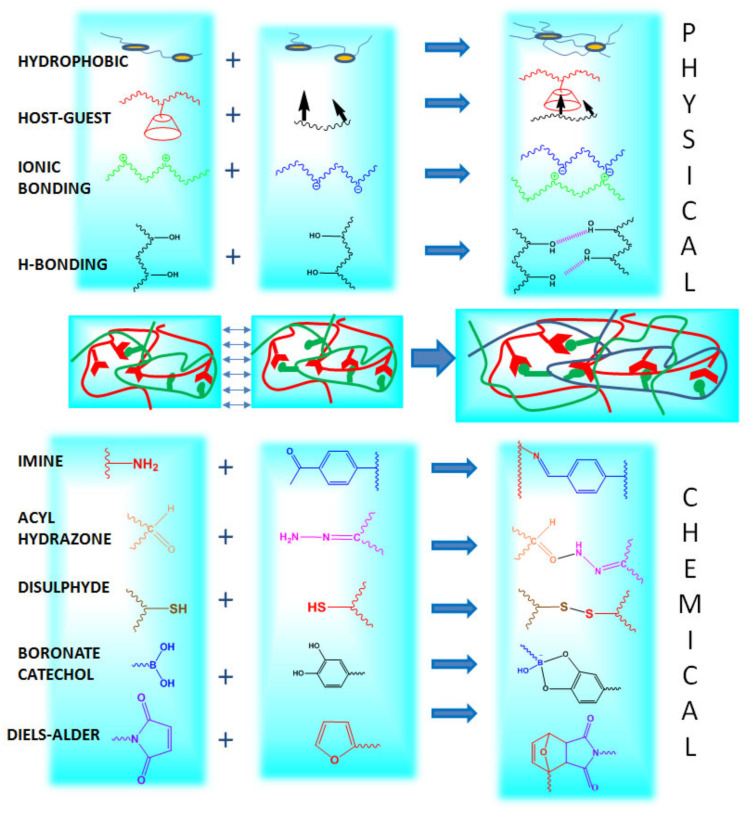
In situ hydrogels have attracted increasing interest in recent years due to the need to develop effective and practical implantable platforms. Traditional hydrogels require surgical interventions to be implanted and are far from providing personalized medicine applications. However, in situ hydrogels offer a wide variety of advantages, such as a non-invasive nature due to their localized action or the ability to perfectly adapt to the place to be replaced regardless the size, shape or irregularities. In recent years, research has particularly focused on in situ hydrogels based on natural polysaccharides due to their promising properties such as biocompatibility, biodegradability and their ability to self-repair. This last property inspired in nature gives them the possibility of maintaining their integrity even after damage, owing to specific physical interactions or dynamic covalent bonds that provide reversible linkages. In this review, the different self-healing mechanisms, as well as the latest research on in situ self-healing hydrogels, is presented, together with the potential applications of these materials in tissue regeneration.
近年来,由于需要开发有效且实用的可植入平台,原位水凝胶引起了越来越多的关注。传统水凝胶需要通过手术干预进行植入,远不能满足个性化医疗应用的需求。然而,原位水凝胶具有多种优势,例如因其局部作用而具有非侵入性,或者能够完美适应待替代部位,无论其大小、形状或不规则性如何。近年来,研究特别关注基于天然多糖的原位水凝胶,因为它们具有生物相容性、生物可降解性以及自我修复能力等有前景的特性。这种源自自然的最后一种特性赋予它们即使在受损后也能保持完整性的可能性,这归因于提供可逆连接的特定物理相互作用或动态共价键。在这篇综述中,介绍了不同的自我修复机制以及原位自修复水凝胶的最新研究,以及这些材料在组织再生中的潜在应用。