Institute of Medical Epidemiology, Biometrics and Informatics, Martin-Luther-University Halle-Wittenberg, Halle (Saale), Germany.
Psychosocial Centre for Refugees and Victims of Torture (PSZ), Halle (Saale), Germany.
PLoS One. 2020 Oct 7;15(10):e0239211. doi: 10.1371/journal.pone.0239211. eCollection 2020.
The prevalence of psychological complaints is known to be very high in populations of asylum seekers. Despite this, data on the health care system's ability to adequately meet these high-risk populations' mental health needs are scarce. This article investigates how well the German outpatient health care system is able to detect and adequately treat them.
To this end, we combined data from a cross-sectional survey with billing data from the local social welfare office from the year 2015. Using descriptive statistics, the data of the cross-sectional study are used to quantify the psychological health care needs of asylum seekers while the secondary data analysis indicates the actual access to and extent of psychological treatment.
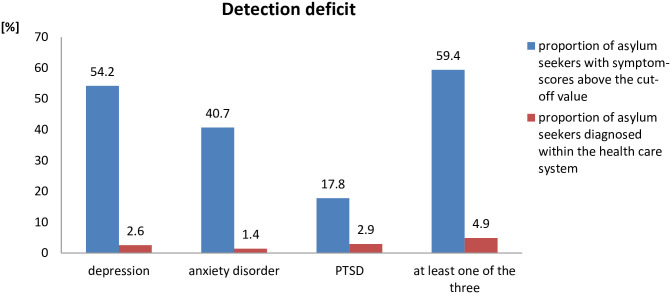
In the cross-sectional study, 54% of patients were screened positive for symptoms of depression, 41% for symptoms of anxiety disorder and 18% for symptoms of Posttraumatic Stress Disorder. In total, 59% were screened positive for at least one of these three disorders. However, when contrasting these screening-based prevalences with the prevalences based on data from the health care system, a mismatch becomes apparent: According to the social welfare office's billing data, only 2.6% of asylum seekers received the diagnosis of depression, 1.4% were diagnosed with anxiety disorder and 2.9% with Posttraumatic Stress Disorder (PTSD). In combination, 4.9% were diagnosed with at least one of these three disorders. Overall, less than one tenth of asylum seekers with symptoms of depression, anxiety or PTSD received the corresponding diagnosis by the health care system. Among those who were diagnosed, about 45% received no treatment at all, while 38% were treated with drugs alone. Only 1% of all patients received psychotherapy.
Psychological complaints are very common among asylum seekers, yet only a small proportion of this population receives the corresponding diagnoses and treatment. While various factors can contribute to these shortcomings, there is an urgent need to systematically address this deficit and introduce measures to improve mental health care for this high-risk population.
寻求庇护者群体中存在大量心理问题,这是众所周知的。尽管如此,关于医疗保健系统是否有能力充分满足这些高风险人群的心理健康需求的数据却很少。本文旨在调查德国的门诊医疗保健系统在识别和充分治疗这些人群方面的效果如何。
为此,我们结合了 2015 年横断面调查的数据和当地社会福利办公室的计费数据。使用描述性统计,横断面研究的数据用于量化寻求庇护者的心理健康需求,而二次数据分析则表明实际获得和治疗的程度。
在横断面研究中,54%的患者出现抑郁症状,41%的患者出现焦虑症症状,18%的患者出现创伤后应激障碍症状。总的来说,有 59%的患者至少有一种这些障碍的症状。然而,当将这些基于筛查的患病率与医疗保健系统的数据进行对比时,就会出现不匹配的情况:根据社会福利办公室的计费数据,只有 2.6%的寻求庇护者被诊断为抑郁症,1.4%的人被诊断为焦虑症,2.9%的人被诊断为创伤后应激障碍(PTSD)。综合来看,有 4.9%的人被诊断出至少有一种这些障碍。总的来说,不到十分之一的有抑郁、焦虑或创伤后应激障碍症状的寻求庇护者通过医疗保健系统获得相应的诊断。在被诊断出的人群中,约有 45%的人根本没有接受任何治疗,而 38%的人只接受药物治疗。只有 1%的患者接受了心理治疗。
心理问题在寻求庇护者中非常常见,但只有一小部分人得到了相应的诊断和治疗。虽然有各种因素导致了这些不足,但迫切需要系统地解决这一问题,并采取措施改善这一高风险人群的心理健康护理。