Shanghai Eighth People's Hospital, Shanghai, 200235, China.
Sci Rep. 2020 Oct 7;10(1):16729. doi: 10.1038/s41598-020-73929-w.
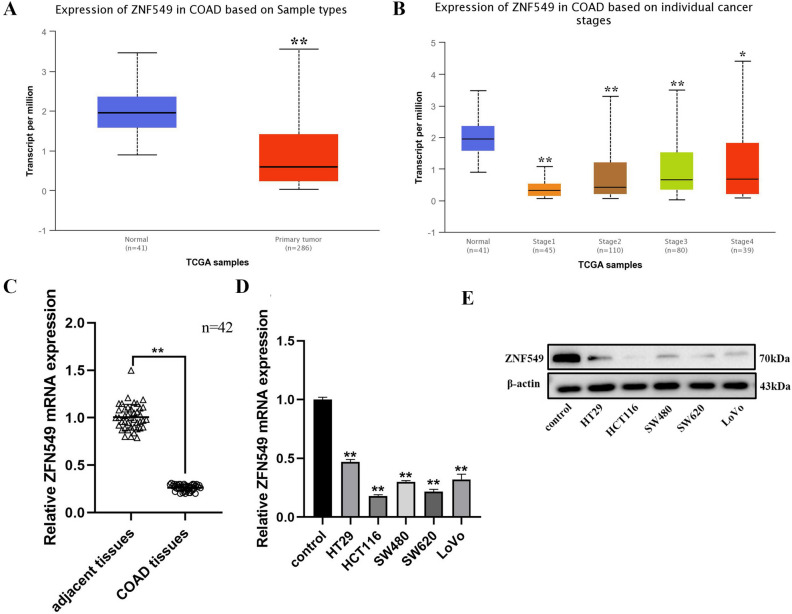
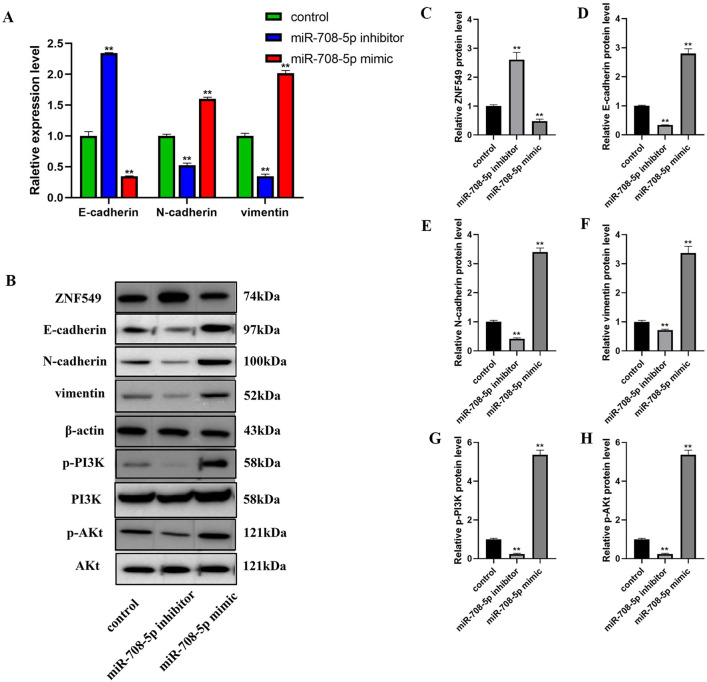
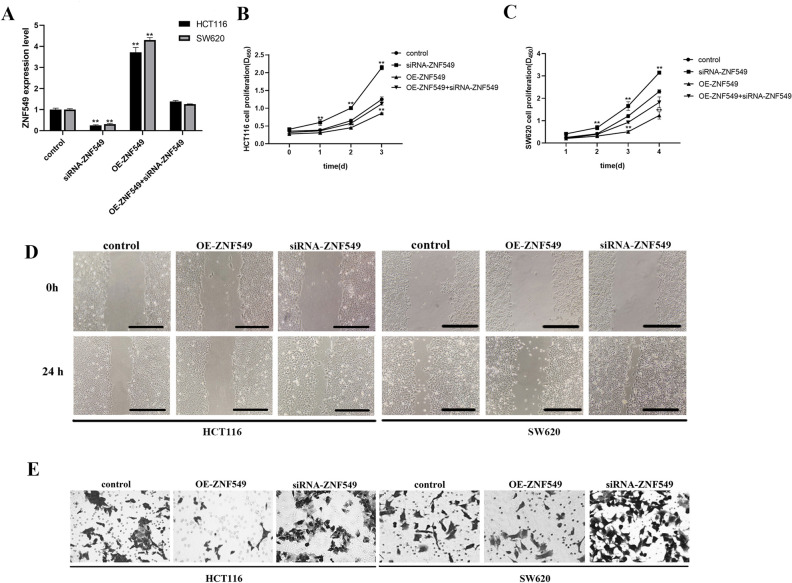
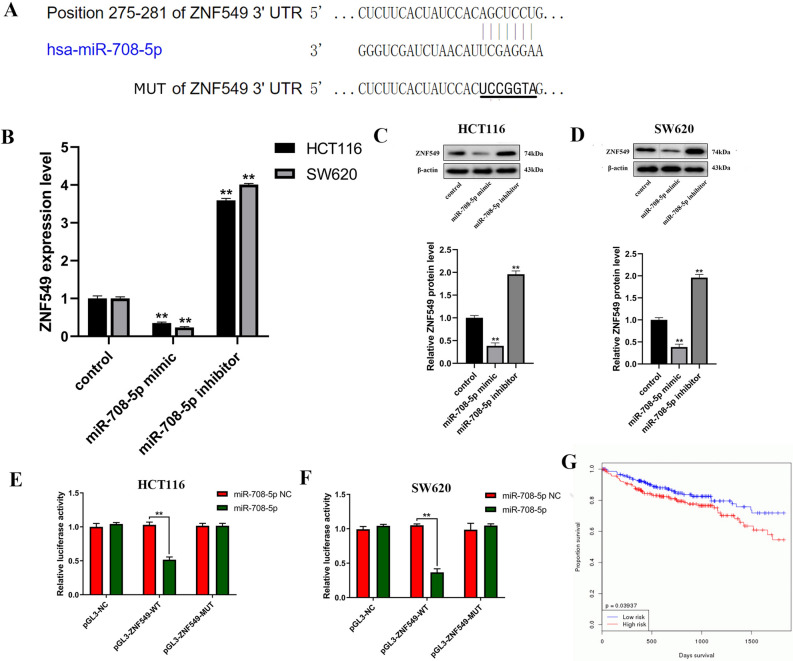
Colon adenocarcinoma (COAD) is the most common type of gastrointestinal cancer and is still the third leading cause of cancer-related mortality worldwide. Therefore, finding new and promising drugs to eradicate cancer may be a feasible method to treat COAD patients. Cys2-His2 zinc finger proteins (ZFPs) is one of the largest transcription factor family and many of them are highly involved in regulation of cell differentiation, proliferation, apoptosis, and neoplastic transformation. In this study, we identified a tumor-inhibiting factor, ZNF549, which expressed lowly in COAD tissues and COAD cell lines (HT29, HCT116, SW480, LoVo, and SW620). Overexpression of ZNF549 inhibit the ability of COAD cell proliferation and migration. On the contrary, decreasing the ZNF549 expression level promote the ability of COAD cell proliferation and migration. Through bioinformatics analysis, we found that ZNF549 was a potential target of hsa-miR-708-5p (miR-708-5p). Furthermore, we verified the possibility of miR-708-5p targeting the ZNF549 gene, and miR-708-5p inhibited the expression of ZNF549 by luciferase reporter assays, qRT-PCR and western blot assays. Moreover, the relationship between miR-708-5p and phosphatidylinositol 3-kinase/AKt (PI3K/AKt) signal pathway was elucidated. Overexpression and inhibition of miR-708-5p resulted in increased and decreased expression of p-AKt and p-PI3K in HCT116 cells, respectively. RT-qPCR and western blot assays results demonstrated that miR-708-5p regulated COAD cells development by promoting the process of Epithelial-mesenchymal transition (EMT) through PI3K/AKt signaling pathway. In summary, our findings demonstrated that ZNF549, the target gene of miR-708-5p, functions as a tumor suppressor to inhibit COAD cell lines proliferation and migration through regulate the PI3K/AKt signal pathway.
结直肠腺癌(COAD)是最常见的胃肠道癌症,仍是全球癌症相关死亡的第三大主要原因。因此,寻找新的有前途的药物来消灭癌症可能是治疗 COAD 患者的可行方法。Cys2-His2 锌指蛋白(ZFPs)是最大的转录因子家族之一,其中许多因子高度参与细胞分化、增殖、凋亡和肿瘤转化的调节。在这项研究中,我们鉴定了一种肿瘤抑制因子 ZNF549,其在 COAD 组织和 COAD 细胞系(HT29、HCT116、SW480、LoVo 和 SW620)中低表达。ZNF549 的过表达抑制了 COAD 细胞的增殖和迁移能力。相反,降低 ZNF549 的表达水平促进了 COAD 细胞的增殖和迁移能力。通过生物信息学分析,我们发现 ZNF549 是 hsa-miR-708-5p(miR-708-5p)的潜在靶点。此外,我们验证了 miR-708-5p 靶向 ZNF549 基因的可能性,并且 miR-708-5p 通过荧光素酶报告基因检测、qRT-PCR 和 Western blot 检测抑制了 ZNF549 的表达。此外,阐明了 miR-708-5p 与磷脂酰肌醇 3-激酶/AKt(PI3K/AKt)信号通路的关系。miR-708-5p 的过表达和抑制分别导致 HCT116 细胞中 p-AKt 和 p-PI3K 的表达增加和减少。RT-qPCR 和 Western blot 检测结果表明,miR-708-5p 通过 PI3K/AKt 信号通路促进上皮间质转化(EMT)过程,从而调节 COAD 细胞的发育。总之,我们的研究结果表明,miR-708-5p 的靶基因 ZNF549 通过调节 PI3K/AKt 信号通路,作为肿瘤抑制因子发挥作用,抑制 COAD 细胞系的增殖和迁移。