School of Public Health, Fudan University, Key Laboratory of Public Health Safety, Ministry of Education, Shanghai, China.
Key Laboratory of Health Technology Assessment (Fudan University), Ministry of Health, Shanghai, China.
BMJ Open. 2020 Oct 8;10(10):e040910. doi: 10.1136/bmjopen-2020-040910.
To investigate psychological and behavioural responses to COVID-19 among the Chinese general population.
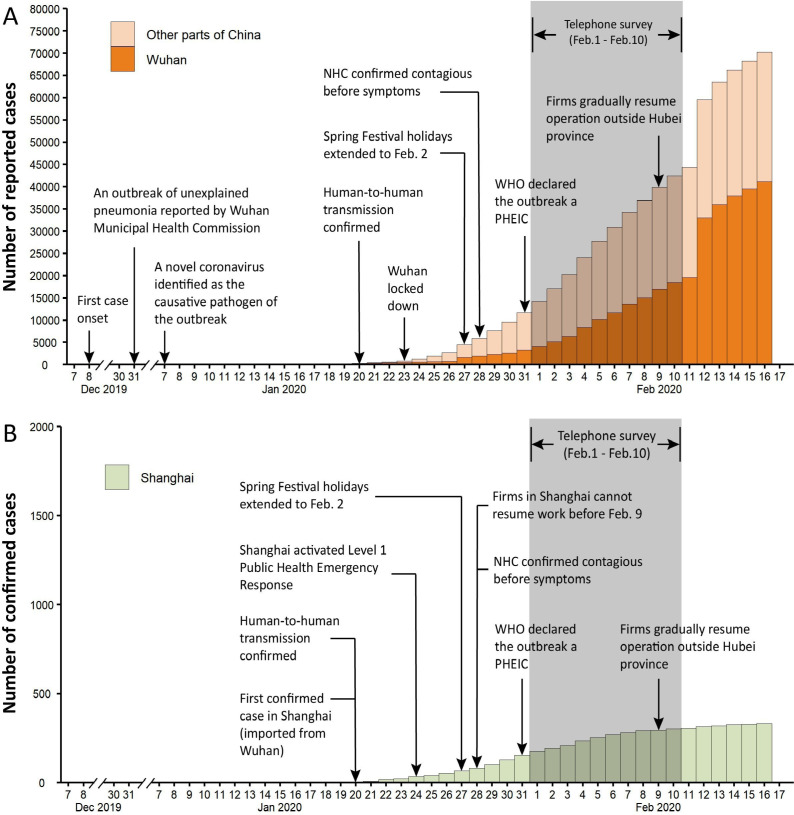
DESIGN, SETTING AND PARTICIPANTS: We conducted a population-based mobile phone survey between 1 February and 10 February 2020 via random digit dialling. A total of 1011 adult residents in Wuhan (n=510), the epicentre and quarantined city, and Shanghai (n=501) were interviewed. Proportional quota sampling and poststratification weighting were used. Multivariable logistic regression models were used to investigate perception factors associated with the public responses.
We measured anxiety levels using the 7-item Generalised Anxiety Disorder Scale (GAD-7) and asked respondents to report their precautionary behaviours before and during the outbreak.
The prevalence of moderate or severe anxiety was significantly higher (p<0.001) in Wuhan (32.8%) than Shanghai (20.5%). Around 79.6%-88.2% residents reported always wearing a face mask when they went out and washing hands immediately when they returned home, with no discernible difference across cities. Only 35.5%-37.0% of residents reported a handwashing duration above 40 s as recommended by the WHO. The strongest predictor of moderate or severe anxiety was perceived harm of the disease (OR 1.8, 95% CI 1.5 to 2.1), followed by confusion about information reliability (OR 1.7, 95% CI 1.5 to 1.9). None of the examined perception factors were associated with odds of handwashing duration above 40 s.
Prevalence of moderate or severe anxiety and strict personal precautionary behaviours was generally high, regardless of the quarantine status. Our results support efforts for handwashing education programmes with a focus on hygiene procedures in China and timely dissemination of reliable information.
调查中国普通人群对 COVID-19 的心理和行为反应。
设计、设置和参与者:我们于 2020 年 2 月 1 日至 2 月 10 日通过随机数字拨号进行了一项基于人群的手机调查。共采访了武汉市(n=510)和上海市(n=501)的 1011 名成年居民,这两个城市分别是疫情中心和隔离城市。采用比例配额抽样和事后分层加权。使用多变量逻辑回归模型调查与公众反应相关的感知因素。
我们使用 7 项广泛性焦虑障碍量表(GAD-7)测量焦虑水平,并要求受访者报告在疫情爆发前和爆发期间采取的预防措施。
武汉市(32.8%)中度或重度焦虑的患病率明显高于上海市(20.5%)(p<0.001)。约 79.6%-88.2%的居民表示外出时总是戴口罩,回家后立即洗手,两个城市之间没有明显差异。只有 35.5%-37.0%的居民报告说洗手时间超过 40 秒,符合世界卫生组织的建议。中度或重度焦虑的最强预测因素是疾病的危害感知(OR 1.8,95%CI 1.5 至 2.1),其次是对信息可靠性的困惑(OR 1.7,95%CI 1.5 至 1.9)。在所检查的感知因素中,没有一个与洗手时间超过 40 秒的几率有关。
无论隔离状态如何,中度或重度焦虑以及严格的个人预防措施的患病率普遍较高。我们的结果支持在中国开展注重卫生程序的洗手教育计划和及时传播可靠信息的努力。