West African Centre for Cell Biology of Infectious Pathogens, Department of Biochemistry, Cell and Molecular Biology, University of Ghana, Legon, Ghana.
Department of Infection Biology, Faculty of Infectious and Tropical Medicine, London School of Hygiene and Tropical Medicine, London, UK.
Malar J. 2020 Oct 9;19(1):364. doi: 10.1186/s12936-020-03435-x.
The immune mechanisms that determine whether a Plasmodium falciparum infection would be symptomatic or asymptomatic are not fully understood. Several studies have been carried out to characterize the associations between disease outcomes and leucocyte numbers. However, the majority of these studies have been conducted in adults with acute uncomplicated malaria, despite children being the most vulnerable group.
Peripheral blood leucocyte subpopulations were characterized in children with acute uncomplicated (symptomatic; n = 25) or asymptomatic (n = 67) P. falciparum malaria, as well as malaria-free (uninfected) children (n = 16) from Obom, a sub-district of Accra, Ghana. Leucocyte subpopulations were enumerated by flow cytometry and correlated with two measures of parasite load: (a) plasma levels of P. falciparum histidine-rich protein 2 (PfHRP2) as a proxy for parasite biomass and (b) peripheral blood parasite densities determined by microscopy.
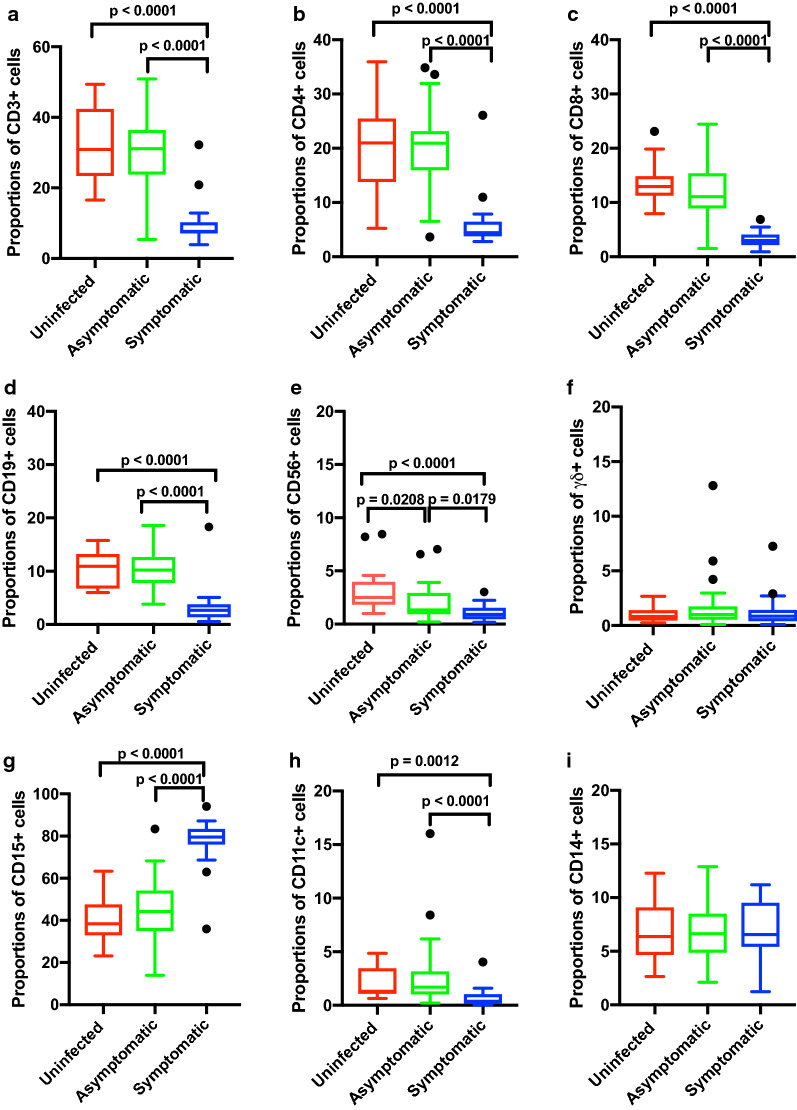
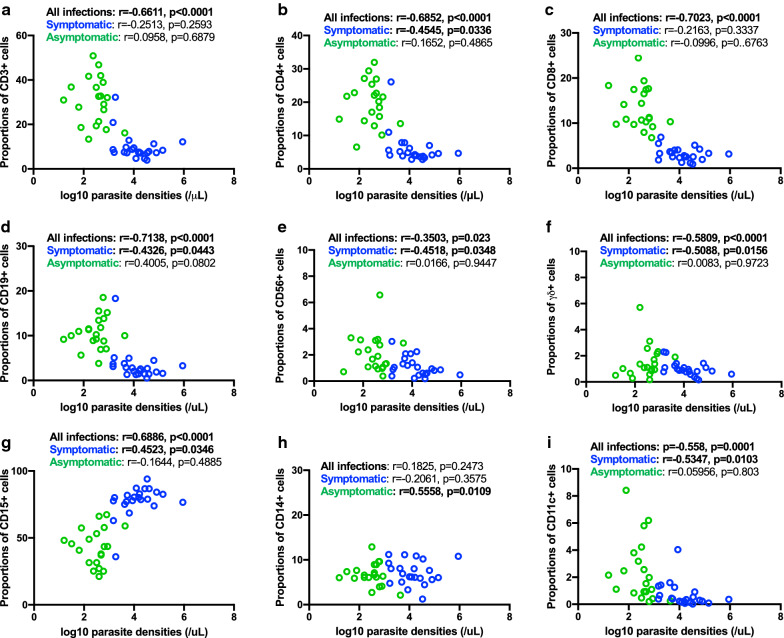
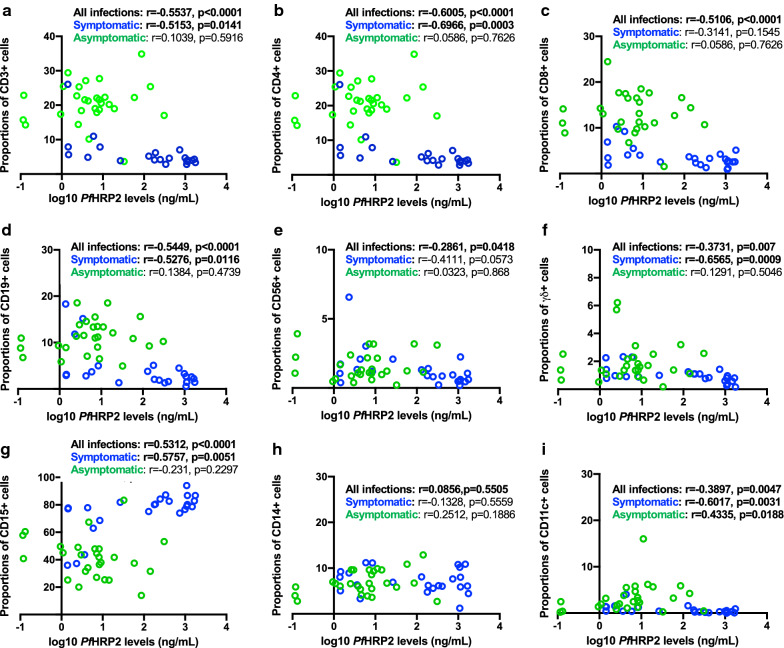
In children with symptomatic P. falciparum infections, the proportions and absolute cell counts of total (CD3 +) T cells, CD4 + T cells, CD8 + T cells, CD19 + B cells and CD11c + dendritic cells (DCs) were significantly lower as compared to asymptomatic P. falciparum-infected and uninfected children. Notably, CD15 + neutrophil proportions and cell counts were significantly increased in symptomatic children. There was no significant difference in the proportions and absolute counts of CD14 + monocytes amongst the three study groups. As expected, measures of parasite load were significantly higher in symptomatic cases. Remarkably, PfHRP2 levels and parasite densities negatively correlated with both the proportions and absolute numbers of peripheral leucocyte subsets: CD3 + T, CD4 + T, CD8 + T, CD19 + B, CD56 + NK, γδ + T and CD11c + cells. In contrast, both PfHRP2 levels and parasite densities positively correlated with the proportions and absolute numbers of CD15 + cells.
Symptomatic P. falciparum infection is correlated with an increase in the levels of peripheral blood neutrophils, indicating a role for this cell type in disease pathogenesis. Parasite load is a key determinant of peripheral cell numbers during malaria infections.
决定恶性疟原虫感染是否出现症状或无症状的免疫机制尚不完全清楚。已经进行了几项研究来描述疾病结局与白细胞数量之间的关联。然而,这些研究大多数是在患有急性无并发症疟疾的成年人中进行的,尽管儿童是最脆弱的群体。
在加纳奥博姆的急性无并发症(有症状;n=25)或无症状(n=67)恶性疟原虫疟疾以及无疟疾(未感染)儿童(n=16)中,通过流式细胞术对外周血白细胞亚群进行了特征描述。白细胞亚群的计数与两种寄生虫负荷量的衡量标准相关:(a)血浆恶性疟原虫富含组氨酸蛋白 2(PfHRP2)水平作为寄生虫生物量的代表,以及(b)显微镜下检测到的外周血寄生虫密度。
患有有症状恶性疟原虫感染的儿童,其总(CD3+)T 细胞、CD4+T 细胞、CD8+T 细胞、CD19+B 细胞和 CD11c+树突状细胞(DC)的比例和绝对细胞计数明显低于无症状恶性疟原虫感染和未感染的儿童。值得注意的是,有症状儿童的 CD15+中性粒细胞比例和细胞计数显著增加。三组研究对象的 CD14+单核细胞比例和绝对计数没有显著差异。如预期的那样,有症状病例的寄生虫负荷量测量值明显更高。值得注意的是,PfHRP2 水平和寄生虫密度与外周白细胞亚群的比例和绝对数量呈负相关:CD3+T、CD4+T、CD8+T、CD19+B、CD56+NK、γδ+T 和 CD11c+细胞。相比之下,PfHRP2 水平和寄生虫密度与 CD15+细胞的比例和绝对数量呈正相关。
有症状的恶性疟原虫感染与外周血中性粒细胞水平的升高相关,表明这种细胞类型在疾病发病机制中起作用。寄生虫负荷量是疟疾感染期间外周细胞数量的关键决定因素。