Department of Electrical Engineering and Computer Science, University of California Irvine, Irvine, CA, United States.
Department of Computing, University of Turku, Turku, Finland.
JMIR Mhealth Uhealth. 2020 Nov 2;8(10):e20465. doi: 10.2196/20465.
Assessment of sleep quality is essential to address poor sleep quality and understand changes. Owing to the advances in the Internet of Things and wearable technologies, sleep monitoring under free-living conditions has become feasible and practicable. Smart rings and smartwatches can be employed to perform mid- or long-term home-based sleep monitoring. However, the validity of such wearables should be investigated in terms of sleep parameters. Sleep validation studies are mostly limited to short-term laboratory tests; there is a need for a study to assess the sleep attributes of wearables in everyday settings, where users engage in their daily routines.
This study aims to evaluate the sleep parameters of the Oura ring along with the Samsung Gear Sport watch in comparison with a medically approved actigraphy device in a midterm everyday setting, where users engage in their daily routines.
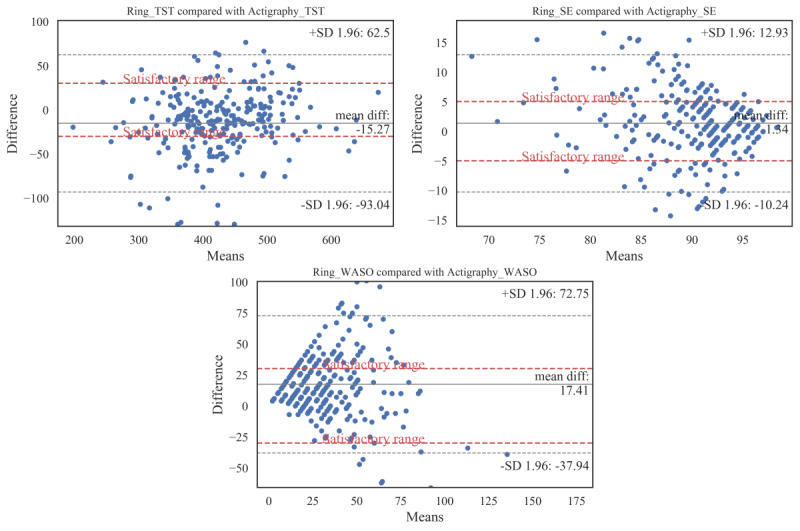
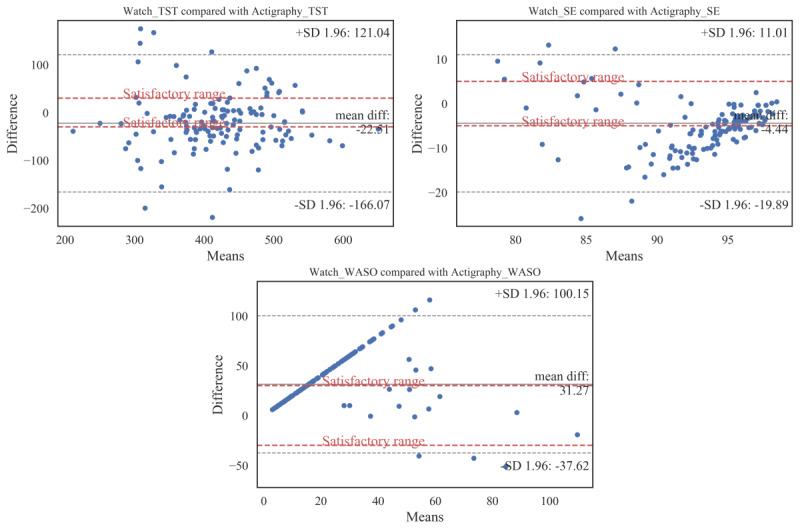
We conducted home-based sleep monitoring in which the sleep parameters of 45 healthy individuals (23 women and 22 men) were tracked for 7 days. Total sleep time (TST), sleep efficiency (SE), and wake after sleep onset (WASO) of the ring and watch were assessed using paired t tests, Bland-Altman plots, and Pearson correlation. The parameters were also investigated considering the gender of the participants as a dependent variable.
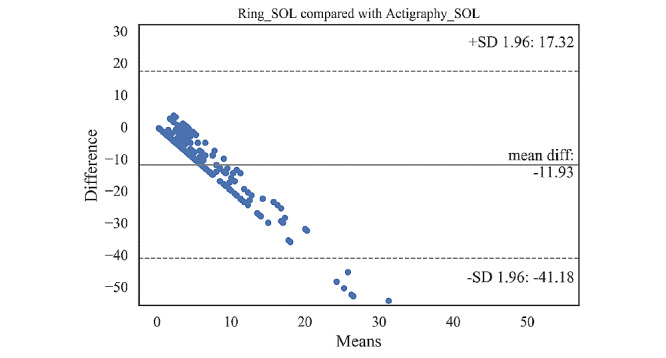
We found significant correlations between the ring's and actigraphy's TST (r=0.86; P<.001), WASO (r=0.41; P<.001), and SE (r=0.47; P<.001). Comparing the watch with actigraphy showed a significant correlation in TST (r=0.59; P<.001). The mean differences in TST, WASO, and SE of the ring and actigraphy were within satisfactory ranges, although there were significant differences between the parameters (P<.001); TST and SE mean differences were also within satisfactory ranges for the watch, and the WASO was slightly higher than the range (31.27, SD 35.15). However, the mean differences of the parameters between the watch and actigraphy were considerably higher than those of the ring. The watch also showed a significant difference in TST (P<.001) between female and male groups.
In a sample population of healthy adults, the sleep parameters of both the Oura ring and Samsung watch have acceptable mean differences and indicate significant correlations with actigraphy, but the ring outperforms the watch in terms of the nonstaging sleep parameters.
评估睡眠质量对于解决睡眠质量差和了解睡眠质量变化至关重要。由于物联网和可穿戴技术的进步,在自由生活条件下进行睡眠监测已经变得可行和切实可行。智能戒指和智能手表可用于进行中期或长期的家庭睡眠监测。然而,这些可穿戴设备的有效性应根据睡眠参数进行评估。睡眠验证研究大多仅限于短期实验室测试;需要进行一项研究,以评估可穿戴设备在日常环境中的睡眠属性,在日常环境中,用户会进行日常活动。
本研究旨在评估 Oura 戒指和三星 Gear Sport 手表的睡眠参数,与经过医学认可的活动记录仪设备在中期日常环境中进行比较,在日常环境中,用户会进行日常活动。
我们进行了家庭睡眠监测,其中 45 名健康个体(23 名女性和 22 名男性)的睡眠参数被跟踪了 7 天。使用配对 t 检验、Bland-Altman 图和 Pearson 相关分析评估戒指和手表的总睡眠时间(TST)、睡眠效率(SE)和睡眠后觉醒时间(WASO)。还根据参与者的性别作为因变量研究了这些参数。
我们发现戒指和活动记录仪的 TST(r=0.86;P<.001)、WASO(r=0.41;P<.001)和 SE(r=0.47;P<.001)之间存在显著相关性。与活动记录仪相比,手表的 TST 显示出显著相关性(r=0.59;P<.001)。戒指和活动记录仪的 TST、WASO 和 SE 的平均差异在可接受范围内,尽管参数之间存在显著差异(P<.001);手表的 TST 和 SE 平均差异也在可接受范围内,WASO 略高于范围(31.27,SD 35.15)。然而,手表和活动记录仪之间的参数平均差异明显高于戒指。手表的 TST 在女性和男性组之间也存在显著差异(P<.001)。
在健康成年人的样本人群中,Oura 戒指和三星手表的睡眠参数具有可接受的平均差异,并与活动记录仪显示出显著相关性,但戒指在非分期睡眠参数方面优于手表。