Inria, 200 av.de la Vieille Tour, 33400 Talence, France; LaBRI (Univ.Bordeaux, CNRS, Bordeaux-INP), 351, cours de la Libération, 33405 Talence, France.
Handicap, Activity, Cognition, Health, Inserm/University of Bordeaux, 146 rue Léo Saignat, 33076 Bordeaux cedex, France.
Neuroimage Clin. 2020;28:102417. doi: 10.1016/j.nicl.2020.102417. Epub 2020 Sep 15.
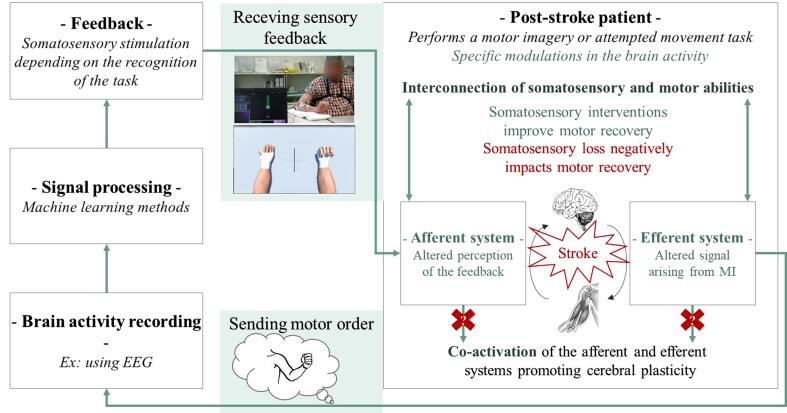
The neuronal loss resulting from stroke forces 80% of the patients to undergo motor rehabilitation, for which Brain-Computer Interfaces (BCIs) and NeuroFeedback (NF) can be used. During the rehabilitation, when patients attempt or imagine performing a movement, BCIs/NF provide them with a synchronized sensory (e.g., tactile) feedback based on their sensorimotor-related brain activity that aims at fostering brain plasticity and motor recovery. The co-activation of ascending (i.e., somatosensory) and descending (i.e., motor) networks indeed enables significant functional motor improvement, together with significant sensorimotor-related neurophysiological changes. Somatosensory abilities are essential for patients to perceive the feedback provided by the BCI system. Thus, somatosensory impairments may significantly alter the efficiency of BCI-based motor rehabilitation. In order to precisely understand and assess the impact of somatosensory impairments, we first review the literature on post-stroke BCI-based motor rehabilitation (14 randomized clinical trials). We show that despite the central role that somatosensory abilities play on BCI-based motor rehabilitation post-stroke, the latter are rarely reported and used as inclusion/exclusion criteria in the literature on the matter. We then argue that somatosensory abilities have repeatedly been shown to influence the motor rehabilitation outcome, in general. This stresses the importance of also considering them and reporting them in the literature in BCI-based rehabilitation after stroke, especially since half of post-stroke patients suffer from somatosensory impairments. We argue that somatosensory abilities should systematically be assessed, controlled and reported if we want to precisely assess the influence they have on BCI efficiency. Not doing so could result in the misinterpretation of reported results, while doing so could improve (1) our understanding of the mechanisms underlying motor recovery (2) our ability to adapt the therapy to the patients' impairments and (3) our comprehension of the between-subject and between-study variability of therapeutic outcomes mentioned in the literature.
中风导致的神经元损失迫使 80%的患者接受运动康复,而脑机接口 (BCI) 和神经反馈 (NF) 可用于此。在康复过程中,当患者尝试或想象进行运动时,BCI/NF 会根据他们与运动相关的脑活动为他们提供同步的感觉(例如触觉)反馈,旨在促进大脑可塑性和运动恢复。上行(即感觉)和下行(即运动)网络的共同激活确实可以实现显著的功能性运动改善,同时伴随着显著的与运动相关的神经生理变化。感觉能力对于患者感知 BCI 系统提供的反馈至关重要。因此,感觉障碍可能会显著改变基于 BCI 的运动康复的效率。为了准确理解和评估感觉障碍的影响,我们首先回顾了中风后基于 BCI 的运动康复的文献(14 项随机临床试验)。我们表明,尽管感觉能力在中风后基于 BCI 的运动康复中起着核心作用,但在该领域的文献中,它们很少被报道并用作纳入/排除标准。然后我们认为,感觉能力通常会反复影响运动康复的结果。这强调了在基于 BCI 的中风后康复文献中也考虑并报告它们的重要性,特别是因为一半的中风患者患有感觉障碍。我们认为,如果我们要准确评估它们对 BCI 效率的影响,就应该系统地评估、控制和报告感觉能力。如果不这样做,可能会导致对报告结果的误解,而这样做可以改善(1)我们对运动恢复机制的理解,(2)我们适应患者损伤的治疗能力,以及(3)我们对文献中提到的治疗结果的个体间和研究间可变性的理解。