Helguera-Repetto Addy Cecilia, Soto-Ramírez María Dolores, Villavicencio-Carrisoza Oscar, Yong-Mendoza Samantha, Yong-Mendoza Angélica, León-Juárez Moisés, González-Y-Merchand Jorge A, Zaga-Clavellina Verónica, Irles Claudine
Department of Immunobiochemistry, Instituto Nacional de Perinatología, Mexico City, Mexico.
Department of Microbiology, Escuela Nacional de Ciencias Biológicas, Instituto Politécnico Nacional, Mexico City, Mexico.
Front Pediatr. 2020 Sep 11;8:525. doi: 10.3389/fped.2020.00525. eCollection 2020.
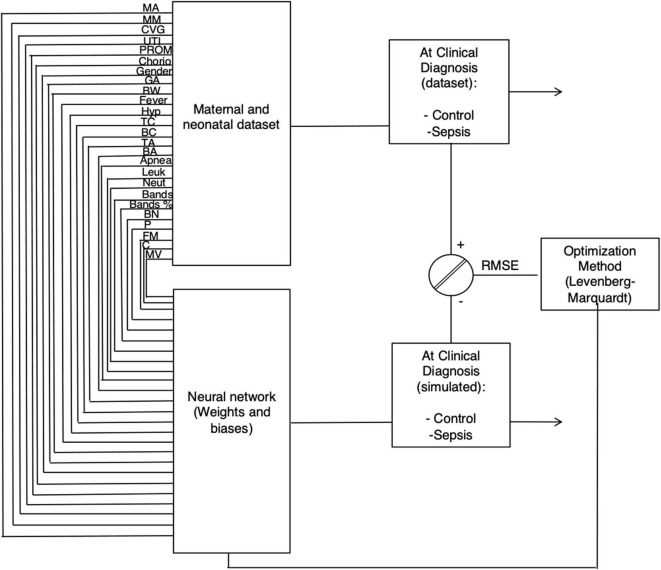
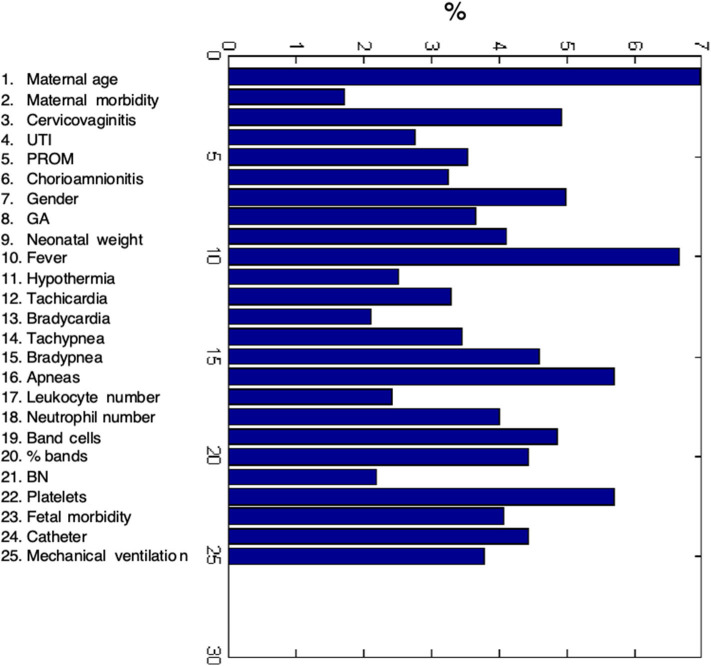
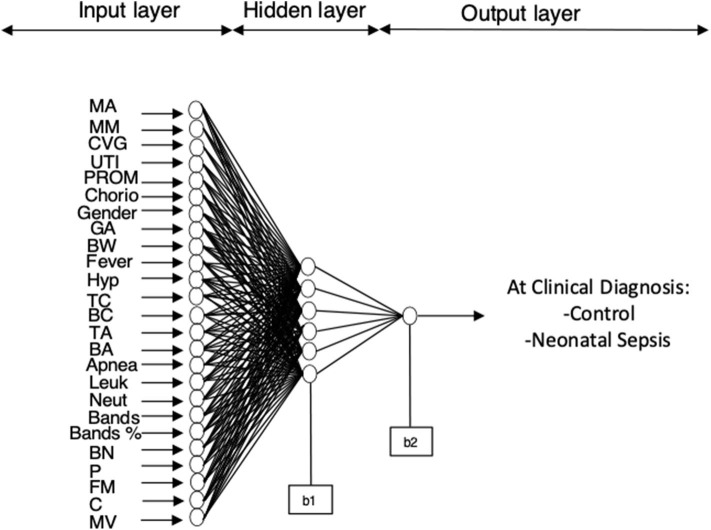
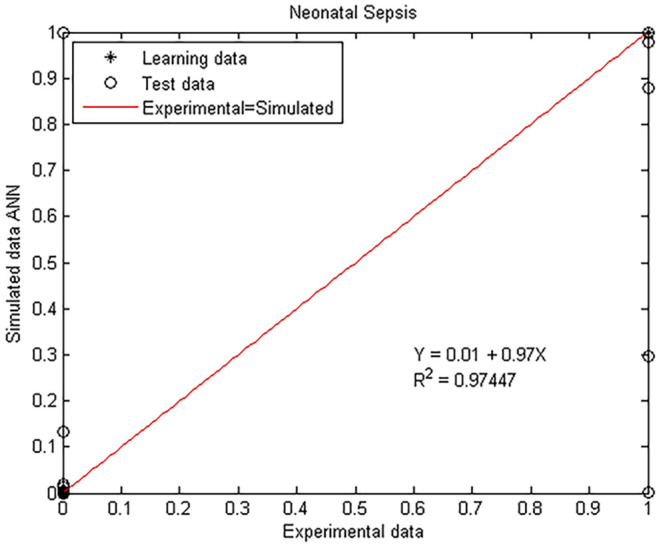
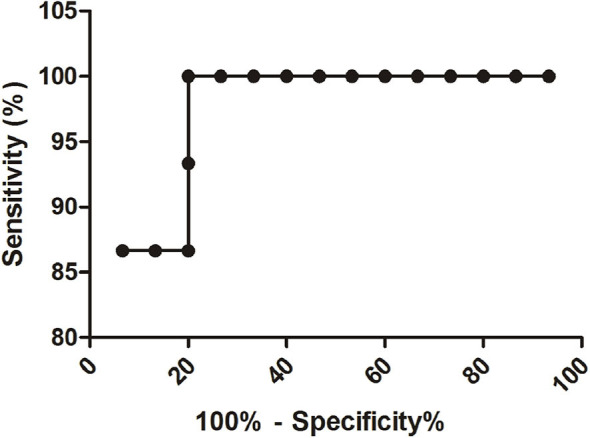
Neonatal sepsis remains difficult to diagnose due to its non-specific signs and symptoms. Traditional scoring systems help to discriminate between septic or not patients, but they do not consider every single patient particularity. Thus, the purpose of this study was to develop an early- and late-onset neonatal sepsis diagnosis model, based on clinical maternal and neonatal data from electronic records, at the time of clinical suspicion. A predictive model was obtained by training and validating an artificial Neural Networks (ANN) algorithm with a balanced dataset consisting of preterm and term non-septic or septic neonates (early- and late-onset), with negative and positive culture results, respectively, using 25 maternal and neonatal features. The outcome of the model was sepsis or not. The performance measures of the model, evaluated with an independent dataset, outperformed physician's diagnosis using the same features based on traditional scoring systems, with a 93.3% sensitivity, an 80.0% specificity, a 94.4% AUROC, and a regression coefficient of 0.974 between actual and simulated results. The model also performed well-relative to the state-of-the-art methods using similar maternal/neonatal variables. The top 10 factors estimating sepsis were maternal age, cervicovaginitis and neonatal: fever, apneas, platelet counts, gender, bradypnea, band cells, catheter use, and birth weight.
由于新生儿败血症的体征和症状不具有特异性,其诊断仍然存在困难。传统的评分系统有助于区分败血症患儿和非败血症患儿,但它们并未考虑到每个患者的具体情况。因此,本研究的目的是基于临床怀疑时电子记录中的母亲和新生儿临床数据,开发一种早发型和晚发型新生儿败血症诊断模型。通过使用25个母亲和新生儿特征,对由早产和足月非败血症或败血症新生儿(早发型和晚发型)组成的平衡数据集进行训练和验证人工神经网络(ANN)算法,获得了一个预测模型。该模型的结果为是否患有败血症。使用独立数据集评估该模型的性能指标,其表现优于基于传统评分系统使用相同特征的医生诊断,敏感性为93.3%,特异性为80.0%,曲线下面积(AUROC)为94.4%,实际结果与模拟结果之间的回归系数为0.974。相对于使用类似母亲/新生儿变量的现有方法,该模型也表现良好。估计败血症的前10个因素为母亲年龄、宫颈阴道炎以及新生儿的发热、呼吸暂停、血小板计数、性别、呼吸过缓、杆状核细胞、导管使用情况和出生体重。